Affiliate marketing is becoming an increasingly popular channel for marketers in financial institutions. More and more, we’re seeing partnerships between financial institutions and third-party publishers or influencers that are helping them better reach their target audiences.
As financial brands engage in this newer marketing model, it’s important to remember that these partnerships are subject to the same regulatory requirements as their in-house marketing efforts. Compliance tools are thus an integral part of a successful affiliate channel — one that needs to be incorporated from the get-go.
In this article, we address the need for compliance tools as part of your affiliate marketing efforts, and share best practices for choosing the right solutions.
Want to know more about how our tool, Fintel Check, can help your team save time and stay ahead of the regulators? Reach out to us here.
The Regulatory Landscape for Marketers in Finance
When it comes to marketing compliance, financial institutions have a lot to stay on top of. There are a number of rules, regulations, and guidelines from various regulatory bodies that exist to safeguard the interests of consumers and maintain integrity in the industry. These regulations, such as those imposed by the Securities and Exchange Commission (SEC), Federal Deposit Insurance Corporation (FDIC), and the Consumer Financial Protection Bureau (CFPB), outline the dos and don’ts of marketing practices in the industry.
Not complying with these rules can not only result in financial fines, they can also compromise your brand’s reputation and negatively impact its ability to build trust and generate deposits. As such, there’s a significant need for financial institutions to keep their marketing efforts within the confines of existing regulations.
Affiliate marketing has become an appealing channel for financial institutions for numerous reasons. Based on third-party relationships with publishers, influencers, or other brands in the same sphere of influence, affiliate marketing allows banks and other financial institutions to access an existing audience of target customers. Other benefits of affiliate marketing include:
Increased diversification within the marketing strategy
A cost-effective approach to customer acquisition
Enhanced online presence
Improved brand awareness
More refined target marketing efforts
While the benefits are plentiful, affiliate marketing can also open the door to potential compliance risks. At the end of the day, if your third-party partner is producing and publishing the content for an affiliate campaign, your marketing team will inherently have less control over what is published. Your affiliates might not know about the various regulations your brand needs to adhere to, and they may post something that ultimately puts you in a position of non-compliance.
This is where a marketing compliance tool — one that automatically checks any mention of your brand for compliance — is key. It can make or break the success of your affiliate marketing program.
Compliance Tools: What They Are and Why You Need Them
Marketing compliance tools are software solutions that have been crafted to help marketing teams keep their activities aligned with legal and regulatory standards and policies. These tools typically include automated or AI-driven compliance checks, real-time monitoring across specific web pages, and reporting functionalities that provide a central viewpoint into the regulatory health of a specific brand or family of brands.
Without these marketing compliance tools, teams are left to manually check and review whether their messaging is compliant across the board, and that opens the door to frequent and costly human error. Instead, using a marketing compliance tool can help teams stay focused on their strategic initiatives while also having peace of mind that their brand is not at risk of non-compliance.
As financial brands operate in such a complex regulatory environment, compliance tools are particularly useful in this context. They vastly reduce the risk of human error and can catch content discrepancies before regulators do so that teams can act quickly to address them. Not only does this help build trust with regulators, it also ensures that your brand is communicating with customers in the most effective, ethical, and appropriate way.
If you’re in the search for a marketing compliance tool for your financial institution, consider the following questions:
Was the tool designed exclusively for financial institutions? As we discussed above, financial institutions have very specific marketing regulations that go beyond what other industries might have to navigate. Choosing a tool that was designed for the industry will ensure that you have broader and more specific coverage.
Does it have a robust technology behind it? What type of software supports the solution? And are you able to set the frequency for your scans? Ideally, you’ll be looking for a rules-based engine that allows you to flexibly set your own rules for monitoring content (e.g., inclusion of disclosures).
Does it monitor links outside your website? The best platforms automate the process of finding and reviewing your content, comprehensively scanning it to ensure it aligns with your brand guidelines and desired placements.
Does it include reporting capabilities? Are you able to pull a report of all your live campaigns to understand whether they are compliant?
Other important factors to keep in mind as you make your decision will be the cost, scalability, ease of use, and the quality of the customer support. Once you’ve landed on the compliance tool that makes the most sense for your business and marketing efforts, you will be well-positioned to expand your affiliate partnerships and scale your program knowing you’ve got your content compliance covered.
Financial institutions use Fintel Check to amplify their compliance team’s capacity and set their marketing programs up for long-term success. Reach out to our team to learn more.
If you’re a banking-as-a-service (BaaS) sponsor bank, or looking to become one, fintech partner marketing compliance is likely high on your priority list to address.
Between the FDIC’s most recent claims against fintechs like Maza (story covered by Fintech Business Weekly here) and the FTC announcing stronger intention to prevent deceptive marketing practices, compliance teams are facing even greater pressure to ensure their bank isn’t next in the hot seat.
If you’re looking to understand how you can efficiently and proactively manage and police your fintech partners’ marketing activities, You’ve come to the right place.
In this blog, we’ve put together everything you need to consider when preparing your BaaS marketing compliance strategy and how to do it without needing to 2x (or 5x) your head count.
Want to know more about how our tool can help your team save time and stay ahead of the regulators? Reach out to us here.
Biggest Hurdles to Ensuring Fintech Partner Marketing Compliance
Fintechs are innovation driven and one of the key reasons banks partner with them.
They are good at things like product development, brand-building, and marketing, but the truth is, compliance is not typically their greatest strong suit.
This means there’s a high probability these partners might – and likely will – step out of line with their marketing at one point or another.
While many sponsor bank(s) have compliance processes in place, it is clear they may not be comprehensive enough to catch even the most obvious content issues.
This is likely in part due to the fintech’s lack of compliance experience or personnel, but it is also because monitoring what fintech partners are doing is challenging and most often involves manual audits and spot-checking.
The problem with manual monitoring is it is time-consuming, not comprehensive so prone to errors, and does not scale effectively. So, what’s the alternative?
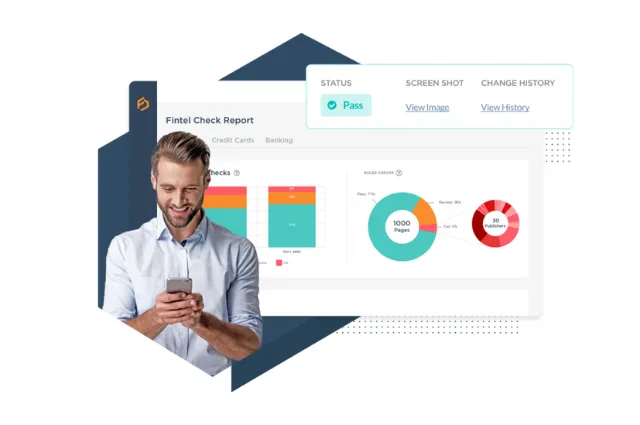
Fintel Check is a comprehensive marketing monitoring tool that is built to take the heavy lifting out of monitoring, finding, evaluating, and documenting fintech marketing activity.
In short, Fintel Check does the tedious heavy-lifting aspects of compliance monitoring so BaaS teams can focus on resolving issues found before the regulators do.
The platform is built on a rules-based engine. The rules tell the system what to monitor, and when the tool performs its scans, it will evaluate what it finds against the rules and provide an easy red, yellow, or green outcome.
This makes it easy for compliance teams to action any identified issues.
More importantly, the tool ensures wider and more frequent reviews and oversight, increases review accuracy, and gives teams much more comprehensive transparency on partner activity.
Image: Fintel Check for BaaS Dashboard. Expand your digital efforts and get complete transparency over your fintech partners’ activity and products. Book a demo now
Fintel Check in Action – Real Examples of How to Prevent and Avoid FDIC Claims
In early July, Jason Mikula of Fintech Business Weekly highlighted the challenges and weaknesses that BaaS players are still facing when it comes to operating their fintech partner programs in a safe and compliant manner.
These challenges most recently included issues with fintech partners making false and misleading claims in their marketing.
Many of these infringements identified by regulators are things that really “should” be easy to catch with the right tools in place.
We’ve pulled together a few tangible examples of how Fintel Check could have caught some of these identified issues from the article:
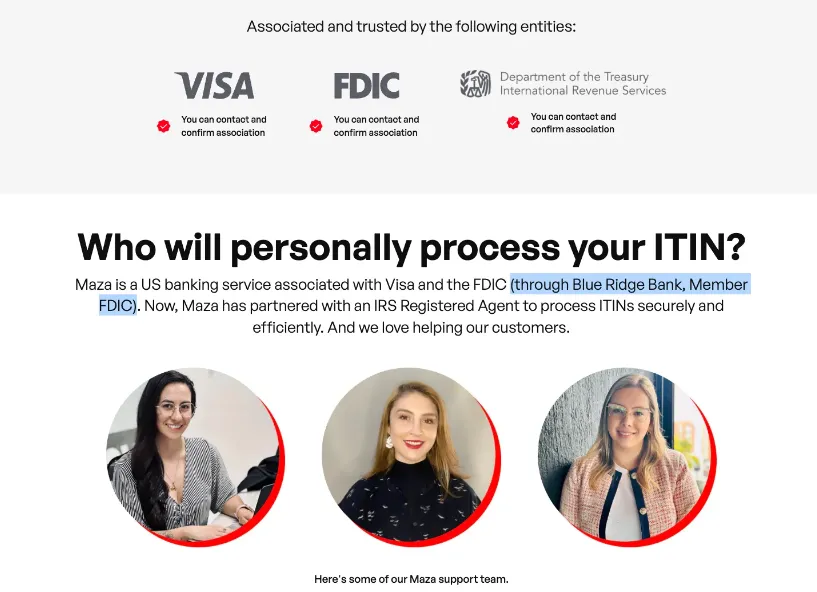
Flagged Issue : Maza repeatedly describes itself as a ‘banking service’ and ‘banking platform,’ without always making clear that such services are provided by banking partner Blue Ridge.
Image: Screencap of Maza’s site as of 6/28/2023 (via Fintech Business Weekly)
Solution : Rules to check for appropriate disclosures
In Fintel Check, a compliance team could create a rule with a conditional requirement that if “banking service” is mentioned on a fintech’s webpage(s), specific disclosure language defined in the rule must be present.
When the tool conducts its regularly scheduled scans, if the fintech’s content does not meet the rule’s specific criteria, this would be flagged in the tool’s reporting dashboard as a ‘fail’.
Not only that, but a compliance team would also be able to easily see in the web-based reports the specific pages where the fails occurred, what specifically the findings were compared to the “expected” results defined in the rule.
The alternative would be manually combing through the various assets and pages to spot-check the content on a regular basis.
Flagged Issue : The site also makes repeated use of the Department of Treasury and IRS logo and language, even claiming an ‘IRS guarantee.
Image: Screencap of Maza’s site as of 6/28/2023 (via Fintech Business Weekly)
Flagged Issue : There are a handful of other potentially false and misleading claims, including that Maza has “no hidden fees” and that users can “open an account in minutes.
Image: Screencap of Maza’s site as of 6/28/2023 (via Fintech Business Weekly)
Solution: Rules to check for use of “trigger” words
The tool has the ability to monitor specific “trigger” words or phrases. In this case, a compliance team could create a rule to monitor terms like “IRS,” “Department of Treasury” or “hidden fees.”
When the tool runs, every time it finds one of these terms in the content of the pages, it will store a record in the reports and alert the compliance team to further review the content where the words were found. Again, exact URLs are provided, and screenshots would be stored.
This means more time correcting potential issues rather than spending time trying to find them.
Next Steps in Enhancing Your Bank’s Compliance Processes
As you continue to grow your BaaS business and the number of fintech partners on board, it is likely time to evaluate what processes your organization has in place and where there are opportunities to enhance your team’s capacity — without having to increase your headcount.
Reach out to our team to learn more about Fintel Check and how leading BaaS banks and players are currently using the tool to amplify their compliance team capacity and set their BaaS programs up for long-term success.
In the fast-paced and highly regulated world of BaaS, marketing compliance is crucial for building trust, upholding industry standards, and protecting consumers.
By understanding and adhering to marketing regulations, BaaS providers can establish themselves as reputable and reliable partners, mitigate legal and financial risks, and foster long-term customer relationships.
Embracing best practices, such as establishing a robust compliance framework and utilizing compliance tools, ensures that BaaS providers stay on the right side of marketing compliance and thrive in the competitive landscape.
If you’re looking to chat more about BaaS and how your bank can leverage the opportunities it presents, get in touch with us. We’d love to chat!
What Do We Mean By Fintech Marketing Compliance?
Marketing compliance refers to adhering to the rules, regulations, and guidelines set forth by regulatory bodies to ensure that marketing activities are conducted in a lawful and ethical manner.
In the financial sector, where trust and transparency are paramount, marketing compliance plays a pivotal role in building trust and confidence among customers.
Get into BaaS with eyes wide open – the what, why, and flip side of Banking-as-a-Service
Banking-as-a-Service (BaaS) is a strategy many financial institutions (FIs) are considering achieving scalable growth and customer deposits. This whitepaper explores some of the opportunities and challenges FIs face in maintaining transparency and accountability as it relates to the BaaS model and marketing compliance.
Purpose of Regulations and Legal Requirements for Marketing in the Financial Sector
The financial sector operates under strict regulations to safeguard the interests of consumers and maintain the integrity of the industry.
These regulations, such as those imposed by regulatory bodies like the Securities and Exchange Commission (SEC), Federal Deposit Insurance Corporation (FDIC) and the Consumer Financial Protection Bureau (CFPB), outline the dos and don’ts of marketing practices in the industry.
Marketing compliance serves as a safeguard for maintaining industry standards and protecting consumers. By ensuring that marketing activities are truthful, transparent, and fair, compliance helps prevent misleading or deceptive practices that could harm consumers.
Compliance with these regulations is not only a regulatory requirement, it is also essential for preserving the reputation and credibility of financial institutions.
By extension, what fintech marketing teams do to promote their products is also subject to the same regulations and a direct reflection of their sponsor bank partners.
Consumer Expectations and the Need for Transparent and Ethical Marketing Practices
Today’s consumers have become more discerning and demand transparency from businesses. Especially in the context of financial services.
New and upcoming neobanks and fintech brands have to work even harder to build this trust and ensure they are adhering to best practices when marketing and positioning their products and services.
This includes clear communication of their services without hidden fees or misleading claims.
Many fintechs can find it challenging to balance meeting the specific regulatory requirements while also wanting to be nimble and innovate quickly. And it’s up to their sponsor banks to ensure they’re keeping in line.
This is where having strong marketing compliance processes is critical to the success of a scaling BaaS program.
As sponsor banks expand their fintech partnerships, it is important to set both clear expectations to ensure both bank and fintech teams are aligned and therefore reduce any potential risks of compliance infringements.
Whether managed manually or with the use of tools or third-party solutions, there are a number of key elements to consider.
Here is quick summary :
– Establishing Clear Policies & Procedures
Sponsor banks must develop and maintain comprehensive policies and procedures that outline the compliance requirements for fintech marketing activities, and ensure all parties involved are clear and in agreement.
The key is making these achievable and flexible – they can’t be too arduous that they stifle growth (which is the whole purpose of partnering with fintechs in the first place), and flexible enough to adapt to evolving resources, regulations, and partner dynamics.
– Training & Educating Marketing Teams On Compliance Requirements
BaaS providers should invest in training programs to educate their teams about compliance requirements, how to prioritize, how to risk-mitigate and remediate when issues do arise.
Having these well-defined allows for proactive management and efficient reactive actioning.
– Proactive Content Review Processes
Most compliance teams will have planned steps for how net new assets can be launched.
This includes how fintech partners can present marketing collateral or assets for approval, what key stakeholders are needed on the sponsor bank side, agreed upon turnaround times for feedback and review, as well as clearly defined expectations on what is – and isn’t – permitted.
– Conducting Regular Audits & Monitoring
While most bank-fintech relationships run smoothly with proactive approvals, there are often cases where items slip through the cracks without approval, or items that aren’t maintained or updated as needed.
This is where ongoing content policing becomes an important consideration. Scheduling ongoing audits and monitoring help identify and correct any compliance gaps before the regulators do.
– Ensuring Scalability As Programs Expand
As BaaS players bring on more fintech partners to expand the line of business, it can become arduous for compliance teams to manage manually.
While trying to prove out profitability, it isn’t always as easy as hiring more team members to increase capacity.
Instead, consider marketing monitoring tools built to streamline manual processes, automate checks and data storage, and ensure ongoing marketing compliance.
In the fast-paced and highly regulated world of BaaS, marketing compliance is crucial for building trust, upholding industry standards, and protecting consumers.
By understanding and adhering to marketing regulations, BaaS providers can establish themselves as reputable and reliable partners, mitigate legal and financial risks, and foster long-term customer relationships.
Embracing best practices, such as establishing a robust compliance framework and utilizing compliance tools, ensures that BaaS providers stay on the right side of marketing compliance and thrive in the competitive landscape.
If you’re looking to chat more about BaaS and how your bank can leverage the opportunities it presents, get in touch with us. We’d love to chat!
Is personalization overrated? We weigh in on a recent op-ed from Marketing Week.
Remember when personalization was the big thing? The allure of tailoring brand experiences and messages to a specific audience of one became impossible to resist. Before you could say “third-party cookies,” many marketers failed to implement personalization in their output – from targeted emails to recommended website purchases based on previous actions.
And the trend continues to be as popular today as it was in 2019 when personalization was triumphantly declared”Word of the Year.” Yet, despite its ongoing popularity within the industry, two authors (Weinberg and Lombardo) have put forward a compelling argument that will make you question personalization.
In the article, they highlight two primary issues preventing personalization from ever reaching its true utopian potential:
Data
All good companies understand the inherent value of data. But according to these two experts, the volume of good, accurate data needed to create personalized experiences doesn’t exist. Moreover, what data there is, is unreliable and can often be poorly applied.
Tastes
Like any creative output, good marketing succeeds when it shares universal truths that get people talking, thinking, and acting. And that’s before you consider the resources needed to accomplish that.
So, what does this mean for financial institutions (FIs) focused on personalization in their marketing strategies?
Affiliate marketing for bottom-funnel lead gen
Learn how affiliate partners can drive customers to your website, delivering as much as 40% of your net new customers.
Data: Future-proof your marketing strategies against reliance on third-party cookies
How can we action this information?
Because of the change in Google policy, FI will increasingly rely on data collected by first-party cookies drawn most commonly through the website or affiliate website partners.
As data sourced via third parties fall away, FI should use both channels to maximize their first-party data yield.
What is it telling us?
How can we action this information?
Because of the change in Google policy, FI will increasingly rely on data collected by first-party cookies drawn most commonly through the website or affiliate website partners.
As data sourced via third parties fall away, FI should use both channels to maximize their first-party data yield.
Where is it coming from?
What is it telling us?
How can we action this information?
Because of the change in Google policy, FI will increasingly rely on data collected by first-party cookies drawn most commonly through the website or affiliate website partners.
As data sourced via third parties fall away, FI should use both channels to maximize their first-party data yield.
Is the company getting the correct data?
Where is it coming from?
What is it telling us?
How can we action this information?
Because of the change in Google policy, FI will increasingly rely on data collected by first-party cookies drawn most commonly through the website or affiliate website partners.
As data sourced via third parties fall away, FI should use both channels to maximize their first-party data yield.
With the end of third-party cookies in sight, building out a marketing strategy that the upcoming policy changes won’t impact is a necessity. While 2024 may seem a long way off, now is the ideal time to pivot. Doing so can give FI a head-start in future-proofing any personalization plans. It also offers opportunities to assess and refine current processes.
Is the company getting the correct data?
Where is it coming from?
What is it telling us?
How can we action this information?
Because of the change in Google policy, FI will increasingly rely on data collected by first-party cookies drawn most commonly through the website or affiliate website partners.
As data sourced via third parties fall away, FI should use both channels to maximize their first-party data yield.
Google’s controversial decision is forcing FI to rethink how they operate. For example, personalization, as it’s currently defined and understood, will dramatically shift without access to third-party data cookies.
With the end of third-party cookies in sight, building out a marketing strategy that the upcoming policy changes won’t impact is a necessity. While 2024 may seem a long way off, now is the ideal time to pivot. Doing so can give FI a head-start in future-proofing any personalization plans. It also offers opportunities to assess and refine current processes.
Is the company getting the correct data?
Where is it coming from?
What is it telling us?
How can we action this information?
Because of the change in Google policy, FI will increasingly rely on data collected by first-party cookies drawn most commonly through the website or affiliate website partners.
As data sourced via third parties fall away, FI should use both channels to maximize their first-party data yield.
Google’s controversial decision is forcing FI to rethink how they operate. For example, personalization, as it’s currently defined and understood, will dramatically shift without access to third-party data cookies.
With the end of third-party cookies in sight, building out a marketing strategy that the upcoming policy changes won’t impact is a necessity. While 2024 may seem a long way off, now is the ideal time to pivot. Doing so can give FI a head-start in future-proofing any personalization plans. It also offers opportunities to assess and refine current processes.
Is the company getting the correct data?
Where is it coming from?
What is it telling us?
How can we action this information?
Because of the change in Google policy, FI will increasingly rely on data collected by first-party cookies drawn most commonly through the website or affiliate website partners.
As data sourced via third parties fall away, FI should use both channels to maximize their first-party data yield.
It’s been in the cards for years, but in the second half of 2024, Google is phasing out third-party cookies from its Chrome web browser. According to the search engine giant, “improving people’s privacy while giving businesses the tools they need to succeed online is vital to the future of the open web.”
Third-party cookies have been a critical weapon for marketers, helping them track visitors, actions, and other data that should allow targeting individuals with personalized content.
Google’s controversial decision is forcing FI to rethink how they operate. For example, personalization, as it’s currently defined and understood, will dramatically shift without access to third-party data cookies.
With the end of third-party cookies in sight, building out a marketing strategy that the upcoming policy changes won’t impact is a necessity. While 2024 may seem a long way off, now is the ideal time to pivot. Doing so can give FI a head-start in future-proofing any personalization plans. It also offers opportunities to assess and refine current processes.
Is the company getting the correct data?
Where is it coming from?
What is it telling us?
How can we action this information?
Because of the change in Google policy, FI will increasingly rely on data collected by first-party cookies drawn most commonly through the website or affiliate website partners.
As data sourced via third parties fall away, FI should use both channels to maximize their first-party data yield.
It’s been in the cards for years, but in the second half of 2024, Google is phasing out third-party cookies from its Chrome web browser. According to the search engine giant, “improving people’s privacy while giving businesses the tools they need to succeed online is vital to the future of the open web.”
Third-party cookies have been a critical weapon for marketers, helping them track visitors, actions, and other data that should allow targeting individuals with personalized content.
Google’s controversial decision is forcing FI to rethink how they operate. For example, personalization, as it’s currently defined and understood, will dramatically shift without access to third-party data cookies.
With the end of third-party cookies in sight, building out a marketing strategy that the upcoming policy changes won’t impact is a necessity. While 2024 may seem a long way off, now is the ideal time to pivot. Doing so can give FI a head-start in future-proofing any personalization plans. It also offers opportunities to assess and refine current processes.
Is the company getting the correct data?
Where is it coming from?
What is it telling us?
How can we action this information?
Because of the change in Google policy, FI will increasingly rely on data collected by first-party cookies drawn most commonly through the website or affiliate website partners.
As data sourced via third parties fall away, FI should use both channels to maximize their first-party data yield.
On the other hand, personalization based on reach makes it far easier to appeal more generally to a broad, mutually aligned target market. For example, the bank might partner with influencers and affiliates within a particular film genre to spread the word, confident that their message strikes a chord with viewers.
Ultimately, instead of over-curating to be as personalized as possible at every turn, successful FI must focus on reaching the intended target audience – a universal group of people with some level of sentiment with the content.
When you’re on the proper channels, harnessing the power of the right influencers and affiliates to reach the right audience, it’s far more cost effective than trying to appeal to all the people all the time.
For example, let’s imagine a bank is offering a booklet of free movie tickets for opening a new account. Traditional personalization would mean different theatres, different films, and even different background music for every viewer -even those who never go to the movies.
On the other hand, personalization based on reach makes it far easier to appeal more generally to a broad, mutually aligned target market. For example, the bank might partner with influencers and affiliates within a particular film genre to spread the word, confident that their message strikes a chord with viewers.
Ultimately, instead of over-curating to be as personalized as possible at every turn, successful FI must focus on reaching the intended target audience – a universal group of people with some level of sentiment with the content.
When you’re on the proper channels, harnessing the power of the right influencers and affiliates to reach the right audience, it’s far more cost effective than trying to appeal to all the people all the time.
According to Weinberg and Lombardo’s article, “reach is, and has always been, the greatest predictor of marketing success.” Effectively, reach allows FI to personalize output based on shared sentiments across a particular group or sub-set.
For example, let’s imagine a bank is offering a booklet of free movie tickets for opening a new account. Traditional personalization would mean different theatres, different films, and even different background music for every viewer -even those who never go to the movies.
On the other hand, personalization based on reach makes it far easier to appeal more generally to a broad, mutually aligned target market. For example, the bank might partner with influencers and affiliates within a particular film genre to spread the word, confident that their message strikes a chord with viewers.
Ultimately, instead of over-curating to be as personalized as possible at every turn, successful FI must focus on reaching the intended target audience – a universal group of people with some level of sentiment with the content.
When you’re on the proper channels, harnessing the power of the right influencers and affiliates to reach the right audience, it’s far more cost effective than trying to appeal to all the people all the time.
According to Weinberg and Lombardo’s article, “reach is, and has always been, the greatest predictor of marketing success.” Effectively, reach allows FI to personalize output based on shared sentiments across a particular group or sub-set.
For example, let’s imagine a bank is offering a booklet of free movie tickets for opening a new account. Traditional personalization would mean different theatres, different films, and even different background music for every viewer -even those who never go to the movies.
On the other hand, personalization based on reach makes it far easier to appeal more generally to a broad, mutually aligned target market. For example, the bank might partner with influencers and affiliates within a particular film genre to spread the word, confident that their message strikes a chord with viewers.
Ultimately, instead of over-curating to be as personalized as possible at every turn, successful FI must focus on reaching the intended target audience – a universal group of people with some level of sentiment with the content.
When you’re on the proper channels, harnessing the power of the right influencers and affiliates to reach the right audience, it’s far more cost effective than trying to appeal to all the people all the time.
The solution is to focus on reach.
According to Weinberg and Lombardo’s article, “reach is, and has always been, the greatest predictor of marketing success.” Effectively, reach allows FI to personalize output based on shared sentiments across a particular group or sub-set.
For example, let’s imagine a bank is offering a booklet of free movie tickets for opening a new account. Traditional personalization would mean different theatres, different films, and even different background music for every viewer -even those who never go to the movies.
On the other hand, personalization based on reach makes it far easier to appeal more generally to a broad, mutually aligned target market. For example, the bank might partner with influencers and affiliates within a particular film genre to spread the word, confident that their message strikes a chord with viewers.
Ultimately, instead of over-curating to be as personalized as possible at every turn, successful FI must focus on reaching the intended target audience – a universal group of people with some level of sentiment with the content.
When you’re on the proper channels, harnessing the power of the right influencers and affiliates to reach the right audience, it’s far more cost effective than trying to appeal to all the people all the time.
Genuine personalization at a granular, personal level is an impossible dream. Our tastes are too rich and diverse. And even if this was achieved, it risks isolating audiences. At best, it’s jarring; at worst, it deconstructs the emotional underpinnings of marketing content -the gold dust that gives it power.
The solution is to focus on reach.
According to Weinberg and Lombardo’s article, “reach is, and has always been, the greatest predictor of marketing success.” Effectively, reach allows FI to personalize output based on shared sentiments across a particular group or sub-set.
For example, let’s imagine a bank is offering a booklet of free movie tickets for opening a new account. Traditional personalization would mean different theatres, different films, and even different background music for every viewer -even those who never go to the movies.
On the other hand, personalization based on reach makes it far easier to appeal more generally to a broad, mutually aligned target market. For example, the bank might partner with influencers and affiliates within a particular film genre to spread the word, confident that their message strikes a chord with viewers.
Ultimately, instead of over-curating to be as personalized as possible at every turn, successful FI must focus on reaching the intended target audience – a universal group of people with some level of sentiment with the content.
When you’re on the proper channels, harnessing the power of the right influencers and affiliates to reach the right audience, it’s far more cost effective than trying to appeal to all the people all the time.
No financial institution has the resources to design creative content for every person’s taste at every level. But, even if they could, should they? Many successful marketing campaigns speak universal truths that unite us; they don’t fixate on our differences.
Genuine personalization at a granular, personal level is an impossible dream. Our tastes are too rich and diverse. And even if this was achieved, it risks isolating audiences. At best, it’s jarring; at worst, it deconstructs the emotional underpinnings of marketing content -the gold dust that gives it power.
The solution is to focus on reach.
According to Weinberg and Lombardo’s article, “reach is, and has always been, the greatest predictor of marketing success.” Effectively, reach allows FI to personalize output based on shared sentiments across a particular group or sub-set.
For example, let’s imagine a bank is offering a booklet of free movie tickets for opening a new account. Traditional personalization would mean different theatres, different films, and even different background music for every viewer -even those who never go to the movies.
On the other hand, personalization based on reach makes it far easier to appeal more generally to a broad, mutually aligned target market. For example, the bank might partner with influencers and affiliates within a particular film genre to spread the word, confident that their message strikes a chord with viewers.
Ultimately, instead of over-curating to be as personalized as possible at every turn, successful FI must focus on reaching the intended target audience – a universal group of people with some level of sentiment with the content.
When you’re on the proper channels, harnessing the power of the right influencers and affiliates to reach the right audience, it’s far more cost effective than trying to appeal to all the people all the time.
Today’s audiences are broad, and they’re only growing bigger – in 2021, the number of internet users worldwide hit 4.9bn, up from 4.6bn the year before. That makes genuine personalization at the individual level almost impossible to achieve.
No financial institution has the resources to design creative content for every person’s taste at every level. But, even if they could, should they? Many successful marketing campaigns speak universal truths that unite us; they don’t fixate on our differences.
Genuine personalization at a granular, personal level is an impossible dream. Our tastes are too rich and diverse. And even if this was achieved, it risks isolating audiences. At best, it’s jarring; at worst, it deconstructs the emotional underpinnings of marketing content -the gold dust that gives it power.
The solution is to focus on reach.
According to Weinberg and Lombardo’s article, “reach is, and has always been, the greatest predictor of marketing success.” Effectively, reach allows FI to personalize output based on shared sentiments across a particular group or sub-set.
For example, let’s imagine a bank is offering a booklet of free movie tickets for opening a new account. Traditional personalization would mean different theatres, different films, and even different background music for every viewer -even those who never go to the movies.
On the other hand, personalization based on reach makes it far easier to appeal more generally to a broad, mutually aligned target market. For example, the bank might partner with influencers and affiliates within a particular film genre to spread the word, confident that their message strikes a chord with viewers.
Ultimately, instead of over-curating to be as personalized as possible at every turn, successful FI must focus on reaching the intended target audience – a universal group of people with some level of sentiment with the content.
When you’re on the proper channels, harnessing the power of the right influencers and affiliates to reach the right audience, it’s far more cost effective than trying to appeal to all the people all the time.
Today’s audiences are broad, and they’re only growing bigger – in 2021, the number of internet users worldwide hit 4.9bn, up from 4.6bn the year before. That makes genuine personalization at the individual level almost impossible to achieve.
No financial institution has the resources to design creative content for every person’s taste at every level. But, even if they could, should they? Many successful marketing campaigns speak universal truths that unite us; they don’t fixate on our differences.
Genuine personalization at a granular, personal level is an impossible dream. Our tastes are too rich and diverse. And even if this was achieved, it risks isolating audiences. At best, it’s jarring; at worst, it deconstructs the emotional underpinnings of marketing content -the gold dust that gives it power.
The solution is to focus on reach.
According to Weinberg and Lombardo’s article, “reach is, and has always been, the greatest predictor of marketing success.” Effectively, reach allows FI to personalize output based on shared sentiments across a particular group or sub-set.
For example, let’s imagine a bank is offering a booklet of free movie tickets for opening a new account. Traditional personalization would mean different theatres, different films, and even different background music for every viewer -even those who never go to the movies.
On the other hand, personalization based on reach makes it far easier to appeal more generally to a broad, mutually aligned target market. For example, the bank might partner with influencers and affiliates within a particular film genre to spread the word, confident that their message strikes a chord with viewers.
Ultimately, instead of over-curating to be as personalized as possible at every turn, successful FI must focus on reaching the intended target audience – a universal group of people with some level of sentiment with the content.
When you’re on the proper channels, harnessing the power of the right influencers and affiliates to reach the right audience, it’s far more cost effective than trying to appeal to all the people all the time.
Look at personalization Objectively, not Aspirationally
Personalization, as we know it, isn’t just changing. It’s being radically redefined, helped in no small part by Google killing off the once-ubiquitous third-party cookie. That evolution is forcing smart FIs’ to get ahead of the game – whether they’re challenging the industry status quo or looking to retain their position at the top of the market.
Personalized experiences, online or in a branch, are a common strategy among any FI looking to gain a competitive advantage. However, it’s essential to look at personalization from a realistic perspective and evaluate what works for the FI – whatever the size.
See, the shift isn’t just benefitting mainstream mega-banks. Community banks, regional banks, and emerging fintech may find focusing on reach more beneficial to get the brand name out there and target new markets on limited resources. And influencers today are the modern masters of reach – authentically building communities of mutual interest.
Influencer partners offer a cost-effective way to boost reach. If you want to learn more about Fintel Performance and how we can help you place your brand in front of the right customers, reach out.
You may be familiar with the idea of influencer marketing, but do you know how it differs from performance marketing? Keep reading to learn more.
Whether it’s YouTube tutorials, TikTok dances or product comparisons, creating digital content can be a lot of fun when you’re just starting out. But if you’re looking to climb to the next level and parlay your content creation into a sustainable revenue stream, it’s essential to understand the landscape of monetizable content; specifically, the difference between influencer marketing and performance marketing.
Shane Barker explains that nowadays, people are generally familiar with the term “influencer marketing” due to the rise of social media. However, performance marketing (also known as affiliate marketing) has not yet attained that level of mainstream recognition, yet is one of the most impactful digital channels out there.
It’s not uncommon to confuse them as one in the same, and if you’re looking to generate income as a content creator, understanding the difference will help you identify the right brand partnerships that can maximize your income potential.
What is influencer marketing?
Influencers are online personalities that have an engaged relationship with their niche audience and the ability to influence their purchasing decisions (Influencer Marketing Hub, 2021). Brands partner with influencers in specific niches, where the influencer uses their own channels to promote the brand’s products and services.
Influencer marketing is one of the most powerful ways to get brand awareness and exposure. According to sellbrite, over 3 billion people use social media, with the most popular platforms being Instagram, Facebook, and YouTube for video. With such a large market, the opportunity to target niche audiences is virtually limitless.
What is performance marketing?
In performance marketing, a content creator – more often known as a “publisher” – promotes or recommends a product to their audiences and receives a commission from a brand when an audience member takes a specific action, such as applications received, account activations, post-sign-up activities, and more.
In this respect, performance marketing is a cost-effective, scalable channel for brands that wish to drive customer acquisition, because they pay only for new customers.
Yet if performance marketing is considered so impactful, why aren’t many people as familiar with it? The truth is most people have seen performance marketing in action without even realizing it, particularly because it’s arguably less overt than other forms of digital advertising. Performance marketing is popular in channels where creators have the most editorial authority, such as their own blogs and YouTube channels. As such, people have likely come across it across the content they regularly consume online.
When considering performance marketing or influencer marketing, there are some unique differentiators that lead brands to strategically include one or the other, or even both, for their marketing campaigns.
Performance marketing has not yet attained the mainstream recognition of influencer marketing, yet is one of the most impactful digital channels out there.
Influencer marketing vs. performance marketing
Understanding the similarities and differences between the two can help you identify your strengths as a content creator and, in turn, the opportunities you can pursue with brands. Firstly, let’s look at what these two types of marketing have in common:
Content creators come in a variety of personalities and mediums, from bloggers, YouTubers, podcasters, online personalities, to brands of all shapes and sizes
The goal is to reach niche audiences with products or services that match their needs and interests
Authenticity is key, and education – a review, product comparisons, stories of hands-on experiences – is a popular way to frame content, capturing interest and curiosity to spark a potential new customer journey
As you can see above, influencer marketing and performance marketing have a few things in common, but the real differences are evident when you look from a strategic perspective:
Influencer Marketing
Performance Marketing
Ideal for companies seeking
Brand awareness (top of funnel)
Customer acquisition (bottom of funnel)
Payment model
Flat-fee
Commission-based
Popular mediums/ platforms
YouTube, Instagram, Facebook, TikTok
Blogs, YouTube
Advantages
Income received quickly
Total earnings guaranteed via signed contract
Opportunities for free products and/or services from brand
Long-term, scalable income
Uncapped earnings (in most cases)
Higher earning potential over time
Increased editorial authority and authenticity; no scripts to read
Challenges
Earnings caps due to fixed, one-time rate
Less editorial authority and creative freedom
Brand’s required key messages may position you as biased to their brand
High-quality traffic and audiences required to drive action
Effort to keep brand’s offers and terms up -to-date
Time & effort to nurture before driving results
The payment model is one of the most critical elements to consider for your incoming-earning potential as a content creator. Take a look at our Pros and Cons of Flat Fee vs. Performance Marketing Models to learn the benefits and challenges of these payment models.
Slowdown in Influencer Marketing
Last year, there was a significant slowdown of investments in partnerships for influencer marketing campaigns (eMarketer 2020). It’s no surprise: economic downturn and skyrocketing unemployment made people more cautious with their disposable income. As such, it was more difficult for brands to push and sell products that weren’t absolutely essential to personal livelihood.
In response to the dramatic shift in spending behaviors, advertisers adjusted their marketing budgets. Performance marketing was viewed as a budget-friendly, cost-effective choice for customer acquisition during unpredictable times in the market.
Which one should you choose?
When considering which channel to focus on, choose the channel where you as a content creator have clear-cut advantages in serving your audience, your brand partner, and your own financial needs. As a marketer, you should aim to:
Be an extension of your brand partner’s marketing strategy. If your brand partner’s objective is awareness, do you have audiences in the right channels to facilitate that? If it’s acquisition targets, will your audience follow through on conversion? The proof is in the pudding: be prepared to have your metrics on hand when discussing opportunities.
Deliver useful, relevant products and services to your audience. Don’t select brands that are uninteresting to your audience or select solely by how much money the brand offesr. You’ve earned your audience’s trust, and they can quickly sniff out when you’re not sincere.
Define and fulfill your revenue goals. Whether you’re looking for reliable, ongoing income streams or shorter campaigns, carefully select partnerships that match your income goals.
Lastly, don’t forget that marketing isn’t always just one swing of the bat: test new channels, models, methods, and content to see what drives the optimal results. What works in one niche or one audience segment might not work for another, so keep creating to find your sweet spot.
If you’re unsure about working with companies directly, a performance marketing network is a great option to become an affiliate of top-performing brands with competitive CPAs (cost per acquisition). At Fintel Connect, we’ve found that financial affiliate marketing is one of the most lucrative opportunities to increase your affiliate earnings no matter what your niche is.
Four key tactics to achieving a growth mindset at your company:
Focusing on bottom-funnel attribution
Leads: quality vs. quantity
Referrals to scale your growth exponentially
Choosing purposeful technologies
When it comes to identifying best practices, marketing can often be unpredictable.
With the pace of rapidly emerging trends, frequently shifting priorities, and the demands of an ever-evolving user landscape, brands are being challenged to keep up.
This leads to experimentation with various tactics to understand what sticks and generates sales.
Adopting a growth mindset is essential for brands looking to elevate their marketing performance. A growth-focused stand enables teams to plan at the highest logical level before implementing any tactical operations.
This is why we’ve seen such an increase in growth-specific marketing roles at leading companies. More than ever, the link between marketing and company growth is clear, and organizations worldwide are investing in experts who can lead the change.
Here are four ways to implement leading growth marketing strategies into your business.
1. Implement bottom-funnel attribution early
So, you’ve just launched a product with a waitlist and are collecting future customers into your pipeline.
They’re rearing and ready to go: they’ve joined your email list, are following your updates on social media, and are sharing with friends and family to join as well. Or are they?
Too often, early-stage companies leave potential customers to sit and stew, missing the critical period between sign-up and conversion.
This is the stage where founders may be looking at views, impressions, and clicks as a reflection of their marketing performance when they should be assessing the quality of leads and converting them as quickly as possible.
To achieve this result, focus on the lower-funnel metrics and attribute them as an indicator of marketing performance.
Bottom-of-the-funnel metrics could include incomplete account sign-ups, new users, webinar registrations, frequency of logins, or looking at users who create accounts but don’t purchase products (or whatever your desired next step is).
To help drive the growth of these types of high-intent users in a budget-friendly way, your brand may consider using a channel like affiliate marketing.
Affiliates and influencers often have earned trust and credibility with your target customers, and understand their needs and the problems they wish to solve.
Affiliate marketing can be applied to virtually any channel used by publishers and influencers, including TikTok, YouTube, Instagram and websites, and using tracking codes make bottom-funnel attribution simple.
Affiliate marketing for bottom-funnel lead gen
Learn how affiliate partners can drive customers to your website, delivering as much as 40% of your net new customers.
Suppose you’ve raised a pre-seed, seed, or Series A round. In that case, you may feel pressured to emphasize the exact number of users you’ve acquired in your investor reports, as this specific metric is often associated with growth.
However, as you shift to a growth mindset, consider showcasing the quality of your user-base rather than focusing on the quantity.
For example, if your model has both a freemium and paid structure, take a look at how your paid user activation rates compare to free users.
Is the activation of free users outpacing paid users? If not, ask yourself why then put yourself in your customer’s shoes.
You may find it could be a fragmented user experience on your app or users’ perception of your product value, among others. No matter the cause, a quality base of paying users is an essential signal for growth: customers that drive recurring revenue are more likely to satisfy investors.
In tandem, start to think about your user retention. It’s well-known that the cost to acquire a new customer is higher than to retain or upsell an existing one.
A growth mindset will combine a healthy new-user acquisition strategy with purposeful retention and upsell initiatives, ultimately nurturing your existing user base into brand evangelists.
To achieve this, try implementing real-time customer feedback mechanisms: they’ll enable your product innovation and create stickiness with your users, both free and paid.
Partnering with affiliates and influencers can ultimately help you scale customer referrals at exponential levels. The right partnerships can enable you to hone your message, expand your reach, and improve scale in a cost-effective, sustainable way.
3. Capitalize on referral at scale
“Refer your friends and family!” Do you remember hearing that from your local store? What if you could do that on a massive scale and grow your business at an unprecedented rate? Good news! You can.
Affiliate marketing can provide the same brand evangelism that a local store owner would get from their neighborhood customers.
For affiliates, influencers, and publishers, their “friends and family” are their followers -at a much larger, more trackable, and sustainable scale. It can put your company at the forefront of your industry through credible partners and adds ‘unseen’ bonuses such as customer research, brand growth, and positioning.
Partnering with affiliates and influencers can help you scale customer referrals at exponential levels. Facilitating 1:1 word-of-mouth referrals is powerful in driving the correct type of growth activity.
With the right partnerships in place, you can hone your message, expand your reach, and improve scale cost-effectively, sustainably.
To ensure your partnerships give you a competitive edge, arm your partner with a unique offer tailored to their audiences—for example, a product, service, or discount that is only accessible via that relationship.
Additionally, look for partners with strong influence, such as extensive social media reach. Also, analyze their following against engagement; compare email lists relative to monthly page views, monthly unique visitors, and open and click-through rates.
Once your partner’s content is published, consider using paid ads for retargeting users that interact with the partner’s content.
This initial interaction can signal a level of intent with your product or offer, and it may be worthwhile to allocate a budget towards re-engaging them as they’re more likely to convert.
Finally, sharing these insights and performance with your partners can create cyclical insights that are mutually beneficial.
With a growth mindset, you can use tactics like these to take advantage of the referral opportunities presented to grow your business and partner relationships.
4. Choose purposeful technologies that match your business needs
Mastering the growth mindset means uncovering opportunities and anticipating and clearing out roadblocks.
When you have visibility into the friction points impeding your growth, you can tackle them head-on – especially if technology can solve them.
Knowing where your challenges lie allows you to choose and implement purposeful technologies that not only suit your business needs, they’ll make your life easier.
For selecting technology partners or solutions that meet your needs in the long term, here are some essential must-haves to consider that will help you maximize your growth:
Workflow tools to facilitate a smooth customer journey
Flexible solutions that can adapt to evolving regulatory requirements (CAN-SPAM, GDPR, and other regulations)
Analytics capabilities that fit your criteria for monitoring customer experience
Seamless API integrations with other best-of-breed tools
Conclusion
Mastering a growth mindset can take you from a start-up to a stand-out, and you don’t have to be an expert marketer.
When you’re focused on the right metrics, like attribution and quality of users, combined with referrals at scale and impactful technology usage, you can grow your business from the inside out.
Jumpstart your performance marketing
Our award-winning platform can take your acquisition marketing to the next level.








 English
  Français