
Marketing Regulatory Compliance: A Financial Services Guide


If you are in a highly regulated industry like financial services and researching marketing regulatory compliance, you may have the following questions:
- What are the risks of marketing noncompliance and the regulations you need to adhere to?
- How can marketing and compliance teams work more efficiently on compliance monitoring without missing crucial issues?
- How can you reduce the time and energy your team spends on marketing compliance?
We experienced firsthand the time-intensive nature of navigating and monitoring marketing compliance for our affiliate marketing clients. So we know how crucial the right marketing compliance setup can be — not just to avoid run-ins with regulators and improve your internal workflows, but also to build trust with future and current customers through clear messaging.
We’ll cover the basics of marketing regulatory compliance for a better understanding of what compliance looks like in practice. We’ll especially focus on financial institutions and fintechs and how they can ease their compliance burdens without missing compliance issues.
In this article:
- What are the different types of marketing compliance for financial services?
- What are the most common risks of marketing regulatory non-compliance in financial services?
- How does marketing regulatory compliance affect marketing and compliance roles – and how can software help?
- How Fintel Check helps financial services firms maintain marketing regulatory compliance
If you are a financial services company ready to improve your marketing regulatory compliance, reach out to us to learn more about how we can help you.
What are the different types of marketing compliance for financial services?
“Marketing compliance” is a general term which spans everything from industry-specific regulations to legal requirements all companies need to follow in their marketing practices. These compliance regulations can vary by country and even state or province. As a financial company, you need to be aware of a range of compliance standards, such as the following.
Customer data use compliance
Regulatory requirements dictate how you manage data collection. For example, email addresses are a great way to reach customers with offers, but email marketing (and other avenues) falls under spam and misleading communication protections.
In the US, for example, the Federal Trade Commission (FTC) has guidelines for appropriate use of email by businesses, and in Canada, the CRTC is the one outlining anti-spam regulations.
Customer data security
Data privacy and security are compliance requirements that determine how you use, store, and delete the personal data gathered during your marketing activities.
The most well-known data privacy law is the General Data Protection Regulation (GDPR) in Europe. In the US, financial services companies must conform with the Gramm-Leach-Bliley Act to maintain transparent and appropriate use of customer data, among other regulations on the state level.
Organizations such as the International Association of Privacy Professionals and the National Conference of State Legislatures can help you stay up-to-date on new bills, including industry regulations.
Disclosures and faithful product representations
Financial institutions must ensure they describe their products or services accurately, with no false promises or claims. In Canada, the FCAC has specific compliance rules as well as a Financial Consumer Protection Framework regarding disclosure requirements. In the US, the FTC has specific regulations for credit and finance disclosures, in addition to general marketing disclosure regulations.
Sweepstakes, giveaways and promotional rules
If you run any type of contest or giveaway, you need to adhere to state, province or country regulations, which can fall under lottery and gambling laws in the US and Canada, even if your business is not involved in betting.
Content and messaging
You may be liable for material hosted and controlled by your company, such as your website and social media, as well as for partner, influencer and publisher content where you have a specific advertising and marketing relationships in place.
For example, BaaS providers need to monitor their fintech partner’s marketing to ensure the relationship is transparent to end-customers (when required), disclaimers are present, and product information is accurate.
To know the exact rules you need to adhere to, you will need to consult the different regulatory bodies that make rules for your industry in every state, province and/or country you operate in. For example, in addition to the resources above, the FDIC in the United States sets consumer protections and marketing regulations for banks and financial services.
What are the most common risks of marketing regulatory non-compliance in financial services?
How severe the penalties are for non-compliant marketing depends on several factors. As per the FDIC, this may include:
- The scope of a compliance violation
- The response of your legal compliance and marketing teams
- The quality of your overall approach to marketing and compliance
Compliance risks can range from small fines and increased scrutiny to complete audits and restrictions on the products and services a financial institution can offer. Harsher penalties can depend on the industry, the product, and the regulatory bodies.
For example, if you’re launching a product in Europe, the EU’s GDPR outlines it can take up to 4% of profit in fines for “especially severe violations”. Or banks may have regulators curb their charter and may even have to shutter their business.
Most regulatory agencies do not jump immediately to the most extreme punishments. For example, the FTC sends notices of penalty offenses, such as misleading claims, before they move on to fines. So it’s in your best interest to understand regulations and work with regulatory bodies if you have an infringement. This can avoid heightened scrutiny in the future and help you stay in good standing with the regulators.
How does marketing regulatory compliance affect compliance and marketing roles — and how can software help?
Financial services marketing compliance will create more work for marketers and compliance teams. For example, you’ll want to:
- Have in place marketing compliance checklists that cover all the regulations you have to adhere to.
- Create a workflow to pass materials through marketing, compliance and legal teams for approval.
- Create and maintain audit records showing due diligence for digital marketing materials – pre and post campaign launch.
The question is: how can you minimize the amount of work your team has while still catching and fixing non-compliant materials quickly?
You could outsource your compliance, but this could be costly. For example, in affiliate marketing, platforms may offer bespoke consulting services to help you with compliance. But this can cost thousands of dollars a month — and still involves heavy-lifting work with risk of human error.
Monitoring your marketing compliance completely in-house may save you agency fees. But it may require you to hire more marketing and compliance team members to keep up with regulations, facilitate cross-department communication, manage workflows with internal and external stakeholders, and manually keep track of and record every detail relevant to potential audits.
The right software can help your in-house team do all the work necessary to meet compliance standards without hiring or outsourcing. But banks and fintechs need to ensure they have enough workload to warrant investing in a solution, and that the marketing compliance software they choose can meet the specific needs of financial compliance.
Fintel Connect knows how hard compliance is because we’ve done it ourselves. When we searched for software to help us run marketing compliance for our customers, we couldn’t find a solution to meet the needs of financial services firms — so we built our own.
How Fintel Connect helps financial services firms maintain marketing regulatory compliance
Fintel Connect is an all-in-one affiliate marketing platform for financial institutions, with an affiliate network, agency services, and compliance tool. We focus solely on financial services firms, helping to make marketing and compliance easier for this highly regulated and competitive industry.
Fintel Check is our compliance monitoring software, which helps BaaS providers and financial firms monitor partner and affiliate marketing content. With a central dashboard and features tailored to help prove due diligence to financial regulators, Fintel Check helps you keep your web pages and partner content compliant.
Here are the marketing compliance tools our financial services clients appreciate the most:
Automation means you can monitor your marketing compliance in less time (and with greater accuracy)
Marketing compliance can mean an overwhelming amount of manual work for your team, from individually updating publishers when you have changes to individually checking and capturing partners’ web content.
When you monitor partner pages with Fintel Check, you can decide to monitor only the pages where you have a commercial relationship, so you don’t collect any material you aren’t responsible for. For BaaS providers, you can add fintech partner URLs to Fintel Check once for continued monitoring.
If you’re already using Fintel Connect, this relevant page monitoring is automatic for publishers you have an affiliate relationship with through our network. You can add your own URL to make sure your web pages are compliant, as well.
Fintel Check has an AI-powered, rules-based system that uses automation to relieve your marketing and compliance teams of much manual work. You can simply input the rules you want to ensure are being met across your marketing campaigns and materials and use those to monitor multiple partners at once.
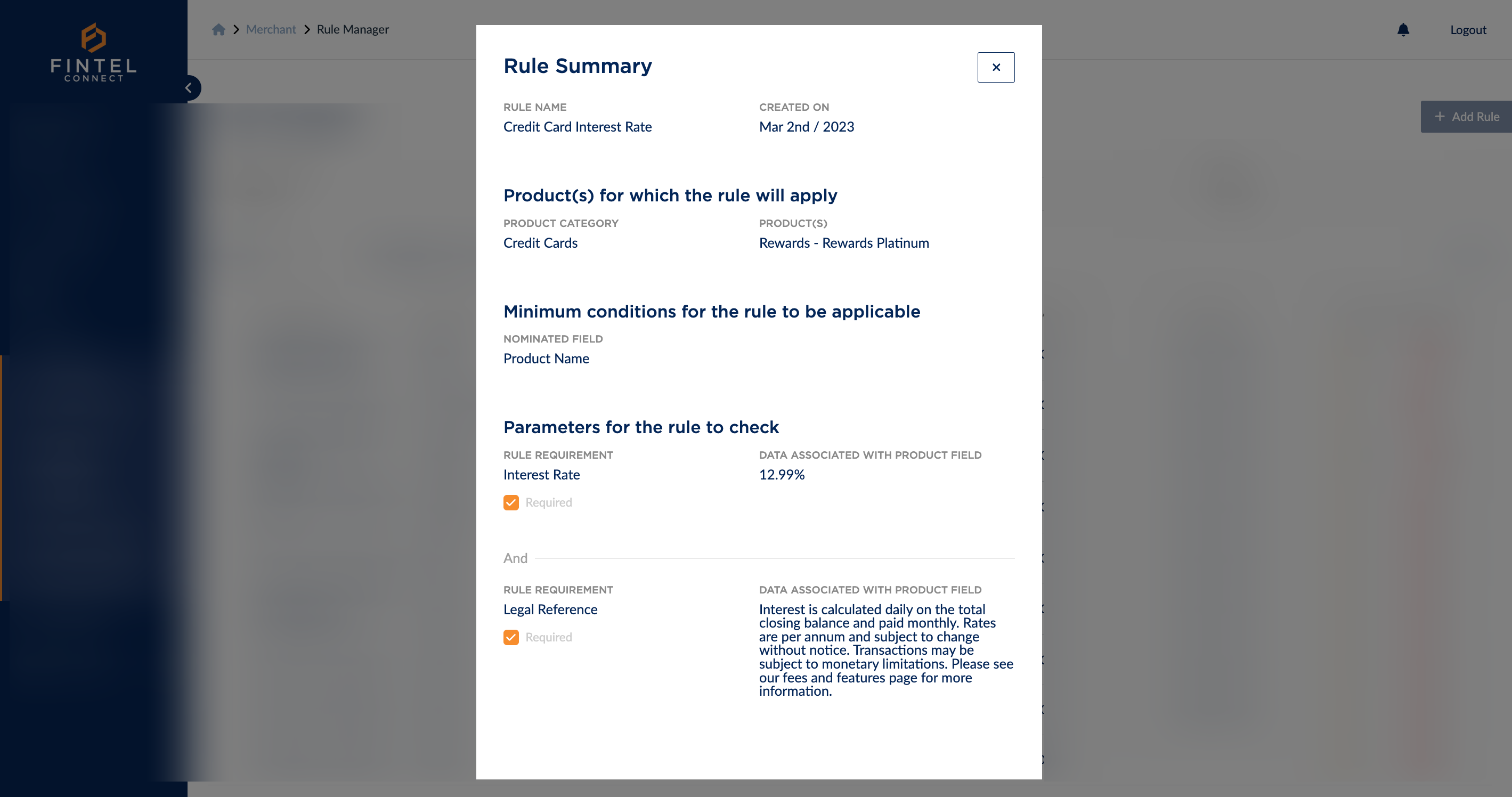
As part of your setup, you can have Fintel Check take automated screenshots to capture pages you’re responsible for monitoring, whether that be partner pages, publisher sites or any other webpage. Your team can set a time frame that works for you so you can build a paper trail without manually documenting and sorting content.
This means your team spends less time manually checking web pages and comparing partner material to compliance standards than they would manually.
You can also easily adjust product information via the Fintel Connect platform to push updates, so you don’t have to manually notify publishers individually. This means your marketing and compliance teams can spend less time on manual alerts.
Centralized compliance data management will enable better visibility for your teams
Not having a centralized place to monitor and manage compliance data means reviews take much longer to complete between marketing, compliance and legal teams. And having to manually sort through hundreds of screenshots means human error can creep in.
With Fintel Check, you’ll have the visibility you need. Our rules-based engine enables you to monitor and evaluate the specific data you want, from trigger terms like “free” or “guaranteed” to product information (e.g., pricing or interest rates). You can then see the results of your automated compliance monitoring at a glance, with our compliance dashboard providing an overview and with detailed reports.
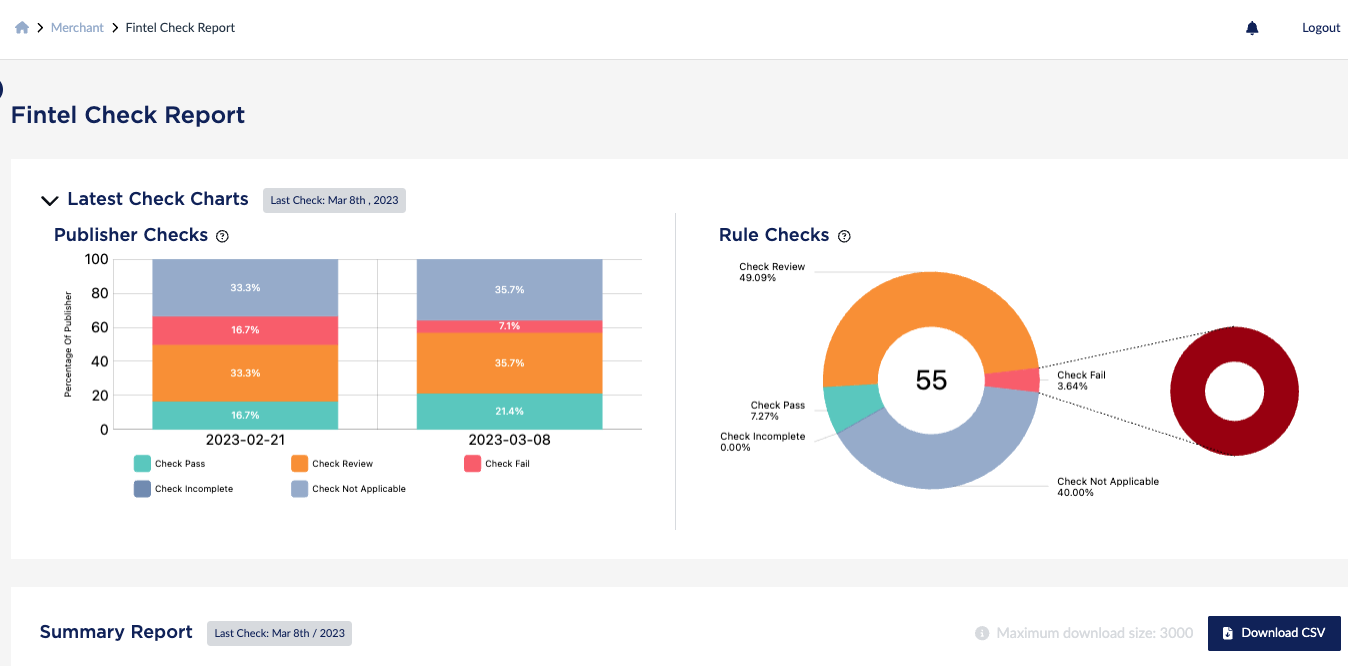
Since everyone who works on compliance can access the same real-time data in one place, we’ve made your internal processes easier with our Workflow Management tool. You can track complete or incomplete actions so everyone working on reporting and remediation knows what needs to be done, and a full history of all Checks ever found by Fintel Check.
With Fintel Check, you can more easily review your team’s work or provide a paper trail for regulators by looking at a historical record of compliance tasks.
Automated screenshots provide proof of compliance
One of the most important parts of compliance is maintaining records which prove your due diligence to regulators. Without a good software tool, that may mean your team is manually checking, screenshotting and storing content.
While many other marketing tools, like BrandVerity and PerformLine can also help you automate your marketing compliance monitoring, you may not receive the right amount of data at the right frequency for your audits.
Fintel Check automatically takes screenshots of the pages you are responsible for, with a time frame of your choice. You can choose the level of data captured that works for your team according to a schedule you set.
Fintel Check automatically stores these, so they are ready to show auditors at any time. Fintel Check even enables you to see how much traffic, impressions and clicks specific pages received, so you can estimate the scope of impact for non-compliant content in an audit. You can tell regulators the size of the problem with confidence, along with a paper trail that proves your monitoring and remediation actions.
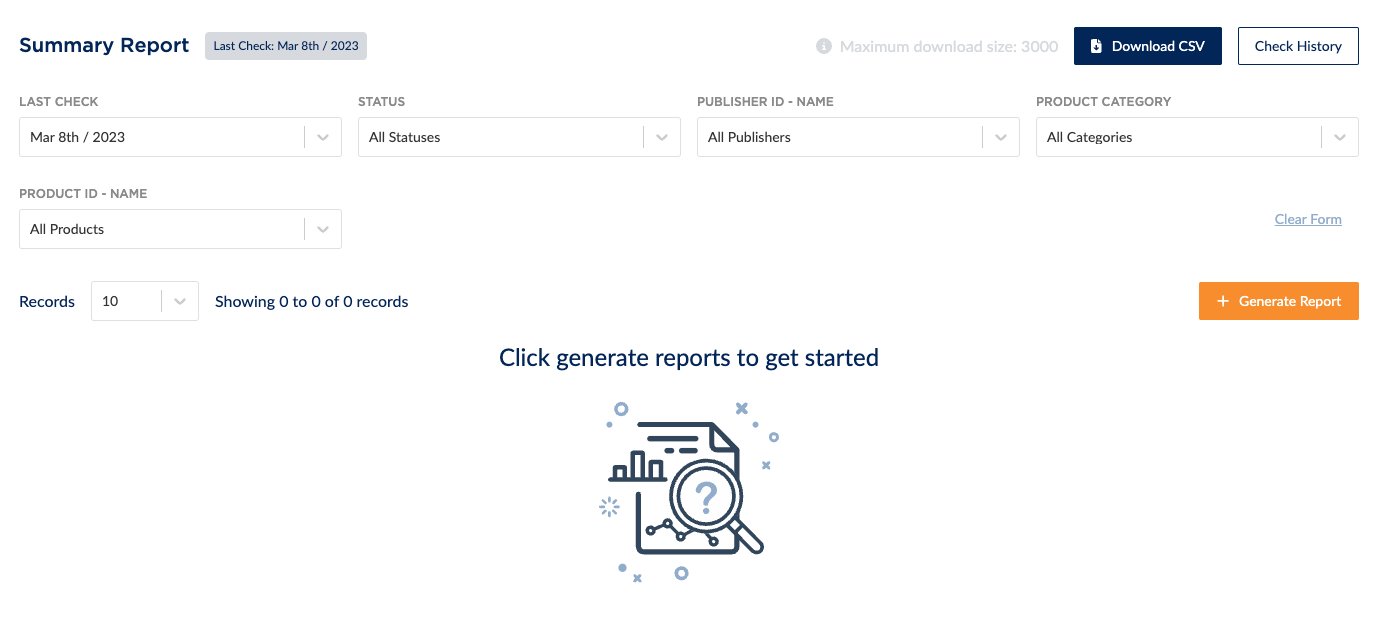
Finally, our Page Change Monitoring enables you to check pages and capture screenshots only when a change has been made. That means you have a record of updates for yourself and auditors without having to sift through dozens of copies of the same web content.
Strengthen your marketing regulatory compliance with a software that fits your industry’s needs
The compliance process will always be a detailed, time-consuming task that your business needs to get right or risk penalties. But software designed specifically for marketing compliance can make things much easier on your team and reduce the most tedious and repetitive tasks.
For financial services companies, working with a firm that understands the nuances of the industry is the best way to lessen the burden on your marketing team while maintaining accuracy.
Contact us if you are ready to see what Fintel Check can do for you, or read more about marketing compliance for financial services and how to get things right.



 English
  Français