
Bank Marketing Compliance Checklist & How To Automate It


EvaIf you’re a bank compliance professional looking for a marketing compliance checklist, you may want to:
- Be more proactive in your approach to ensure you’re monitoring the necessary requirements as your marketing efforts become more digitally focused.
- Create a more structured process for managing new partnerships and channels so you can improve your compliance tracking and reporting accuracy.
- Establish more consistent documentation and change tracking, to avoid an overreliance on ad-hoc or manual checks that can lead to errors and audit gaps.
At Fintel Connect, we know how important it is to have a structured checklist from managing our financial services clients’ affiliate and marketing programs. But a checklist alone doesn’t always make it easier to scale your marketing compliance efforts.
Manual monitoring can be resource intensive and error prone, leading to inaccurate reporting, missed instances of non compliance, and difficulty scaling your marketing strategy.
That’s why we created a tool that helps marketers automate and manage campaign policing and reporting to improve efficiency and reduce manual errors.
We’ll share our insights on marketing compliance checklists for banks, what to take into consideration, and how the right tool can enable greater accuracy and scalability.
In this article, we’ll cover:
- Key checklist items for bank marketing compliance
- What to take into consideration when implementing your checklist
- How our tool Fintel Check helps you implement your checklist
- A real-life example of how Fintel Check helped a financial institution
Discover how Fintel Check helps you streamline your bank marketing compliance checklist and automate tasks. Book a demo today.
Key checklist items for bank marketing compliance
Here are the main areas and checklist items to help you stay on top of your bank’s marketing compliance:
1. Understand your compliance scope
Before launching your marketing campaigns, define the scope of your compliance requirements. Different financial products, such as loans, credit cards, or mortgages, are subject to different regulations.
Checklist:
- Identify which products and services you or your marketing partners are promoting
- Confirm which regulatory frameworks apply (e.g., the Fair Lending Act prohibits discrimination in advertising in lending products like mortgages)
- Document any jurisdiction-specific regulations that may apply to your marketing campaigns (e.g., know the state-by-state requirements, like the California Consumer Financial Protection Law)
- Know who is involved in compliance oversight across your organization—this could be marketing, compliance, or risk
2. Set up internal processes (for pre and post campaign launch)
Internal compliance workflows can help ensure you review all marketing materials before publication while avoiding bottlenecks, which can cause publication delays, or publishing non-compliant content.
Ensure your workflow also takes into account the policing of published campaigns at regular intervals, as regulations and product or service information can change (e.g., interest rate updates, promotional offers).
Distinguish between “hard content compliance” (interest rates, disclosure requirements, and disclaimers that, if incorrect, could result in regulatory fines) and “soft content compliance” (marketing language that has room for interpretation as potentially misleading or infringes on regulatory guidelines).
By focusing more resources on monitoring high-risk, hard compliance issues, you can mitigate the risks that could lead to regulatory action.
Checklist:
- Assign compliance tasks across your marketing, legal and compliance teams
- Set up a review and approval process with specific timelines for campaign sign-off
- Create a detailed rule set with examples of approved language and common mistakes to look out for
- Document where campaigns are living—channels and specific URLs
- Schedule regular reviews to catch any unauthorized changes or newly non-compliant content due to regulatory updates or product changes
- Set up a separate workflow to prioritize higher-risk campaigns or urgent issues
3. Ensure language, disclosures and promotions adhere to requirements
Using the wrong wording or failing to disclose terms properly can be interpreted by regulators as deceptive and lead to increased regulatory scrutiny, potential fines, and legal challenges. Examples of compliant language and messaging include proper disclosure formatting for annual percentage rates and making sure there are no misleading claims like “guaranteed approval” or “no cost.”
Checklist:
- Be transparent—avoid terms like “free” or “guaranteed” unless they are accurate
- Include the correct legal disclaimers, like FDIC insured for insured deposit products, as well as any disclaimers about eligibility requirements, fees or promotional conditions
- Ensure your terms and conditions and rates are consistent across all campaigns and channels
- Disclose third-party partnerships or incentives that could influence potential customer decisions where required
- Stay up to date with guidelines and best practices from regulatory agencies, like FINRA or the Federal Trade Commission (FTC)
- Follow your brand guidelines to keep messaging consistent across all channels.
4. Monitor marketing across all channels
Continuously monitor your content across all your channels to ensure consistency and accuracy. This includes not just your website, partner pages, social media, and email campaigns, but also checking any third-party content you may not be aware of, like sub affiliates or even instances of ad hijacking.
Checklist:
- Make a list of all your marketing channels, from paid search to affiliate marketing
- Identify which partners and campaigns require regular checks
- Define the frequency of checks across each channel
- Track updates to promotional offers to ensure any change has been updated in your marketing campaigns and materials
- Use specific software to track publisher and affiliate marketing links that may be on third-party websites you may be unaware of
- Take screenshots of your compliance monitoring and create reports to document your compliance actions
5. Create a compliance reporting system (and use technology to help)
Having a structured reporting system in place helps you save time and enhance accuracy when tracking and documenting your compliance efforts. Most importantly, it provides proof of due diligence if regulators audit your firm.
Using specific tools, like AI-powered software to automate your tracking and reporting, can help you ensure continuous oversight while reducing your manual efforts.
Checklist:
- Create a database to log your compliance reviews
- Take screenshots of your compliance checks, ensuring they’re dated and saved
- Categorize compliance issues based on risk level
- Define a process for remediation on flagged content
- Produce regular compliance reports for leadership teams and regulators
What to take into consideration when implementing your checklist
When creating your compliance monitoring program, be aware of common challenges that can undermine its effectiveness. Many financial institutions encounter obstacles that can compromise their compliance efforts if not properly addressed.
Enhance efficiency by moving beyond spreadsheets
Relying on spreadsheets and ad hoc reviews not only increases the chance of human error but also creates inconsistent documentation that can jeopardize your compliance, risking increased scrutiny.
As your network of partnerships grows, manual methods and spreadsheets only become more unsustainable. Look for compliance monitoring tools to help automate your tracking and documenting.
Make sure your compliance program adheres to every jurisdiction
Regulatory requirements can vary significantly across jurisdictions. Ensure your compliance program adapts to these variations so content meets legal standards from state to state or country to country.
Monitor and react to changes in marketing content
Marketing materials are often updated or modified after initial approval, meaning compliant content can quickly become non-compliant. Stay on top of any changes and proactively notify your fintech and channel partners to fix incorrect language to avoid infringements.
Build a scalable compliance framework that grows with your business
Manual processes can lead to higher operational costs, increased staffing needs, and inconsistencies in monitoring. A well-structured compliance framework supports business expansion while keeping overhead costs in check.
To build a compliance program that scales with you, use compliance software specifically designed for banks and financial institutions, like Fintel Check.
How Fintel Check helps you implement your checklist
Fintel Check, an AI-powered marketing compliance monitoring tool, handles many of the scaling issues compliance analysts can face by automating key tasks and providing a centralized platform for compliance management.
Fintel Check is part of Fintel Connect, an all-in-one affiliate marketing agency, platform and network specialized in financial services. With 20+ years of experience in working with highly regulated industries, we developed this tool after witnessing firsthand the difficulties of maintaining marketing oversight for financial services firms.
Sponsor banks and BaaS providers can use Fintel Check to monitor the compliance of their fintech partners, their own website pages, or any URL they want to check. Any financial institution can also use this tool to monitor the compliance of web pages, including affiliate sites, social media platforms, and other digital marketing channels.
Here’s how Fintel Check improves the consistency, accuracy, and scalability of your marketing compliance checklist:
Automate your compliance monitoring and reporting to improve consistency and reduce manual errors
While checklists can keep your compliance monitoring on track, manual implementation leads to inconsistent documentation, missed checks, and human error—all of which create significant regulatory risk.
With a compliance tool designed specifically for financial services firms like Fintel Check, you can streamline your monitoring process to consistently track and document potential compliance risks. Here’s how:
With Fintel Check’s customizable AI-powered rules engine, you can schedule automated, regular scans for compliance checks and record-keeping.
Pro Tip:: It’s important to monitor what really matters. While standardized rule sets can help you get started with your oversight quickly, your results won’t be specific enough and may result in even more work. Taking the time to set up specific customized rules from the start can give you the detailed oversight you need without being resource intensive. |
Automation gives you continuous oversight while removing the manual effort from content scanning, link tracking, screenshot capture, and record maintenance. Its ability to automate screenshots means when you get audited, you’ll have the screenshots ready and organized.
Fintel Check maintains an audit database that stores detailed records of flagged issues, resolved cases, and page modifications. This database simplifies internal reporting and regulatory audits so you’re audit-ready.
You can capture infringements at whatever frequency you choose with Fintel Check. You can monitor even social media content for compliance, as it scrapes any public-facing pages to track fintech partner activity.

By automating these compliance tasks, Fintel Check helps you maintain consistent documentation, reduce the risk of human error, and stay prepared for regulatory inquiries without expending more manual effort.
Enhance accuracy with an AI-powered rules engine and product information updates
Manually checking marketing content against complex regulatory requirements often leads to missed issues and inconsistent evaluations. Individual team members might interpret the same rule differently, leading to a fragmented approach to compliance monitoring.
Fintel Check solves this problem by providing a standardized, AI-powered evaluation system that applies rules consistently across all relevant content. You can customize Fintel Check’s rules engine to align with your institution’s specific regulatory requirements and brand guidelines, so scans adhere to your predefined rules.
Fintel Check then flags potential compliance issues and categorizes them based on your predefined rules, helping you prioritize remediation. That saves you from manually searching through your checklist and guidelines. Fintel Check does the heavy lifting for you and provides greater accuracy in your compliance monitoring process.
With customizable rule settings and scheduled auditing, you get automatically generated reports and screenshots that are time-stamped and consistent, so you’ll have a verifiable audit trail. For example, if a partner updates a landing page after approval, Fintel Check detects the change and re-evaluates the content for compliance.
You can embed Fintel’s product feed feature directly into web pages to proactively manage marketing content within Fintel’s platform. When product information is updated, the tool automatically alerts partners to update their pages, so you can be confident of accuracy across your channels. If your partners have opted to implement the ‘feed’ functionality, the content will automatically get updated on their sites as you update information via Fintel’s platform.
With Fintel Check, you’ll have traffic and impressions data so you can quantify potential exposure and demonstrate the risk level to regulators. For instance, if a regulator questions a compliance issue, you can provide data showing that the non-compliant page had minimal traffic, which can reduce the perceived risk.
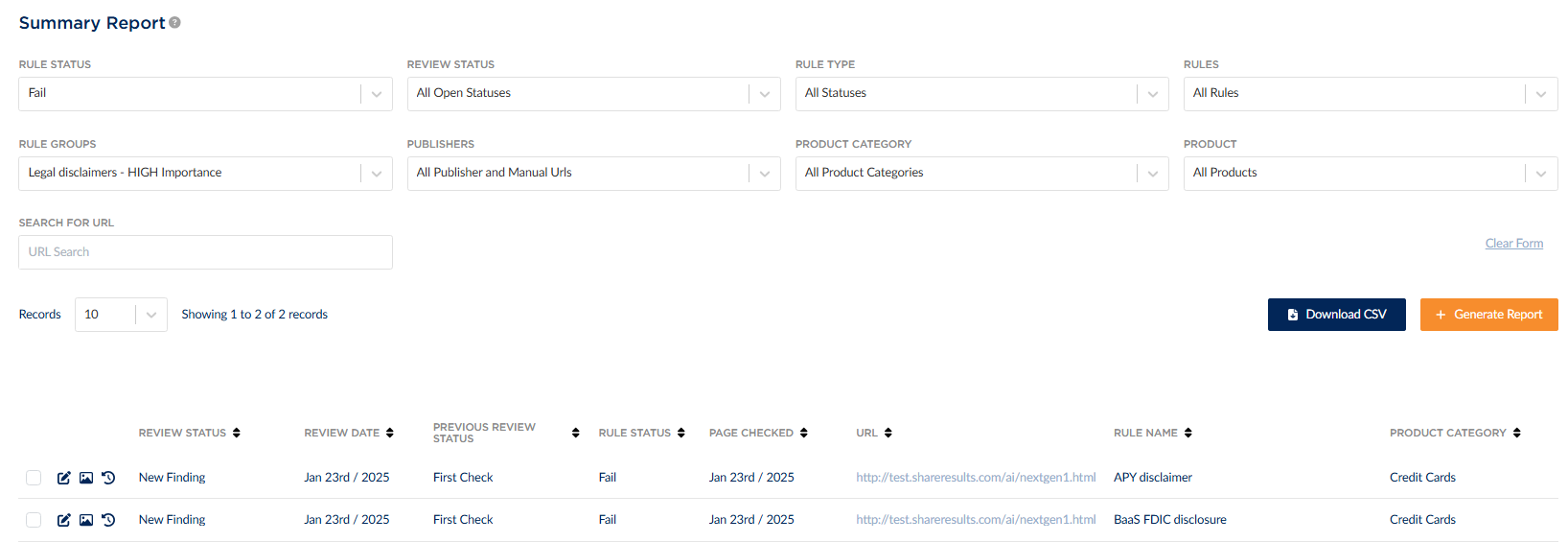
By improving accuracy through automated, consistent rule application, Fintel Check helps you maintain marketing regulatory compliance while providing the documentation needed to demonstrate your diligence to regulators.
Scale your marketing oversight efficiently without increasing manual effort
As your institution grows and increases its marketing partnerships, manual compliance monitoring becomes unsustainable. Each new campaign multiplies the content requiring review, often forcing institutions to either hire more compliance staff or put more pressure on existing teams to manage more. Fintel Check breaks this pattern by providing scalable automation that grows with your business.
Fintel Check provides a page change report to monitor and track partner pages, including any modifications made and the locations where they’re implemented. It simplifies compliance management across multiple URLs. With one glance, you can see which partners are using compliant language and which ones aren’t.
The page change report also provides a summary of content changes. It highlights added, deleted, or modified content compared to previous versions. This lets you focus on the most important partner content changes and take action quickly.
You can instantly prioritize which issues need immediate attention versus further review with Fintel Check’s centralized dashboard. It filters out irrelevant data and categorizes critical compliance issues with a color-coded system (red, yellow, green) and clear wording (fail, review, pass).
You can also improve collaboration between teams with Fintel Check’s workflow management tool by tracking completed and incomplete actions across all reports.
This prevents team members from duplicating efforts and allows you to review your team’s work effectively, understanding who completed which tasks and when. The tool maintains a historical record of remediation tasks, including dates and details, which you can present to auditors.
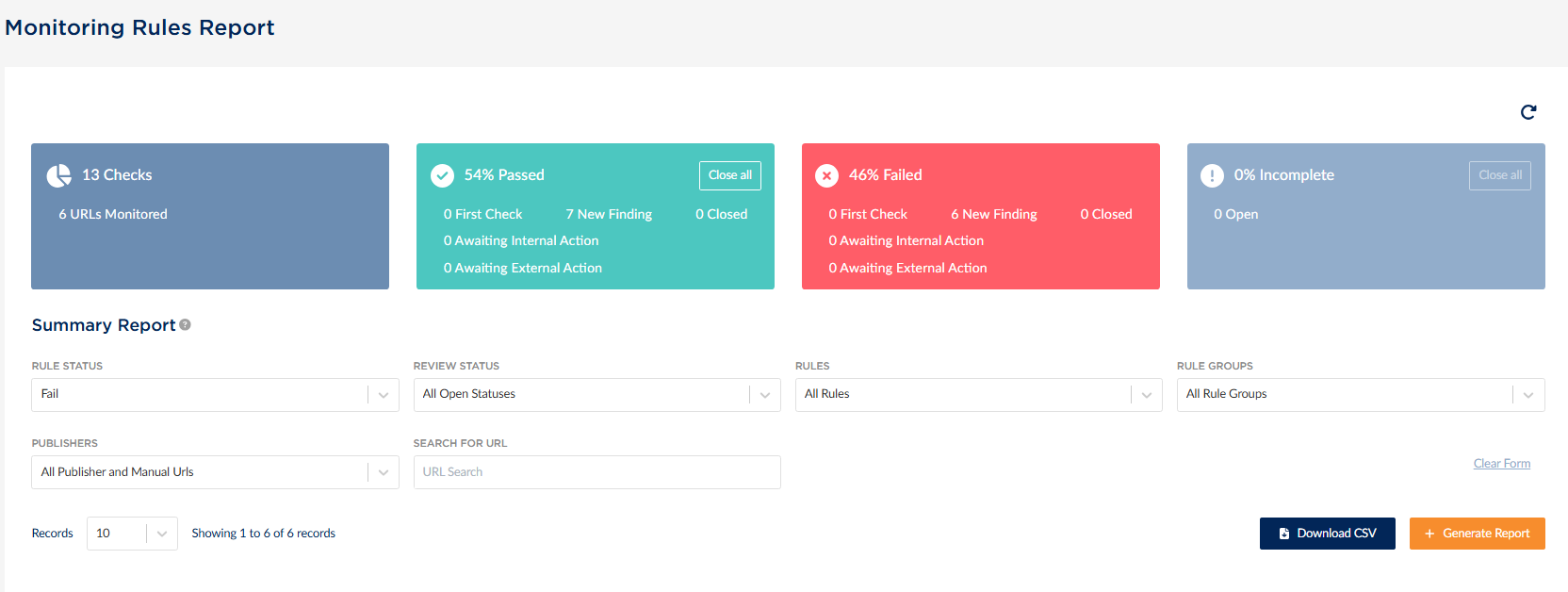
By enabling efficient scaling of compliance operations, Fintel Check helps you maintain strong oversight even as your business grows, without the proportional increase in compliance staff that would otherwise be required.
A real-life example of how Fintel Check helped a financial institution streamline its marketing compliance monitoring
Fintel Check demonstrated its value to a financial services company that was previously relying on manual processes and ad-hoc reviews to manage compliance. Although the company had a dedicated compliance team, it struggled to keep up with the volume of marketing content being published across multiple channels.
The compliance team was manually reviewing partner websites, social media posts, and email campaigns. They relied on spreadsheets to log URLs, take screenshots, and track changes. This process was not only time-consuming but also prone to inaccuracies, which led to missing a critical compliance issue on a partner’s website.
Enter Fintel Check, which the compliance team configured to scan their partners’ websites and other marketing channels to comply with the company’s predefined rules.
During an initial test run, Fintel Check identified several issues that the manual process had missed because their compliance team didn’t have the bandwidth. These issues included changes to their partner pages where:
- Relevant required disclaimers were missing
- Banned trigger terms appeared
With Fintel Check, the compliance team was able to:
- Save 82% of compliance review time by automating content monitoring and streamlining collaboration.
- Reduce manual efforts from 8.5+ hours to just 1.5 hours per month. Automation of the monitoring of 100 partner pages and disclaimer checks removed the need for manual tracking, which freed up the compliance team to focus on remediation.
- Cut review time per partner from over 1.5 hours to just 14 minutes, resulting in a significant time saving across all five partners monitored monthly.
- Easily identify, evaluate, and proactively address content changes. They set specific monitoring and evaluation rules at the frequency of their choice and let our AI-driven rules engine do the heavy-lifting of finding, qualifying and evaluating content on partner pages. Real-time alerts also notified the team of non-compliant content, so they could reach out to partners and request corrections immediately.
- Automated audit reporting. Fintel Check monitored pages and captured and stored screenshots when changes were made, creating automatic audit-ready updates. The tool also registered the team’s workflows and remediation efforts.
- Control compliance costs. Since they could choose the frequency and volume of scans, they could manage costs and stay within budget.
The financial services firm adapted Fintel Check to their needs, automating and streamlining the company’s compliance monitoring.
Automate your bank marketing compliance checklist
Staying compliant with bank marketing regulations doesn’t have to be a manual, error-prone, and time-consuming process. By implementing a structured compliance checklist and using Fintel Check, you can automate monitoring, enhance accuracy, and scale your marketing compliance controls effectively.
With real-time alerts, customizable rules, and a centralized audit database, Fintel Check saves time and reduces the risk of costly violations.
Ready to try Fintel Check? Reach out to us now to get started.



 English
  Français