
Marketing compliance for financial services: how to get it right

Marketing compliance for financial services means every piece of marketing content, whether written in-house, by an affiliate partner, or by a fintech partner, meets regulatory standards like UDAAP (Unfair, Deceptive, or Abusive Acts or Practices) and TILA (Truth in Lending Act) before a consumer ever sees it. Get it wrong and it can cost hundreds of millions of dollars.
Although there are many tools that help banks, credit unions, and fintechs with brand monitoring, there weren’t any that focus on content compliance exclusively for financial regulations and legal regulations. Now with Fintel Check, financial brands can automate up to 90% of content monitoring and evaluation so affiliate campaigns launch faster, issues are identified earlier, and growth doesn’t stall due to manual reviews or uncertainty.
What’s the difference between hard and soft content compliance?
We find it useful to think about marketing content compliance in two buckets:
| Type | What it covers | Example violation |
|---|---|---|
| Hard content compliance | Interest rates, APYs, fees, required disclosures, and disclaimers | A fintech partner calling itself a “bank” when it only offers banking services through a chartered partner |
| Soft content compliance | Language that could mislead or create a false impression, even without a factual error | Using words like “free” or “guaranteed” without the qualifying disclosure nearby |
Hard content compliance failures tend to draw the fastest and most direct regulatory attention, since they misstate a fact regulators can point to. Soft content compliance failures are just as risky, but require more judgment to catch, which is exactly where most manual reviews and generic monitoring tools fall short.
What happens when financial marketing content isn’t compliant?
Non-compliant marketing content rarely ends with a warning letter. Based on recent, real enforcement actions and litigation across the industry, here’s what the consequences actually tend to look like:
- Class action settlements reaching hundreds of millions of dollars. When marketing quietly moves customers into a lower-earning product tier, say, promoting a new high-rate savings account while letting existing customers sit unnotified in a legacy account frozen at a fraction of the rate, private litigation over that marketing has produced settlements north of $400 million in a single case.
- Regulatory consent orders with mandatory restitution. When ads imply a special relationship, a guarantee, or a rate benefit that isn’t accurate, such as suggesting a fixed-rate loan’s payments will drop over time, regulators have required the institution to fund restitution and bring in an independent consultant to calculate and distribute payments to every affected consumer.
- Dismissal isn’t resolution. A change in regulatory priorities can lead an agency to drop its own suit, but the same marketing practices can still be pursued through private class action litigation, and the settlement can still land in the hundreds of millions.
- Increased examination frequency and reporting requirements from your regulator once a marketing-related violation has been flagged.
- Reputational damage that outlasts the settlement, particularly when the case involves a widely used consumer product.
- Liability that extends to partners. In BaaS relationships, the chartered bank, not just the fintech that wrote the ad, is usually the one holding the regulatory and financial exposure.
What are the biggest content compliance challenges for banks, credit unions, and BaaS providers?
Most financial institutions rely on some combination of a marketing compliance checklist, manual review, and a monitoring tool. Each has real limits:
| Approach | Strength | Limitation |
|---|---|---|
| Manual team review | A trained reviewer can catch nuance and context quickly | Labor and time intensive, so reviews happen less often and issues fall through the cracks, especially across multiple BaaS partners |
| Brand and PR monitoring tools | Broad web and social crawling for any brand mention | Built for brand integrity, not marketing regulatory compliance. Surfaces thousands of mentions with no way to evaluate which ones actually violate a rule, and pricing is built for large public companies |
| Purpose-built content compliance tools | Monitors only the specific pages and rules that matter, evaluates pass or fail, and builds the audit trail automatically | Fewer providers built specifically for financial services and BaaS relationships |
How is a marketing compliance tool different from a brand monitoring tool?
Brand and PR monitoring tools answer “where is my brand being mentioned?” A marketing content compliance tool answers a narrower, harder question: “does this specific page follow this specific rule, right now?”
That’s the gap Fintel Check was built to close. At Fintel Connect, we’re an all-in-one platform, network, affiliate marketing agency, with an integrated content compliance tool built specifically to help financial services companies grow through the affiliate marketing channel. Part of doing that responsibly is making sure every affiliate partner describes your products correctly.

How does Fintel Check help financial institutions manage marketing compliance?
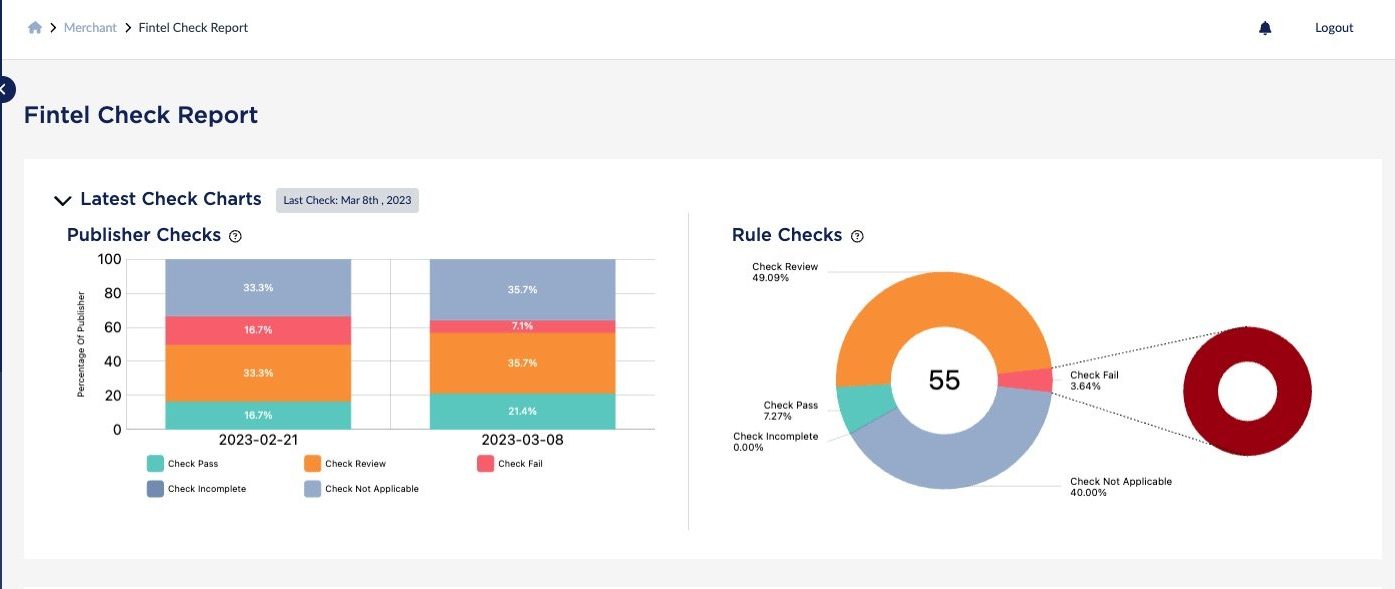
Fintel Check is an AI-powered, rules-based system built for banks, credit unions, and fintechs. It’s built to automate up to 90% of content monitoring and evaluation, so affiliate campaigns launch faster, issues surface earlier, and growth doesn’t stall waiting on manual reviews. It gives your team:
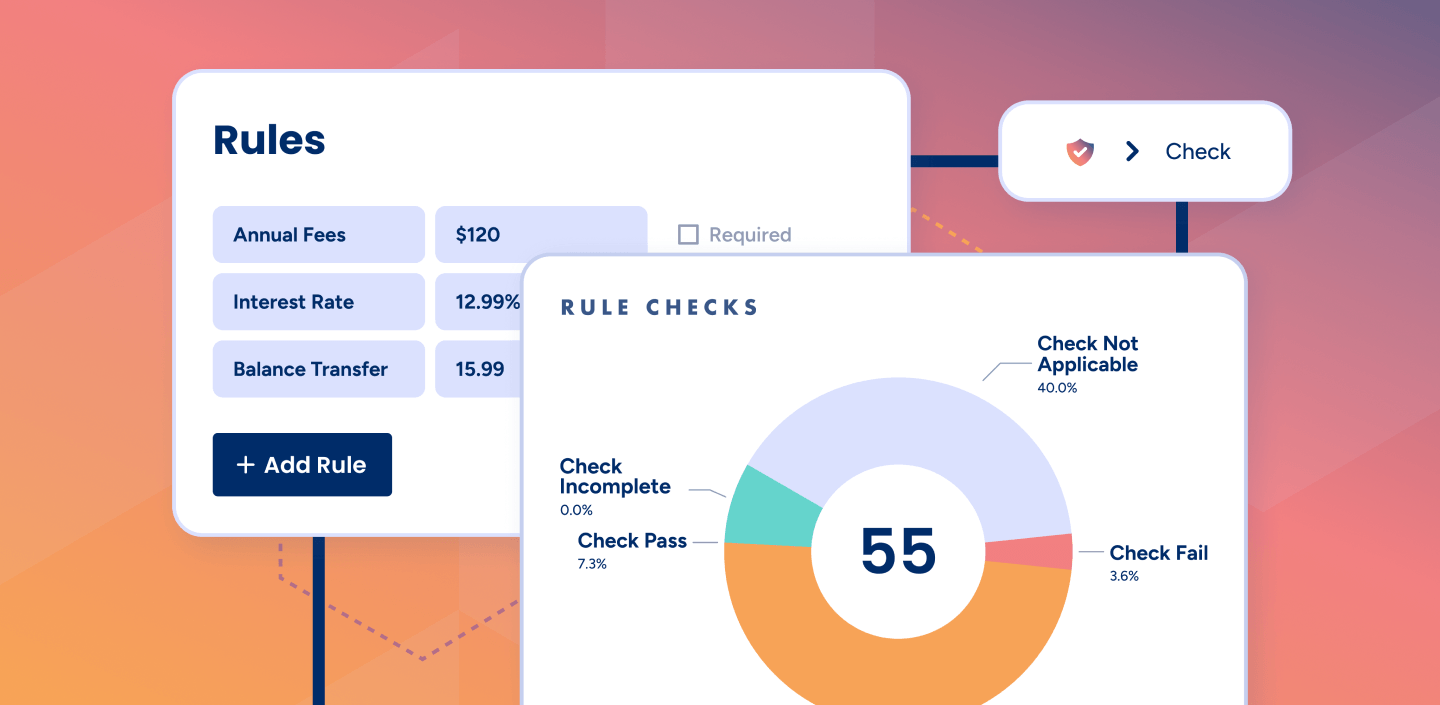
- Unlimited custom rules: upload the URLs that matter, your own site, affiliate pages, or fintech partner sites, and set rules for what to flag (say, a required annual fee, interest rate, or balance transfer disclosure). Each page is automatically marked Pass, Fail, Review, or Not Applicable against your rules.
- A pass/fail dashboard: see at a glance which pages meet your rules and which don’t, plus how much traffic, impressions, and clicks a failing page received, so you can gauge real exposure.
- An automated Page Change Report: get an AI-generated summary and before-and-after view whenever a previously compliant page changes.
- A built-in audit trail: scheduled screenshots and a workflow log of remediation, ready to export if a regulator asks for evidence.
- Partner collaboration: invite fintech or affiliate partners into the dashboard so they can fix flagged pages without a reminder email from your team.
- Automatic coverage on affiliate links: for brands using our affiliate platform, Fintel Check runs automatically anywhere your tracking link appears, including sub-affiliates you might not know about.
How much time can Fintel Check save your team? A real result
One Fintel Check client wanted to catch outdated promotions across its affiliate content, so it set a single rule to flag any mention of expired bonus language. Here’s what happened:
| Objective | Result | Impact |
|---|---|---|
| Detect outdated promotions across affiliate content by flagging any mention of expired bonus language | ~6,600 pages scanned; 18 pages flagged with an outdated offer; 4 affiliate partners identified with non-compliant content | Monitoring time cut by 95% compared to manual checks, saving 120+ hours, with rapid correction of non-compliant pages before issues escalated |
Want to take the heavy lifting out of monitoring? Book a demo of Fintel Check.
What’s a real example of a marketing compliance failure, and how could it have been prevented?
A fintech journalist Jason Mikula reported that Maza, a fintech helping undocumented immigrants apply for US tax ID numbers, described itself on its homepage as a “banking service” without clarifying that the service came from its bank partner, Blue Ridge. The site also misused Department of Treasury and IRS branding, claimed an “IRS guarantee,” and advertised “no hidden fees” and accounts opened “in minutes.”
The regulatory risk fell on Blue Ridge, the chartered bank responsible for its fintech partner’s marketing. With a tool like Fintel Check, Blue Ridge could have:
- Set a rule to flag any page missing a required disclosure
- Set rules to catch specific risky phrases (“IRS,” “Department of Treasury,” “hidden fees,” “in minutes”) the moment they appeared
- Received an automatic report the moment a rule failed, with time to reach out and request a fix before it became a regulatory issue
- Invited Maza into the dashboard so its team could manage its own content proactively
Frequently asked questions
What is marketing compliance in financial services?
Marketing compliance in financial services is the process of ensuring marketing content, whether written internally or by an affiliate or fintech partner, meets regulatory standards like UDAAP and TILA before it reaches consumers.
What is affiliate marketing compliance monitoring?
Affiliate marketing compliance monitoring is the ongoing review of affiliate partner content, such as offers, rates, and disclosures, to ensure it meets regulatory and brand standards. For financial services brands, this means catching outdated promotions, missing disclosures, or non-compliant language before they create legal or reputational risk.
What happens if a bank’s marketing content isn’t compliant?
Consequences can include regulatory fines or restitution, more frequent examinations, reputational damage, and exposure to private litigation that can cost as high as hundreds of millions of dollars in settlement.
Who is responsible for a fintech partner’s marketing compliance in a BaaS relationship?
The chartered bank is typically responsible for its fintech partner’s marketing content, since the bank holds the regulatory relationship, even though the fintech wrote and published the content.
How does Fintel Check monitor UDAAP and disclosure compliance?
Fintel Check uses AI-powered monitoring to scan affiliate content for trigger keywords, required disclosures, and regulatory language tied to UDAAP (unfair, deceptive, or abusive acts or practices) across every partner page. Brands set flexible, brand-specific rules, so evaluations reflect their exact marketing compliance requirements rather than a generic check.
How much time can automated marketing compliance monitoring save compared to manual reviews?
Automated marketing compliance monitoring can reduce review time by up to 95% compared to manual checks. One Fintel Check client saved more than 120 hours while scanning roughly 6,600 pages and flagging non-compliant content for rapid correction.
How often should affiliate content be monitored for marketing compliance?
Monitoring frequency depends on program size and risk tolerance, though weekly reviews are common for financial services brands running active campaigns. Fintel Check lets brands set monitoring on a custom schedule, weekly or as needed, so oversight matches the pace of their program.
Is Fintel Check built specifically for financial services companies?
Yes. Fintel Check is built exclusively for financial services brands, including banks, credit unions, and fintechs. Unlike generalist content compliance tools, it’s designed to evaluate the rates, disclosures, and regulatory language unique to financial products.


 English
  Français