
Affiliate marketing compliance for banks, credit unions, and fintechs


Affiliate marketing compliance is the practice of making sure everything your affiliate partners publish about your financial products, rates, disclosures, and claims, meets regulatory requirements and your brand’s standards. For banks, credit unions, and fintechs, that means managing two distinct risks at once: fraudulent affiliates gaming your program, and honest mistakes from legitimate partners that still expose you to regulatory action.
If you’re an affiliate manager concerned about your program’s marketing compliance, you’re likely:
- Looking for ways to vet affiliate partners and confirm they’re legitimate
- Trying to figure out the best way to manage the content compliance risk of your affiliate partners’ content
- Searching for a tool that makes monitoring affiliate marketing compliance easier as your program scales
- Getting pushback from your content compliance team about expanding partnerships
Looking for support keeping your affiliate program compliant?
What are the risks of non-compliant affiliate marketing in financial services?
Affiliate marketing works because it’s a scalable form of word-of-mouth: consumers trust the YouTubers, bloggers, comparison sites, and finance creators recommending a product more than they trust the brand’s own ad. That trust is worth even more in financial services, a heavily regulated industry where accuracy directly affects a consumer’s money. It’s also exactly what’s at stake when something goes wrong. Two distinct risks can damage that trust, and they require different defenses.
What risks come from fraudulent affiliates?
Bad actors in affiliate marketing typically:
- Claim to manage a website they don’t actually control
- Create fake accounts or use bots to commit click fraud or inflate traffic and sign-ups
- Send high volumes of low-quality, unqualified applications
- Misrepresent your financial product or brand if they think it will boost their conversion rate
This isn’t a marginal problem. Industry estimates put fake or fraudulent affiliate traffic at around 17%, with fraudulent affiliate activity costing digital advertisers an estimated $3.4 billion (TrafficGuard, citing Hello Partner data). Left unchecked, working with fraudulent affiliates can mean paying commissions for worthless traffic, facing legal exposure from misleading endorsements, and losing customer trust once it becomes public.
Sub-affiliate networks compound the risk: if a partner runs placements through sub-affiliates you can’t see, you lose visibility into where your brand is appearing and lose the ability to catch non-compliant content before it spreads.
What risks come from non-compliant content published by legitimate partners?
Most affiliate relationships don’t involve bad actors. Established affiliates protect their own audience’s trust and are usually already familiar with financial services guidelines.
But honest mistakes still happen:
- A rate changes and an old page doesn’t get updated
- A disclosure gets dropped during a redesign
- A new team member at the affiliate doesn’t know your content rules
This kind of drift is easy to catch with a handful of affiliates, but gets significantly harder across dozens or hundreds. And the consequences compound as:
- Regulators flag the content and scrutinize your company more closely
- Customer trust erodes if it becomes public, regardless of intent
- The FTC’s Endorsement Guides put the responsibility on the brand, not just the affiliate: advertisers must maintain reasonable monitoring and training programs for affiliates, and failing to do so can trigger enforcement action, consumer refunds, and civil penalties under the FTC Act
How do you keep a financial affiliate program content compliant as it scales?
There are three common approaches financial institutions use to manage affiliate marketing compliance, and each has real tradeoffs:
| Approach | Best for | Limitation |
|---|---|---|
| Manually vet and manage affiliates | Early-stage programs testing messaging and partner types | You handle every legal agreement, payment, and tracking setup yourself, and manually checking every page for content compliance becomes resource-intensive past a handful of partners such as NerdWallet or Bankrate |
| Join a general affiliate network | Finding a larger volume of potential partners quickly | Most networks don’t audit who joins, so you can end up filtering hundreds of low-quality or fraudulent applications, some with no financial services experience at all |
| Use a PR or brand monitoring tool | General visibility into where your brand is mentioned | Built for brand integrity, not content compliance. It surfaces every mention regardless of whether you have a commercial relationship with that site, burying the content you’re actually responsible for in noise you aren’t |
Manually managing a small program is a reasonable way to start. But once you scale past a handful of partners, the more efficient path is a network and an automated monitoring tool purpose-built for financial services like Fintel Check, one that vets affiliates before they join and lets you monitor only the specific URLs and rules that matter, rather than every mention of your brand anywhere on the web.
What does affiliate marketing compliance look like for banks?
Banks typically run the widest range of products through affiliate channels, checking, savings, credit cards, mortgages, and often manage affiliate relationships across multiple business lines at once. That breadth is the main content compliance challenge: a rate promotion on a credit card affiliate page and a disclosure requirement on a mortgage lead page are governed by different rules (Regulation Z and TILA for credit terms, Regulation DD for deposit accounts), and a single generic marketing compliance checklist rarely covers all of it well.
For banks, the highest-leverage move is usually product-specific rule sets. Instead of one blanket policy applied to every affiliate page, set distinct monitoring rules for each product line’s specific rate, fee, and disclosure requirements, and prioritize monitoring the affiliates and placements driving the most volume first.
What does affiliate marketing compliance look like for credit unions?
Credit unions face a version of this problem shaped by their structure. Credit union advertising is regulated by the National Credit Union Administration (NCUA), the federal agency that charters and supervises credit unions the way the OCC and FDIC do for banks. Its Truth in Savings rules, found in Part 707, require accurate, clearly disclosed rate and fee information in any advertisement, and that requirement applies to content a third-party affiliate publishes on your behalf, not just what you publish yourself.
For credit unions, the practical priority is choosing a monitoring approach that doesn’t require adding headcount to scale: automated rules that check for accurate rate and fee disclosures across affiliate content free up a small content compliance team to focus on judgment calls instead of manual page-by-page review.
What does affiliate marketing compliance look like for fintechs?
Fintechs carry a content compliance wrinkle banks and credit unions don’t: most fintechs don’t hold a charter themselves, so the regulatory and content compliance risk for their marketing, and often their affiliates’ marketing, sits with their chartered bank partner. That means a fintech’s affiliate program content compliance isn’t just an internal concern; it’s something the bank partner will want visibility into as well.
For fintechs, this makes transparency with your bank partner a content compliance requirement, not just a courtesy. Sharing affiliate monitoring data and audit trails with your banking partner proactively, rather than only when asked, tends to make that relationship far smoother, and it’s often a condition banks set before approving a fintech’s affiliate program in the first place.
Financial affiliate marketing compliance checklist
Whether you’re running an affiliate program for a U.S. bank or a Canadian credit union, the fundamentals of a compliant program are the same, even though the regulators differ (the FTC and, for credit unions, the NCUA in the U.S.; Ad Standards Canada and the Financial Consumer Agency of Canada north of the border). Use this checklist across five areas to cover the basics of marketing compliance for financial services before scaling.
1. Define your content compliance scope
- Identify which products your affiliates are promoting (loans, credit cards, deposit accounts, mortgages) since each carries different regulatory requirements
- Confirm which frameworks apply to each product and jurisdiction, including state or provincial rules that may go beyond federal requirements
- Separate hard content compliance issues (interest rates, required disclosures, disclaimers) from soft content compliance issues (language that’s technically accurate but could still mislead), since hard compliance issues carry the higher regulatory risk and deserve more monitoring resources
2. Vet affiliates and set up internal processes before content goes live
- Confirm an affiliate’s business domain and email match, review their existing content quality, and confirm relevant financial content experience before onboarding
- Put content compliance requirements directly in the affiliate contract, not just a style guide, specifying required disclosures, restricted claims, and consequences for violations
- Assign review responsibility across marketing, legal, and compliance teams with clear sign-off timelines before a campaign launches
3. Get the language, disclosures, and promotions right
- Require clear, prominent disclosure of the affiliate or commission relationship on every page, placed close to the product mention (required under the FTC’s Endorsement Guides in the U.S. and Ad Standards Canada’s Influencer Marketing Disclosure Guidelines, which explicitly cover affiliate arrangements)
- Avoid unqualified claims like “free,” “guaranteed,” or “no cost” unless fully accurate, and include required disclaimers (FDIC insurance, eligibility, fees)
- Keep rates, terms, and conditions consistent across every affiliate and channel
4. Monitor continuously across every channel, including sub-affiliates
- List every channel an affiliate might use, including sub-affiliate networks and placements you haven’t directly approved
- Set the monitoring frequency per partner based on risk, and track when promotional offers or rates change to confirm affiliate content gets updated too
- Take dated, stored screenshots of every check so you have evidence if a regulator asks
5. Build a reporting system that scales, and use automation to get there
- Log every content compliance review in a structured system rather than ad hoc spreadsheets, which get harder to trust and audit as a program grows
- Categorize issues by risk level and define a clear remediation process for anything flagged
- Automating this monitoring makes a measurable difference at scale: one financial services firm moved from manually reviewing partner sites with spreadsheets to using an AI-powered rules engine, cutting review time by 82% overall and reducing per-partner review time from over 1.5 hours to 14 minutes
How does Fintel Connect help you maintain affiliate marketing compliance?
At Fintel Connect, we operate as an all-in-one affiliate marketing platform, network, agency, and integrated content compliance too, Fintel Check, built exclusively for financial services.
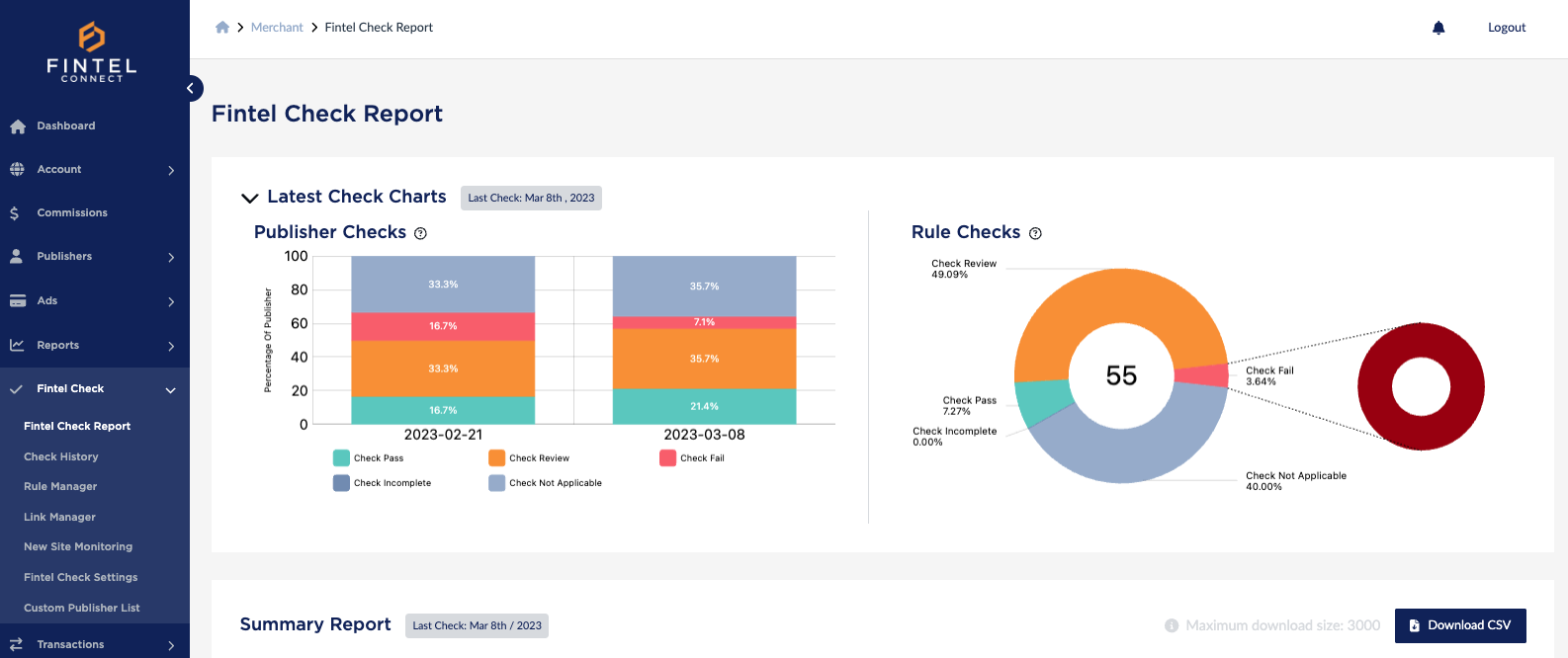
Here’s how that works in practice:
- Vetted affiliates from the start: every affiliate applying to join our 6,000+ partner network goes through technical and content review, including verifying their email and business domains match and confirming they have relevant financial content experience, before they’re approved.
- Rules-based monitoring with Fintel Check: set specific rules for the URLs that matter (your own site, an affiliate’s page, a fintech partner’s site) and see at a glance which pages pass or fail, without sifting through every mention of your brand.
- Impact quantification: when a rule fails, Fintel Check measures the traffic, impressions, and clicks that page received, so you can gauge real exposure if a regulator flags it.
- Automated audit trails: scheduled screenshots and change logs build your content compliance record automatically, ready to export if a regulator asks for proof.
- Agency support: our team helps structure affiliate agreements, get your content compliance team aligned from day one, and match you with partners who already know how to work within financial services rules.
One Fintel Check client used this exact approach to catch outdated promotional language across its affiliate content: a single rule flagging expired bonus offers scanned roughly 6,600 pages, flagged 18 with an outdated offer, and identified 4 affiliate partners with non-compliant content, cutting monitoring time by 95% compared to manual review and saving more than 120 hours.
What’s a real example of an affiliate content compliance failure, and how could it have been prevented?
Fintech journalist Jason Mikula reported on Maza, a US fintech helping undocumented immigrants apply for individual tax ID numbers. Maza’s homepage described its product as a “banking service” and “banking platform” without clearly disclosing that the actual banking came from its chartered partner, Blue Ridge. The site also advertised “no hidden fees” and accounts opened “in minutes,” claims that raised content compliance concerns of their own.
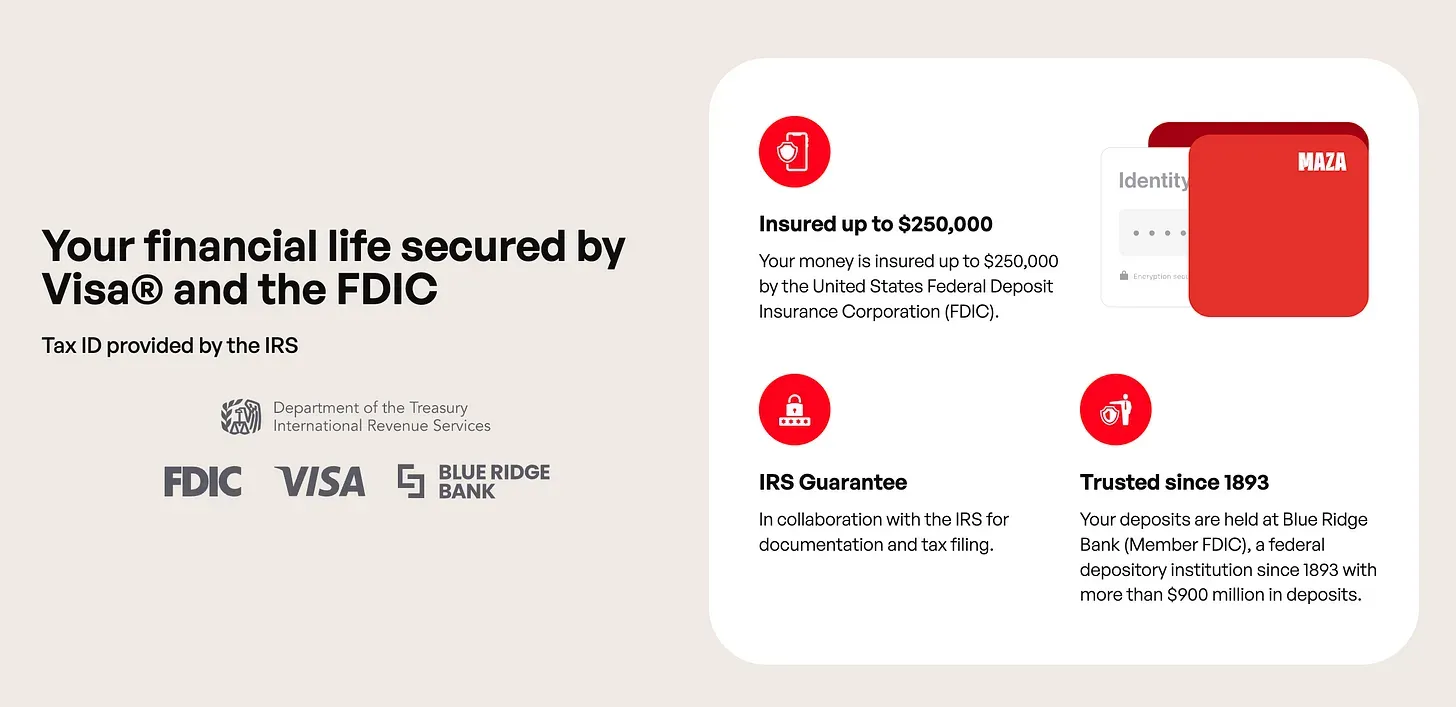
The regulatory exposure here sat with Blue Ridge, the licensed bank behind the product. With a tool like Fintel Check, Blue Ridge could have set rules to flag specific risky language (“hidden fees,” “IRS,” “Department of Treasury”) the moment it appeared, catching the issue and reaching out to Maza before a regulator or journalist did.
Frequently asked questions
What is affiliate marketing compliance?
Affiliate marketing compliance is the practice of ensuring everything your affiliate partners publish about your financial products meets regulatory requirements and your brand’s standards, protecting your reputation, customer trust, and reducing exposure to regulatory fines.
What types of content compliance risks do financial affiliate programs face?
Two main risks: fraudulent affiliates who manipulate tracking or misrepresent their websites, and non-compliant content from legitimate affiliates that unintentionally violates financial regulations due to human error or outdated information. The financial stakes vary widely depending on the scope and duration of the issue, but non-compliance has cost banks, fintechs, and credit unions anywhere from regulatory fines to settlements reaching hundreds of millions of dollars.
What are examples of non-compliant content in financial affiliate marketing?
Common examples include phrases like “no hidden fees” or “banking platform” used without proper context or disclaimers, and failing to clearly disclose the relationship between a fintech and its licensed banking partner.
Can affiliate marketing compliance be managed manually?
Yes, especially for a small, early-stage program. But manual checks, reviewing URLs, taking screenshots, storing records, become unmanageable as the number of affiliate partners grows.
Who is responsible for a fintech’s affiliate content under FTC and banking rules?
The FTC’s Endorsement Guides hold the brand, not just the affiliate, responsible for monitoring and training its affiliate partners. For fintechs specifically, the chartered bank partner typically carries additional regulatory exposure for content published on the fintech’s behalf.
What do credit unions need to know about affiliate advertising rules?
Credit union advertising, including content published by an affiliate on the credit union’s behalf, falls under the NCUA’s Truth in Savings rules (Part 707), which require accurate and clearly disclosed rate and fee information.
What features should a content compliance monitoring tool offer for financial services?
A reliable tool should let you monitor specific URLs rather than every brand mention, apply custom rules, quantify the impact of a violation (traffic and clicks on a non-compliant page), automate screenshot capture and audit trails, and track affiliate content over time.


 English
  Français