
Webinar Recap: What Bank and Credit Union Marketers Get Wrong About ROI (And How to Fix It)

- Last Updated: August 13, 2026
Low cost per lead. High application volume. A clean ROI percentage. On paper, it looks like marketing is working. But the accounts that actually fund, and the deposits that actually grow, often tell a different story entirely.
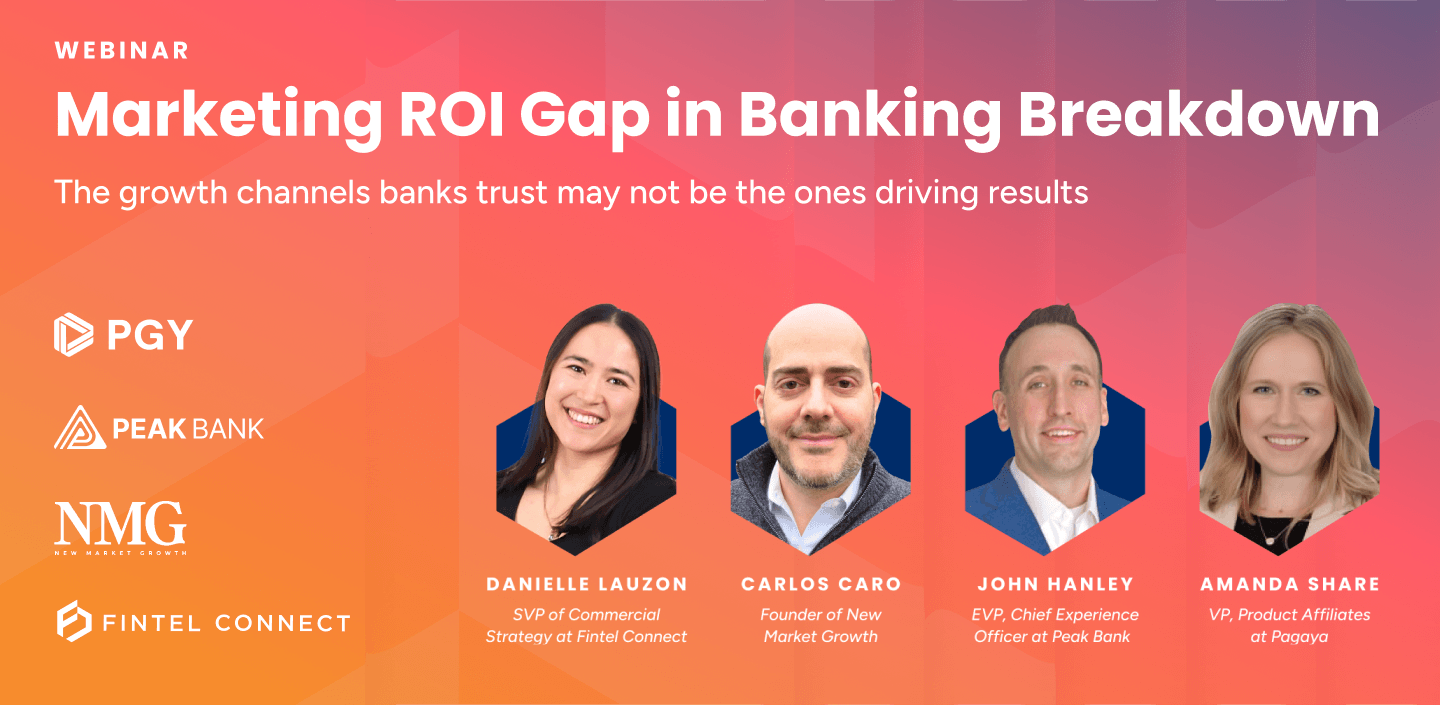
That gap between what dashboards report and what the business actually sees is what our recent conversation with industry experts covered. Danielle Lauzon, Fintel Connect’s SVP of Commercial Strategy, hosted a live discussion on which channels really drive growth, and which signals are worth trusting, with:
- John Hanley, EVP & Chief Marketing Officer, Idaho First Bank/Peak Bank
- Amanda Share, VP of Affiliates, Pagaya
- Carlos Caro, Founder, New Market Growth, and author of The Free Toaster newsletter
Key takeaway: A clean looking metric, whether that’s low CPA, high lead volume, or a strong ROI percentage, can hide a channel that’s quietly destroying value. Financial marketers need to pair every headline number with credit quality, funnel context, and time horizon before they trust it.
Why ROI percentages don’t land with bank leadership
Marketers often boil a campaign down to a single ROI figure, but bank and credit union leadership rarely think in those terms. The panel agreed that CMOs don’t need to present more data. They need to connect the story to what leadership already values.
- A 177% ROI figure means little to a banking executive who thinks in deposit growth, not marketing math
- Different institutions value different outcomes: deposit growth, new customers in the door, or cost per acquisition per end user
- Paid search often gets approved because it’s cheap and easy to greenlight, but it’s frequently the hardest channel to connect to real business outcomes
The fix: ask diligent questions to uncover what leadership actually values, rather than assuming your own metrics to prove success.
The dashboard metrics that can mislead budget decisions
The panelists flagged two commonly “good looking” metrics that can quietly wreck a program if read in isolation.
- Return on ad spend (ROAS): great at optimizing top of funnel volume, but if a campaign isn’t aligned to underwriting or risk criteria, it becomes an expensive trap. Unit economics can turn negative even while lead volume looks strong.
- Cost per acquisition (CPA): pressure to cut CPA at all costs, often from finance or the CFO’s office, is dangerous. Negotiating CPA down changes how an affiliate ranks and places your offer, which can shrink volume and shift audience quality. A loss rate expected at 5% can jump to 8 or 10%.
Carlos recommended that a useful benchmark is to aim for around the 25th percentile of market CPA pricing. Not the cheapest, but not the most expensive either. A better pairing is CPA measured against cost per deposit dollar, so a higher acquisition cost is justified when it brings in larger, longer-term balances.
Because lending outcomes take months or years to mature, any dashboard without credit dimensions (early delinquencies, early losses, model predictions) is incomplete.
“Optimizing for CPA in a vacuum, I think, is really, really dangerous, until you really think about the all in impact of changes like that.” Carlos Caro, Founder, New Market Growth
Lead volume vs. real growth: when a spike should worry you
Both Carlos and Amanda shared real examples of lead volume spikes that looked like wins and weren’t.
A new affiliate publisher paying per lead drove program wide lead volume up 50% to 100% within days, but the leads were shared with 15 other lenders, driving down conversion and quietly becoming the highest CAC, lowest conversion channel once soft credit inquiry costs were factored in.
A different affiliate partner’s overnight volume spike cut approval rates by more than half after the partner changed how they engaged consumers on their own site, with zero changes made on the bank’s side.
The pattern to watch: if lead volume jumps and you can’t immediately explain why, investigate before you celebrate. Stay closely monitored on dashboards by channel and source, especially around unexplained spikes.
“When you see lead volumes blow up on your dashboard and you can’t fully understand why, dig, because usually the story isn’t as rosy as it looks.” Carlos Caro, Founder, New Market Growth
Where performance-based channels help, and where they fall short
Performance channels let CMOs know within days or hours whether creative and messaging landed. But early signals don’t guarantee downstream business results.
In one example John shared, a high-end toaster giveaway tied to new checking accounts produced fantastic top of funnel numbers (an easy sell to leadership, strong lead gen across CTV and paid media) but converted at roughly 100 leads per 1 funded account.
Lesson: leading indicators can look great while the messaging still fails to move consumers far enough outside their expectations to complete the funnel. The real work starts after the campaign lands, translating early engagement into completed applications and funded accounts.
How to spot genuine lead quality
Not all leads, or all batches of 100 leads, are equal. The panel’s advice: understand intention on both sides of the funnel.
- Understand each channel, and each affiliate partner’s own goal. An authenticated login experience signals a different intent than SEO-driven content.
- Watch for artificial surges, such as an affiliate racing to hit an end of quarter budget target.
- Track what happens post application: is the lead fitting your buy box? Is it converting? Are there funnel blockers?
- Predict downstream behavior from top of funnel signals against long term strategic goals, not just against the initial conversion.
Why weak attribution causes teams to over or under invest
The higher up the funnel a channel sits, historically TV, radio, and billboards, and today, YouTube, podcasts, and newsletters, the worse its CAC looks on a dashboard, sometimes appearing infinite because no clean conversion path exists.
Brand building work often makes the bottom of funnel channels look like the hero, when in reality the brand did the hard work of building recognition and trust.
Direct mail is a frequently undervalued channel because it operates as both a branding and a direct response channel at once. Some recipients convert via the mailer directly, others convert weeks later through search or an affiliate site, and that last channel gets full internal credit.
Lenders who demand a clean, linear connection between mail and results often under invest in, or shut down, a channel that still drives billions of dollars in this category every year. In The Marketing ROI Gap report, direct mail rated lowest on average, tied with CTV, across four value attributes. That may reflect this exact attribution and patience gap, rather than the channel’s real value.
Recommendation: compare direct mail lists against who later converts through paid search, social, or affiliates, and assign partial attribution to the mailer.
Does Brand Awareness Get Enough Credit?
The panel’s answer: usually not enough, especially among fintechs, and often among banks too.
Many fintechs invest zero brand dollars outside of direct mail (no TV, no podcasts, no billboards), running a purely arbitrage style model. Banks often resist brand spend because it’s genuinely hard to measure. It can take years to show up in deposit market share or customer surveys.
For early-stage lenders without an established brand, being listed on a trusted platform (Experian, Credit Karma, LendingTree) effectively borrows that platform’s brand trust, a practical way to build credibility before investing in brand independently.
Brands like SoFi succeed by investing heavily in brand and thoughtfully connecting top funnel awareness to downstream performance channels.
“The truth of the matter is, the more you invest in brand, the less you have to spend in affiliate, search, or any other channel.” John Hanley, EVP & CMO, Idaho First Bank / Peak Bank
How to push back when leadership is attached to an underperforming channel
An audience question drew two practical, non-confrontational approaches:
John suggested shifting resources gradually rather than forcing an A/B test. Leave the favored channel alone while quietly testing and building the case for an alternative, then show what those results actually delivered downstream. Keep enough budget available to fund the comparison test without disrupting core acquisition activity.
Carlos said it can be helpful to bring in a different voice, such as an external stakeholder or outside consultant, since the same message often lands differently coming from a board member or consultant than from an internal, subordinate relationship.
Key Takeaways for Financial Marketers
Across every topic, CPA, lead volume, attribution, and brand, the same principle repeated itself: no single metric tells the full story.
- Never evaluate CPA, ROAS, or lead volume in isolation. Pair each with credit quality, funnel context, and time horizon.
- Treat unexplained spikes in lead volume as a signal to investigate, not celebrate.
- Give direct mail and other brand building channels partial attribution credit instead of writing them off for lacking clean, linear results.
- Build the case for brand investment even when it’s hard to measure. It’s often what makes every other channel perform.
- When pushing back on a leadership favored channel, shift resources gradually and bring in outside validation rather than forcing a confrontation.



 English
  Français