
5 Things Forbes Got Exactly Right About CAC (and Why It Matters for Affiliate Marketing)
In this article
Related articles
Customer acquisition cost (CAC) has emerged as one of the most critical KPIs for marketers in financial services today. With rising media costs and heightened scrutiny over budget allocations, knowing how much it costs to bring in a new customer—and whether that spend is efficient—has become non-negotiable.
In a recent Forbes article, Ron Shevlin—Senior Contributor and author of the Fintech Snark Tank on Forbes and one of the top voices in banking and fintech—offered a sharp breakdown of what’s really driving CAC increases. The article featured insights and data from Fintel Connect’s 2025 Cost Per Acquisition Benchmarking Guide and reinforced a growing reality: in today’s environment, it’s not about spending more, but about spending smarter.
If you’re leading customer acquisition at a financial brand, you’re likely asking:
- Are we optimizing CAC by product and channel?
- Are we too reliant on high-cost media like paid search?
- Is there a more predictable, scalable channel we’re overlooking?
This article explores:
- The five key drivers of CAC in financial services
- How affiliate marketing for banks aligns with modern CAC strategy
- Real-world ways to test, benchmark, and optimize CAC across your product lines
- Why lifetime value matters more than acquisition alone—and how affiliate can support both
Want to benchmark your CAC by product and partner type?
Download the 2025 Cost-Per-Acquisition Benchmarking Guide to compare performance across the industry.
Why CAC Demands a Smarter, Not Bigger, Budget
For years, CAC was treated like a tax on growth—a cost you had to accept if you wanted to scale.
But as competition has increased and margins have tightened, especially for financial products with long consideration cycles or heavy regulatory requirements, CAC has taken center stage. Now, marketing, product, and finance teams all have skin in the game.
What we’re seeing at Fintel Connect—and what’s reflected in Ron’s commentary—is a strategic shift in how acquisition is managed. As Ron points out, “too many fintechs think of CAC as a number, when in reality it’s a range—often a wide one—shaped by the product, the channel, and the timing.” The takeaway? To stay efficient and competitive, acquisition strategies need to be just as dynamic as the costs that drive them.
Common mistakes financial institutions make:
- Over-indexing on high-cost channels like paid search without clear attribution or funnel insight
- Measuring CAC based on initial clicks or applications, without tying to downstream events like funding or account usage
- Assuming affiliate is low-scale or low-value, rather than exploring its strategic advantages
With the right structure in place, affiliate marketing in financial services gives you the control and agility to address each of these areas.
Five Core Factors That Directly Impact CAC
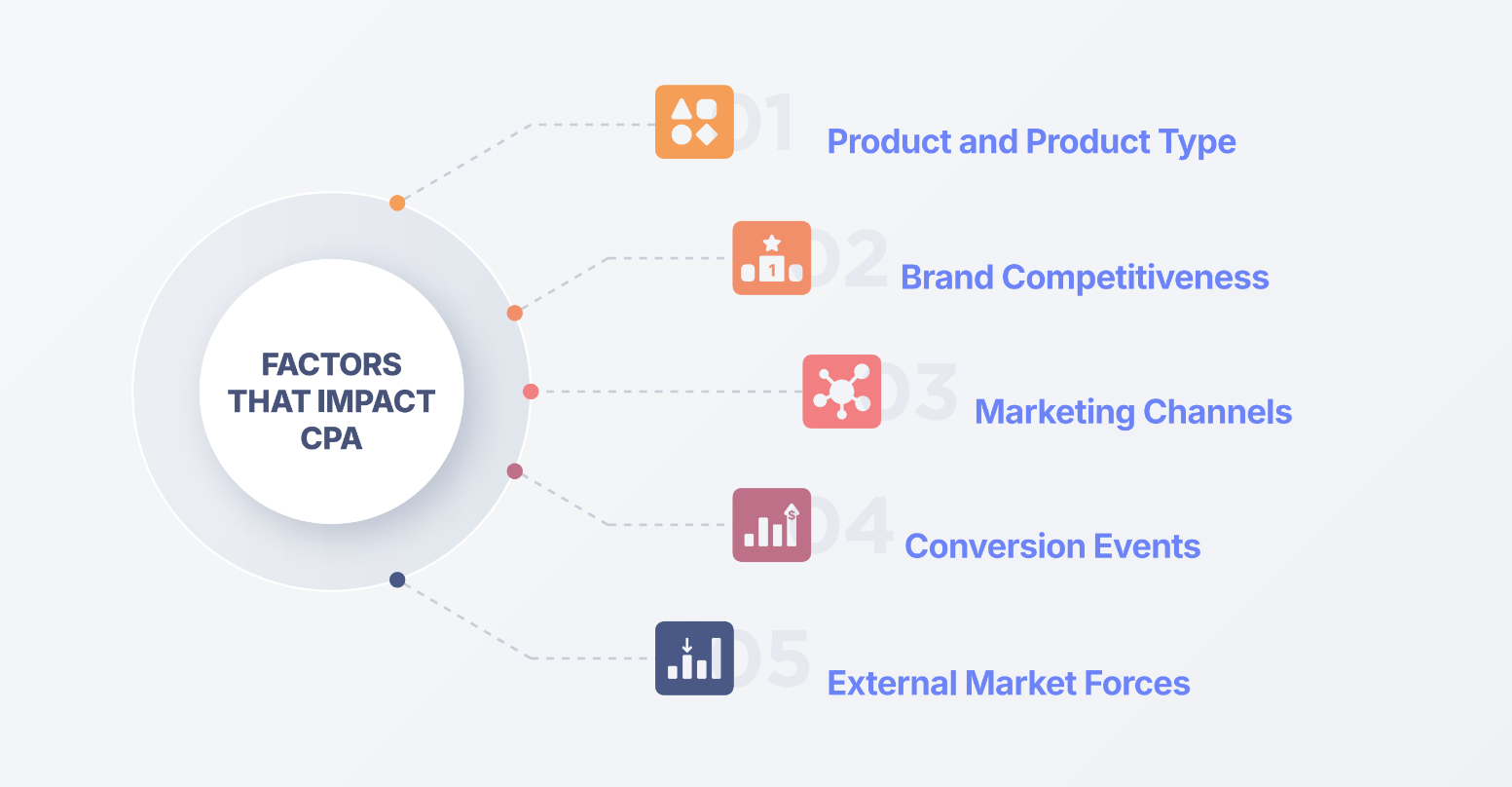
CAC doesn’t exist in a vacuum. If your costs are climbing, it’s likely due to one or more of the following drivers:
- Product complexity: A basic chequing account will convert faster than a business loan product requiring documentation and approval. The more complex the product, the longer the decision cycle—and the higher the acquisition cost.
- Brand recognition: Established brands benefit from trust, reducing the time and touchpoints needed to convert. Challenger brands often need to “borrow” credibility—one area where affiliates like Nerdwallet or Bankrate can be a key asset.
- Channel selection: Not all acquisition channels are created equal. Channels where you pay per impression or click—like display or paid search—come with fixed costs, whether or not they convert. Affiliate flips this model on its head, allowing you to pay only for outcomes.
- Conversion event: If you’re measuring CAC at the email-capture stage, you’ll get a very different picture than if you wait for account funding or card activation. The event you’re optimizing for should reflect real value to your business.
- Market conditions: Seasonality, competitor offers, economic sentiment—these can all swing CAC. Without a diversified, flexible acquisition mix, you’re exposed to sudden spikes.
Why this matters: Understanding these five levers gives you more control. Affiliate marketing is one of the few channels that can adapt across all five.
How Affiliate Marketing Aligns with Modern CAC Strategy
Affiliate marketing is often underestimated—or misunderstood. But when done right, it’s one of the most efficient ways to reduce CAC while maintaining (or even improving) customer quality.
Here’s how affiliate marketing directly supports CAC goals:
- Performance-Based Payouts: Unlike paid media where you pay upfront, affiliate marketing is outcome-based. You only pay when someone takes a defined action, like funding an account, getting approved for a loan, or activating a credit card.
- Built-In Credibility: Content publishers, review sites, and influencers have already built trust with your target audience, especially when you advertise on NerdWallet or other trusted review sites like Bankrate. Their recommendations carry more weight than a banner ad ever could.
- Dynamic Incentive Models: You can set different payout structures by product, partner, or event—funded vs. application, business vs. retail, etc. This means CAC is no longer one-size-fits-all.
- Tracking and Optimization: With integrated tracking, you can monitor CAC by partner, campaign, and even customer segment. This lets you optimize frequently—turning up what’s working and turning down what’s not.
Looking to reduce CAC without sacrificing scale? Partner with an affiliate management agency to get full visibility and control across the entire customer journey. Chat with our team!
Benchmarks Matter—Especially by Product and Partner Type
One of the most common pitfalls in CAC management is treating it as a one-size-fits-all metric. The truth is, not all acquisition costs are created equal—and interpreting them without context can lead to underinvestment in high-performing products or misplaced cuts to valuable campaigns.
Consider this: A $300 CAC for a personal chequing account may feel steep—especially if that account carries low balances and minimal cross-sell potential. But that same $300 CAC for a small business loan customer, who brings in a six-figure balance and requires multiple banking services over time, could be a bargain.
That’s where benchmarking becomes critical.
Why benchmarks matter:
Benchmarks provide a relative, not absolute, measure of efficiency. They help you evaluate CAC against not just internal expectations, but what’s typical and acceptable in the market. Without them, you risk pulling back on campaigns that are actually healthy—or pouring more budget into channels with diminishing returns.
That’s exactly what the 2025 Cost Per Acquisition Benchmarking Guide was designed to solve. It breaks down acquisition cost benchmarks based on:
- Retail vs. business financial products: Retail products (e.g., high-interest savings, personal credit cards) typically have lower CPAs due to simpler application processes and broader appeal. Business products (e.g., commercial loans, business chequing) see higher CPAs, but also drive higher average customer value.
- Conversion events: Whether you’re paying on application, approval, or funding drastically impacts CPA. The deeper the event in the funnel, the more costly it may be—but also the more meaningful the result.
- Partner types: Different affiliates attract different audiences and perform differently depending on the product. Comparison engines might work well for commoditized products, while fintech content creators may be better suited for nuanced offerings.
Key insights from the CPA Guide:
- Search is becoming prohibitively expensive.
Financial terms like “best credit card” or “high-yield savings” are saturated with competitors bidding up CPCs. Even if intent is high, the cost per funded account often doesn’t justify the spend. - Smaller content publishers are punching above their weight.
Highly-targeted partners—such as niche finance bloggers or regional influencers—are delivering strong conversion rates and lower CPAs. These publishers often have loyal, engaged audiences and can drive stronger trust than mass coupon or deal sites. - Business product CPAs are climbing—but so is LTV.
Increased competition and more complex underwriting have pushed up CPAs for business accounts and loans. But when these products are evaluated based on customer stickiness, average balances, and cross-sell, they emerge as some of the most cost-efficient acquisition bets.
What this means for marketers:
Instead of focusing solely on driving CPA down, your goal should be to align CPA with customer value. That means identifying not just the lowest-cost channels, but the most cost-effective ones—based on the long-term revenue those customers deliver.
Pro tip: Use your affiliate channel as a testing ground to fine-tune your CAC benchmarks. Run A/B tests comparing payout models based on different conversion events—for example, application vs. approval vs. funding. Track LTV over time for each cohort to determine where your true CAC efficiency lies.
CAC Is Just the Beginning—Focus on Lifetime Value
Smart teams don’t just optimize for CAC. They optimize for cost-to-value.
Affiliate programs can be a powerful tool here—especially if you integrate partner data with your CRM and analytics stack. You can not only see who’s converting, but who’s staying, engaging, and cross-buying.
In practice:
- High-performing affiliates can be rewarded based on customer retention or balances.
- Cross-sell campaigns can be run through affiliate content—e.g., from chequing to high-yield savings.
- Underperforming partners can be flagged early and optimized or replaced.
The best part? You can track CAC by product, partner, and conversion type—and shift budgets accordingly.
Tip: Use an affiliate marketing tracking software or build a CAC dashboard that overlays partner performance with account-level data. This lets you scale what works and retire what doesn’t—without guesswork.
Affiliate Marketing Is a Strategic Lever, Not Just a Channel
It’s easy to view affiliate marketing as just another line item in your marketing budget—an optional channel to test when things get tight or when leadership asks about diversification.
But the truth is, affiliate marketing is far more than a media tactic. When embedded correctly into your customer acquisition engine, it becomes a strategic lever that aligns marketing, product, finance, and compliance under a common goal: acquiring valuable customers, efficiently and at scale.
The most successful financial brands we work with don’t treat affiliate marketing as a “bolt-on” growth tactic. Instead, they integrate it across functions and use it to support multiple objectives beyond just acquisition volume.
Here’s how forward-thinking institutions are using affiliate marketing strategically:
Launch and test new financial products
Affiliate marketing provides a low-risk, high-speed testing environment. Rather than launching a full-funnel campaign across paid channels, you can use a curated partner set—like fintech content creators or review sites—to test messaging, offers, and value propositions.
For example, launching a new spend account or SMB loan product? Use affiliates to test which product hooks drive the most applications or funded accounts before rolling out your national media campaign. It’s faster, cheaper, and more focused.
Validate messaging and value propositions with real audience feedback
Your partners are closer to your audience than your marketing team might be. Affiliate publishers—especially comparison and review platforms—interact with customers every day, seeing what resonates and what falls flat.
Smart marketers regularly solicit feedback from these partners:
- Are customers responding to the APR or to the cashback benefit?
- Does the signup process feel too long?
- Are there other products audiences are asking for?
This kind of market intelligence can shape not only acquisition strategy, but product development and positioning.
Build credibility and traction for challenger brands
For new or lesser-known institutions, brand recognition is one of the biggest barriers to customer acquisition. Affiliate marketing helps level the playing field.
By partnering with trusted voices—whether that’s NerdWallet, or a niche industry blogger—you can borrow the credibility of the publisher and fast-track consumer trust. It’s especially powerful for fintechs or digital-first institutions entering competitive product categories.
In our work with digital banks and fintech lenders, this credibility boost has led to:
- Increased click-to-application rates
- Higher approval and funding conversions
- More engagement with retargeting efforts downstream
Maintain compliance oversight and reduce brand risk
Unlike traditional media buys, affiliate marketing offers a unique level of control over where and how your brand appears online. That control becomes even more critical in a heavily regulated industry like financial services.
With the right tools in place—such as content monitoring and curated partner lists—you can ensure that:
- Promotions reflect up-to-date interest rates, terms, and disclaimers
- Partners stay within brand guidelines and approved positioning
- Your legal and compliance teams have visibility over every live campaign
At Fintel Connect, we’ve built our platform to give compliance teams direct access to this oversight, while still enabling marketing teams to move at speed. This approach allows brands to scale affiliate marketing programs without compromising on regulatory expectations. Ask us about Fintel Check!
The bottom line?
As CAC continues to rise across traditional digital channels, financial marketers are under pressure to do more with less. Affiliate marketing offers a rare and valuable combination of performance, predictability, and cross-functional value.
Want more control over your CAC in 2025?
Start by benchmarking your current performance. Review your partner mix. And explore how affiliate marketing can give you the flexibility to acquire quality customers—at a cost that makes sense.
Chat with our team to explore how Fintel Connect can help you scale more efficiently.



 English
  Français