
Webinar Recap: How Financial Marketers Can Win in AI-Driven Discovery

- Last Updated: April 10, 2026
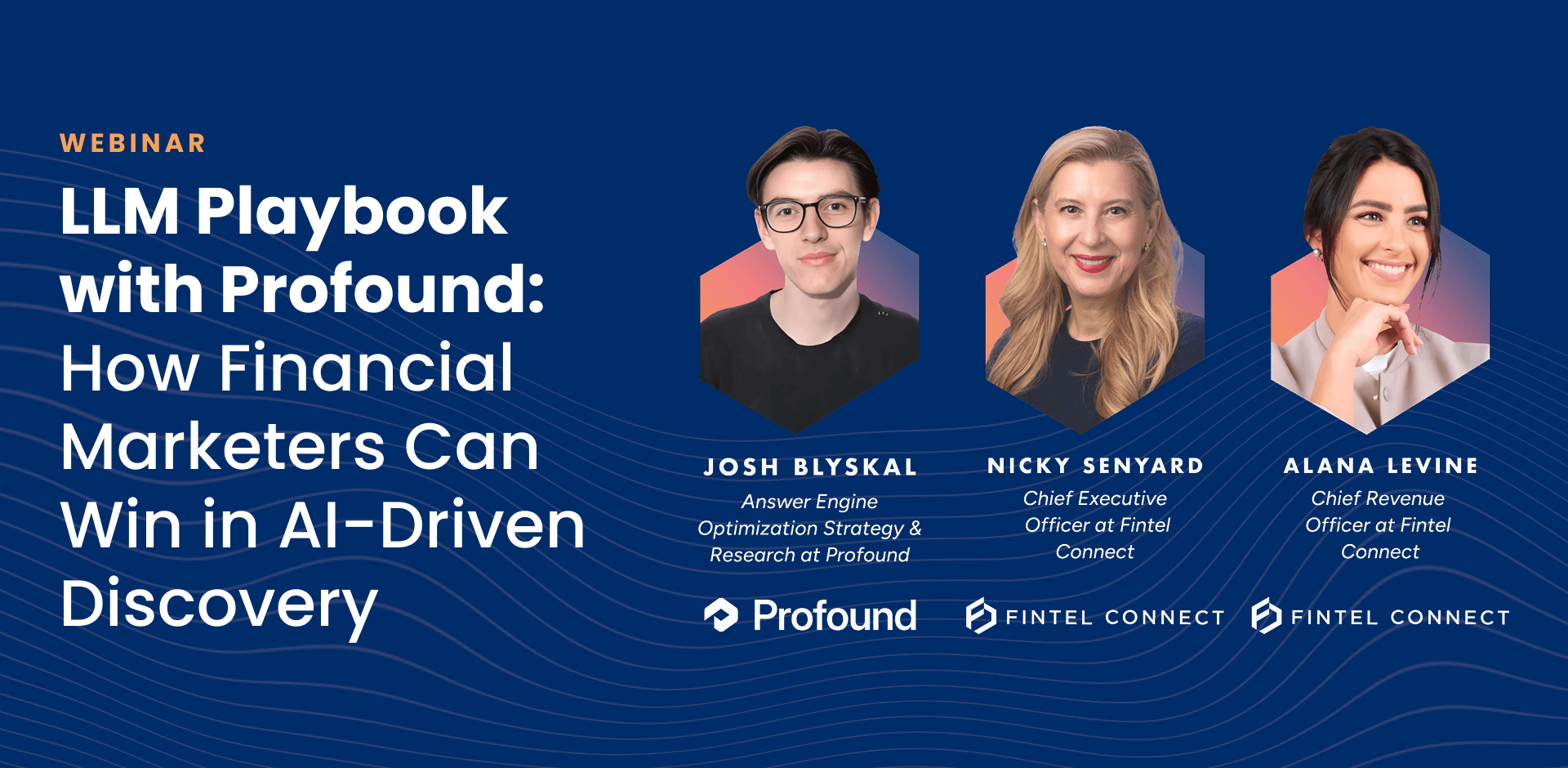
AI is reshaping how consumers find and evaluate financial products and the shift is happening a lot faster than most marketing teams expected. To help marketers adapt to this change, Fintel Connect hosted a live discussion with:
- Josh Blyskal, Head of AI Strategy at Profound
- Nicky Senyard, CEO and Co-Founder at Fintel Connect
- Alana Levine, CRO at Fintel Connect
Drawing from millions of prompts analyzed by Profound’s platform, Josh shared data-backed insights into how large language models (LLMs) choose which brands to highlight. They also discussed the rising influence of affiliates in LLM answers and what financial brands can do today to stay visible in AI-driven search.
How LLMs Source and Rank Financial Content
Consumers are increasingly starting their product research in AI tools rather than traditional search. As Josh explained, models like ChatGPT and Gemini are not only summarizing the web, they are becoming a primary channel for financial product discovery.
How AI Search Engines Collect Information
Profound analyzes millions of queries every day across leading AI search engines, including ChatGPT, Google AI Overviews, and Gemini to show brands how they appear in AI searches and which sources influence that visibility. The platform gives marketers the data they need to take action and it is already used by some of the world’s largest brands. Some of the key data that Profound shares to help guide brands include showing which sources the LLMs site, which content types drive visibility, and how often crawl a site.
Josh walked through how Profound evaluates LLM behavior, sharing three core datasets the platform analyzes:
- Answer Engine Insights: the model’s outputs generated when the team asks a question and evaluates the response
- Prompt Volumes: the questions consumers are asking
- Agent Analytics: how often LLMs visit and crawl a website, showing which pages they access and how they move through the site
What Signals Determine Brand Visibility in LLMs
Together, the datasets reveal patterns in how models present brands. Several factors matter most:
- Citations: the source links an AI platform uses to build its answer
- Semantic URLs: clear and descriptive page paths
- Title tags and meta descriptions: aligned with the question being asked
- Freshness: recent content that reflects current product details
Freshness plays a larger role than many people expect. LLMs increasingly favor up-to-date information, which means long-static financial product pages may no longer be enough to maintain visibility.
Check out our latest report, Competing for Visibility in the Age of AI to get actionable strategies financial brands can use to strengthen your visibility in AI-driven search.
Why Affiliates Are Critical to AI Search Visibility
“Literally, the more technical the product, the more affiliates matter. Because Nerdwallet is ‘AI-ready’, they often get cited.”
— Josh Blyskal
Affiliates play an increasingly important role in AI-driven search because their content is structured, data-rich, and easy for models to interpret. As Josh explained, the more complex a product is, the more essential accurate, detailed content becomes.
Why Affiliates Matter in AI Search
- LLMs rely on structured comparisons. Affiliates create clear side-by-side reviews that help models explain features, trade-offs, and requirements.
- Complex products require more detail. As product complexity increases, LLMs lean more heavily on publishers with deep, accurate content.
- Affiliates influence visibility. They often supply the content that drives an LLM’s recommendation.
Based on Profound’s platform data, around 30–60% of citations on average in many product categories come from affiliates, not brand websites. This aligns with what we see in the financial sector where publishers often provide the detailed comparisons LLMs rely on.
Key Findings About Affiliate Influence
- Consistency matters. If rates, rewards, or product terms differ across publishers, models may treat the brand as unreliable.
- Brands can guide content. Sharing structured briefs or data-driven insights with affiliates can help ensure content is accurate and LLM-friendly.
- Affiliates excel at technical content. The more complex the product, the more LLMs lean on sources that break down details clearly.
Measuring Impact: The “Halo Effect”
Tools like Profound make it possible to measure the “Halo effect”, meaning how often affiliate pages help a brand show up in AI answers, even if the consumer never visits the affiliate page itself.
The Citation Signal Financial Marketers Can’t Ignore
“There’s a better determinant of your actual performance in AI search, which is the citation. This sourcing has really started to take the form of what clicks will be in the future.”
— Josh Blyskal
What LLM Citations Are and How They Work
Based on what Profound is seeing across AI search engines, Josh highlighted that citations are the one signal that now plays a central role in visibility. A citation is the source an LLM uses to build its answer. When a model scans the web, it selects specific pages and displays them as small source tags beneath the response, and these tags show which sites the model trusts.
Why Citations Matter in AI Search
AI-driven discovery is becoming a zero-click environment, meaning consumers get the information they need directly inside tools like ChatGPT or Google AI Overviews. Citations now function as the model’s version of a click, often called a “bot click,” showing which sites the LLM relies on to inform its recommendation.
They indicate:
- Which sites the model relied on
- Which brands appear most often in answers
- Which sources shape consumer understanding early in the journey
Why Citation Frequency Matters for Financial Brands
Financial brands that appear consistently in citations:
- Gain early visibility and consideration
- Are more likely to be included in recommendation-style answers
- Build trust signals within the model’s evaluation process
Brands that are missing from these trusted sources risk losing visibility long before a consumer reaches their website.
What Content Performs Well in LLM Search
While SEO fundamentals still apply, content for LLM discovery has its own requirements. Josh explained that creating content for LLMs is like doing different workouts for the same muscle group. The core elements like URLs, on-page copy, schema, and FAQs remain the same, but LLMs use and prioritize them differently.
Content Formats LLMs Prefer
- Listicles and comparison tables: because they provide structured, comprehensive views of a category
- FAQs: because they map closely to natural-language questions
- Data-forward content: clear, specific product details that are easy for models to extract
Accuracy is essential. LLMs might pull up any outdated or inconsistent information about a product, so ensuring alignment across all content sources, including affiliates, is critical.
Do LLMs Strategies Complement or Contradict Organic Search?
LLM strategies complement organic search, they don’t replace it. As Josh emphasized, SEO remains the foundation because both search engines and LLMs rely on strong structure, clear content, and accurate data. The difference is to use SEO best practices and applying them with greater precision to match the unique ways LLMs evaluate and cite content.
How LLMs Build on SEO
- SEO is still important. LLMs draw on the same core elements: structure, clarity, and trustworthy information.
- LLMs use SEO signals differently. They interpret URLs, on-page content, schema, and FAQs in more specific ways to answer natural-language questions.
- Content quality matters even more. Models favor comprehensive, data-rich pages that are easy to interpret and cite.
- User experience influences visibility. If your content supports a clear, accurate answer, LLMs are more likely to display it.
How Smaller Financial Institutions Can Improve AI Visibility
Not every organization has an SEO engineering team or resources like larger banks. Josh emphasized that smaller financial institutions can still make meaningful progress by focusing on three actions:
- Publish structured content regularly. Even a few strong listicles or product explainers can move visibility within weeks.
- Review affiliate placements for accuracy. Align data across all sources where your products appear so models pick up consistent information.
- Start testing. Simple prompts and manual tracking can reveal early visibility patterns before investing in advanced tools.
Many changes can often begin to appear within one to two weeks, making this a flexible way to learn and iterate.
What’s Ahead for AI, Commerce, and Financial Services
The conversation closed with a look at what the next two to three years may bring. Josh predicts:
- Commerce integrations, where LLMs connect directly to financial product APIs
- An eventual ads model, similar to search, but adapted for conversational interfaces
- Greater accuracy expectations, especially in regulated industries
His core advice for financial marketers:
Make accuracy your first priority. Consumers are already making decisions based on AI-generated guidance, and LLMs will only become more influential. Ensuring product information is correct, current, and consistent across every source is essential.
Check out, Competing for Visibility in the Age of AI for guidance on improving your visibility in AI search.
Continue Exploring AI Visibility
Contact us to explore how affiliates can support your customer acquisition strategy.



 English
  Français