
How Frugal Flyer Drove a 285% Increase in Credit Card Approvals Through Trusted Publisher Content

- Last Updated: June 17, 2026
In this article
Related articles
Most financial institutions trying to grow their credit card portfolios are fighting for the same real estate: paid search, display advertising, direct mail, and rate comparison sites. These channels can work, but they are expensive, heavily competed, and increasingly difficult to differentiate in.
Frugal Flyer took a different route—and the results speak for themselves.
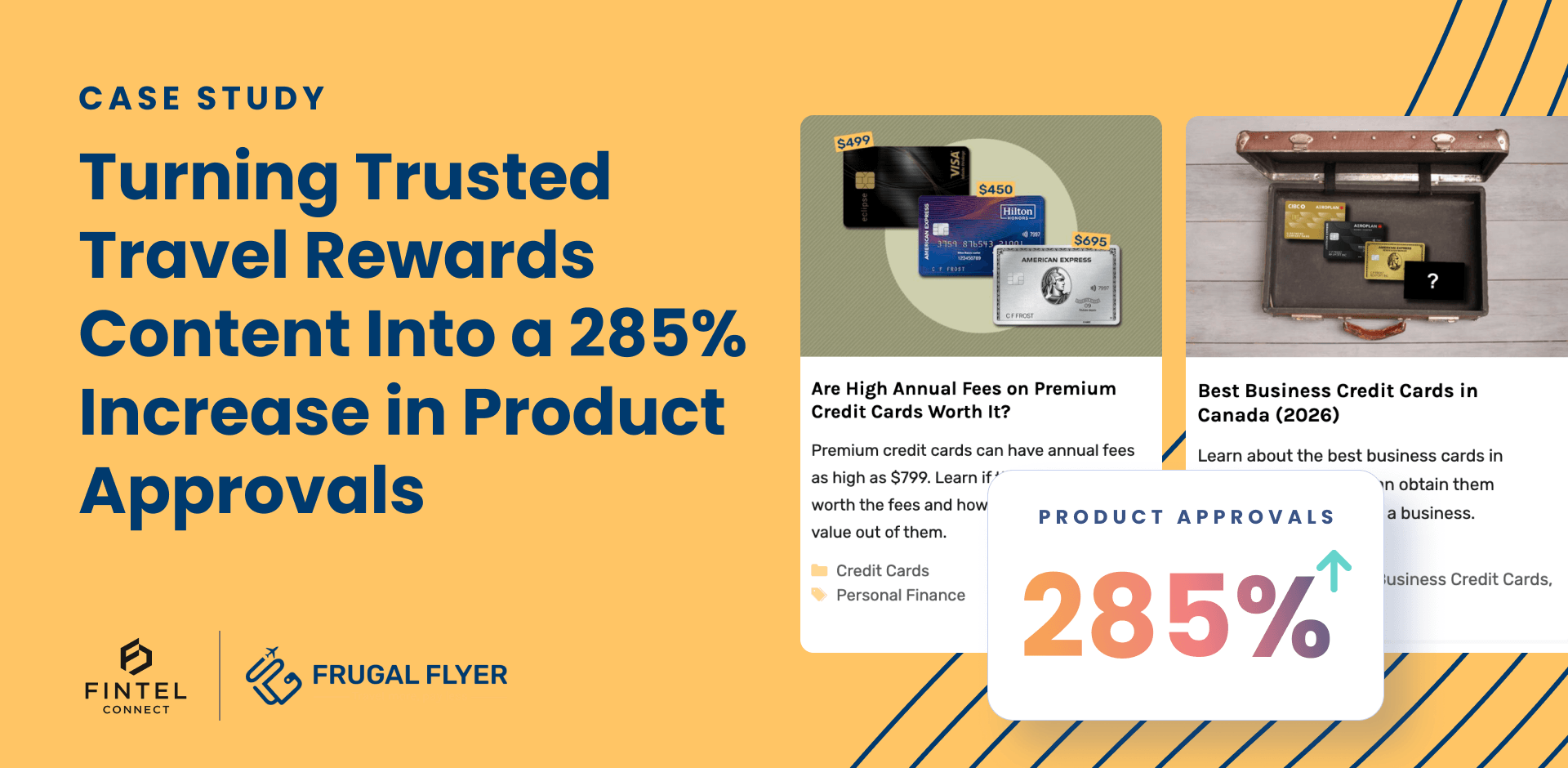
Between 2023 and 2024, Frugal Flyer delivered a 285% year-over-year increase in credit card approvals across participating financial institutions. The following year, that momentum continued with an additional 20% increase. A targeted promotional campaign using their FlyerFunds rebate program drove a further 74% spike in approvals for a single travel rewards card during a short promotional window.
These are not the numbers you typically see from a single publisher. They are the numbers you see when a publisher has built genuine audience trust, a sophisticated content strategy, and a conversion model that moves high-intent consumers from research to application.
This case study breaks down exactly how Frugal Flyer built that model, what made it work, and what financial institutions can take from it when thinking about how to structure their own publisher partnerships.
About Frugal Flyer
Frugal Flyer is one of Canada’s leading resources for travelers, points enthusiasts, and rewards-focused consumers. The platform covers travel credit cards, loyalty programs, airline and hotel rewards, points optimization strategies, and personal finance—helping readers understand how to get more value from the financial products they already hold or are considering.
Content spans detailed editorial reviews, product comparison guides, practical redemption walkthroughs, and podcast content. The team behind Frugal Flyer, led by Josh Bandura and Reed Sutton, has built a platform known for depth, accuracy, and a genuine focus on reader value over affiliate revenue maximization.
That distinction matters. The Frugal Flyer audience is not general consumer traffic. It is made up of active travelers with strong personal finance habits and above-average household income—consumers who are actively engaged with financial products, understand the value of rewards programs, and make deliberate product decisions. For financial institutions focused on credit card customer acquisition, this represents exactly the kind of high-intent, pre-qualified audience that is difficult and expensive to reach through traditional paid channels.
Frugal Flyer’s partnership with Fintel Connect has been ongoing, giving both the publisher and participating financial institutions the stability and data continuity needed to build and optimize long-term acquisition performance.
The challenge: How do you stand out in a crowded travel credit card market?
Travel rewards credit cards are among the most competitive financial products in the market. Issuers are competing on welcome bonuses, earn rates, annual fee value propositions, travel benefits, lounge access, and more—often with products that look similar on the surface but differ meaningfully in the details.
For consumers, this complexity is genuinely difficult to navigate. A consumer trying to choose between two premium travel cards might be weighing a higher welcome bonus on one card against a better long-term earn rate on another, or comparing insurance benefits that are hard to assess without spending hours reading the fine print. That decision-making process often stalls—not because the consumer is not interested, but because they do not have a clear, trustworthy guide to help them act.
For financial institutions, this creates a two-sided problem. First, even strong products can fail to convert if they are not explained clearly and positioned helpfully. Second, many acquisition channels do not reach consumers at the moment they are actively making a decision—they interrupt consumers earlier in the funnel or target based on demographics rather than intent.
Frugal Flyer recognized this gap and built a platform specifically designed to close it: trusted, detailed editorial guidance that helps consumers make confident decisions at the exact point they are ready to act.
The strategy: Education first, conversion second
Frugal Flyer’s acquisition model is built on a deceptively simple premise: help readers make better decisions before they ever see an application link. By doing that consistently and well, the conversion follows naturally.
The strategy breaks down into three interconnected pillars.
Pillar 1 — Gap-led content that captures high-intent search demand
Frugal Flyer’s editorial team does not simply cover what everyone else is covering. They take a systematic approach to identifying content gaps—places where competitor coverage is thin, where consumer questions are going unanswered, or where the existing content in the market is outdated or unclear.
This gap-led approach means that when Frugal Flyer publishes on a topic, they are often one of the first authoritative sources available. That early-mover advantage compounds over time through organic search rankings and reader trust built before competitors catch up.
Search intent is central to how content topics are selected. The goal is not to attract page views—it is to bring in readers who are actively researching a specific financial product and are more likely to convert once they land on the site. A reader searching for the best travel credit card for Air Canada points is significantly more valuable than a general finance reader, and Frugal Flyer’s content strategy is built to capture that specific demand at scale.
The team also invests heavily in keeping existing content current. When a card launches new benefits, when a promotional offer changes, or when a competitor product shifts the competitive landscape, Frugal Flyer updates relevant articles quickly. This combination of new content creation and ongoing content maintenance is what keeps organic search rankings strong over time—and what makes Frugal Flyer’s traffic consistently high-intent rather than incidentally relevant.
This is exactly what effective affiliate marketing for banks looks like in practice. Rather than paying for impressions or clicks that may or may not reach in-market consumers, financial institutions earn placement within trusted editorial content at the exact moment a consumer is comparing products and ready to make a decision.
Pillar 2 — FlyerFunds: A rebate program that turns research into action
Content alone can build trust and drive consideration. But Frugal Flyer layered in a second mechanism to accelerate conversion: FlyerFunds, a consumer rebate program that rewards eligible readers for approved applications on select credit cards and banking products.
FlyerFunds is a meaningful differentiator in the publisher landscape. Most travel and finance publishers can offer editorial context—a review, a comparison, a recommendation. Frugal Flyer can offer all of that, plus a tangible financial incentive for readers who apply through their platform. For a consumer who has already done their research and is weighing their final decision, a cash rebate on an approved application can be the nudge that drives them to act now rather than later.
For financial institutions, FlyerFunds creates a mechanism to increase campaign urgency without having to change the underlying product offer. The rebate sits at the publisher level, meaning financial institutions benefit from improved conversion performance without needing to alter their card terms or welcome bonus structures.
The results from FlyerFunds campaigns validate the model clearly. During a short promotional window for one major travel rewards credit card, Frugal Flyer introduced a FlyerFunds rebate offer and saw approvals increase by 74% compared to the card’s baseline performance earlier in the year. That kind of uplift from a single incentive layer—on top of already-strong editorial performance—shows how well the two mechanisms work together.
Pillar 3 — Integrated campaign execution across multiple touchpoints
When a participating financial institution runs a priority campaign or limited-time offer through Frugal Flyer, the team does not rely on a single placement to drive results. Offers are integrated across relevant editorial guides, dedicated product pages, comparison content, and promotional features—ensuring that readers encounter the offer at multiple points in their research journey.
A reader who discovers Frugal Flyer through a search for travel credit card reviews might first encounter a financial institution’s card within a comparison guide. They might then see it featured on a dedicated card review page. If they are return visitors, they may see it highlighted in a promotional context when a limited-time offer is active. And if FlyerFunds is live on the card, they will see that incentive layered in wherever the card appears.
This integrated approach gives financial institutions something that a single sponsored placement cannot: coordinated campaign visibility that reaches consumers across multiple intent signals and research stages. The result is stronger top-of-funnel awareness, better mid-funnel education, and higher bottom-of-funnel conversion—all through a single publisher relationship.
Answer Engine Optimization: Staying relevant as search evolves
One dimension of Frugal Flyer’s strategy worth examining separately is how they are approaching the shift toward AI-powered search and answer engines.
As tools like AI-powered search summaries, conversational search interfaces, and large language model-based assistants become more common, the way consumers discover financial products is changing. Traditional blue-link search results are being supplemented—and in some cases replaced—by direct answers pulled from trusted editorial sources.
Frugal Flyer’s approach to answer engine optimization (AEO) has remained grounded in the same principle that drives their broader content strategy: create genuinely useful content that naturally answers the questions consumers are asking. Rather than optimizing for a particular algorithm or format, Frugal Flyer focuses on being the most thorough, accurate, and helpful resource on the topics their audience cares about.
This approach positions Frugal Flyer well for the evolving search landscape. Content that earns trust from human readers tends to earn trust from AI systems trained to surface authoritative sources—which means the investment Frugal Flyer has made in editorial quality has compounding value as discovery channels continue to shift.
For financial institutions thinking about where to invest in affiliate marketing for banks, this is a meaningful consideration. Publishers who are building for long-term authority and reader trust are more likely to maintain visibility as search evolves than those optimized purely for short-term algorithmic gains.
The results at a glance
- 285% year-over-year increase in product approvals across participating financial institutions (2023–2024)
- 20% year-over-year increase in product approvals the following period (2024–2025)
- 74% increase in approvals for one major travel rewards credit card during a FlyerFunds promotional window
- Sustained growth across multiple financial institution partners, reflecting both audience expansion and improving conversion performance
“Fintel Connect doesn’t just connect us with financial institutions, they help us build real partnerships. That support has been instrumental in our growth, and it shows in the results.”
— Josh Bandura and Reed Sutton, Frugal Flyer
Why these results are reproducible—and what made them happen
The Frugal Flyer results are not a one-off. They reflect a set of strategic decisions that are replicable—both for publishers looking to improve their performance and for financial institutions building out their publisher programs.
Audience trust built long before the conversion moment
Frugal Flyer earns reader trust through education, not promotion. Readers come to the platform to learn—about how rewards programs work, how to compare card value, how to maximize redemptions, how to evaluate annual fees against real-world benefits. By the time a reader encounters an application link, they have already spent meaningful time with content that has helped them. That pre-built trust is what makes conversion rates meaningfully higher on editorial placements than on interruptive ad formats.
High-intent audience alignment with financial institution goals
Not all traffic is equal. Frugal Flyer’s audience is composed of consumers who are already engaged with credit cards, travel rewards, loyalty programs, and personal finance. That natural alignment between audience interest and financial institution products means a higher proportion of readers are genuinely in-market—which directly improves approval rates and customer quality.
A clear publisher differentiation that adds consumer value
Frugal Flyer’s combination of travel and personal finance content with FlyerFunds rebates creates a value proposition that most publishers cannot match. Readers get expert guidance and a financial incentive in the same place—which makes the platform stickier, drives return visits, and increases the likelihood that readers choose to apply through Frugal Flyer rather than going directly to a card issuer after doing their research elsewhere.
Consistent content optimization over time
The team at Frugal Flyer treats content as a long-term asset, not a one-time deliverable. Older articles are regularly refreshed, internal linking is continually improved, and site structure is optimized to create a stronger overall reader experience. This ongoing investment is what sustains organic search performance over time and keeps content relevant even as market conditions and competitive dynamics change.
Reliable tracking and performance visibility
Underpinning all of this is the infrastructure that makes it measurable. Through the Fintel Connect platform, both Frugal Flyer and participating financial institutions have clear visibility into performance data—which campaigns are converting, which content placements are driving the most approvals, and where optimization opportunities exist. That tracking reliability is what allows both sides of the partnership to make data-driven decisions and improve performance over successive campaigns.
What financial institutions can learn from the frugal flyer model
The Frugal Flyer case study carries a broader message for financial institutions thinking about how to structure their affiliate and publisher programs.
Credit card customer acquisition is increasingly competitive, and consumers are more informed and deliberate than ever. Reaching them requires more than presence in the right channels—it requires appearing in the right context, at the right moment, with the right message delivered by a voice they already trust.
Specialized publishers like Frugal Flyer create that context. They sit closer to the consumer’s decision-making process than almost any traditional paid channel, and they do so with editorial credibility that paid placements cannot replicate.
But this only works when the publisher has the right conditions to perform. The strongest results happen when financial institutions treat publisher partnerships as strategic acquisition channels and provide the ingredients publishers need to convert high-intent audiences:
- Clear and competitive product positioning that gives publishers something compelling to explain and recommend
- Timely access to offers and promotional windows so publishers can build campaigns around priority periods
- Reliable tracking and attribution so both sides can measure performance and optimize with confidence
- Ongoing communication and partnership so publishers understand what financial institutions need and can align their content strategy accordingly
- Flexibility to test incentive structures—like FlyerFunds—that give consumers a clear reason to act through the publisher rather than going direct
Financial institutions that approach publisher relationships this way—as strategic partnerships rather than one-off placements—are the ones seeing the kinds of results Frugal Flyer has delivered. And the compounding nature of trust-based content means those results tend to grow over time rather than plateau.
The Role Fintel Connect Plays
The Frugal Flyer partnership operates through the Fintel Connect platform—and the infrastructure Fintel Connect provides is a meaningful part of why it works at scale.
Fintel Connect is the only affiliate platform and agency purpose-built for financial institutions. That means compliance controls are built into the platform, publisher vetting is designed specifically for the regulatory requirements of financial services, and the tracking and attribution tools are built to handle the complexity of financial product acquisition—funded accounts, approved applications, specific conversion events—rather than generic e-commerce metrics.
For publishers like Frugal Flyer, Fintel Connect provides reliable tracking, payment infrastructure, and campaign management support that lets them focus on content quality rather than operational complexity. For financial institutions, it means they can build publisher programs with confidence that compliance requirements are met, performance data is accurate, and the publisher network they are accessing has been vetted for quality and brand safety.
Ready to build publisher partnerships that drive measurable growth?
Frugal Flyer’s results demonstrate what becomes possible when the right publisher, the right platform, and the right financial institution products come together. A 285% increase in approvals is not a lucky outcome—it is the result of a deliberate strategy executed well over time, supported by infrastructure that makes performance measurable and optimization possible.
If you are a financial institution looking to build or scale a publisher program that delivers this kind of acquisition performance, the full Frugal Flyer case study walks through the complete picture—including the specific tactics, campaign structures, and partnership dynamics that drove the results.



 English
  Français