
Webinar recap: How financial institutions can make smarter customer acquisition decisions in 2027

- Last Updated: August 13, 2026
A low cost per acquisition can look like a win. But if the customers acquired through that channel have weaker long-term value, higher delinquency, or would have converted elsewhere anyway, the economics can tell a very different story.
That was the focus of our recent discussion on how financial institutions can evaluate acquisition more effectively as competition increases, customer behavior changes, and AI adds another layer to attribution.
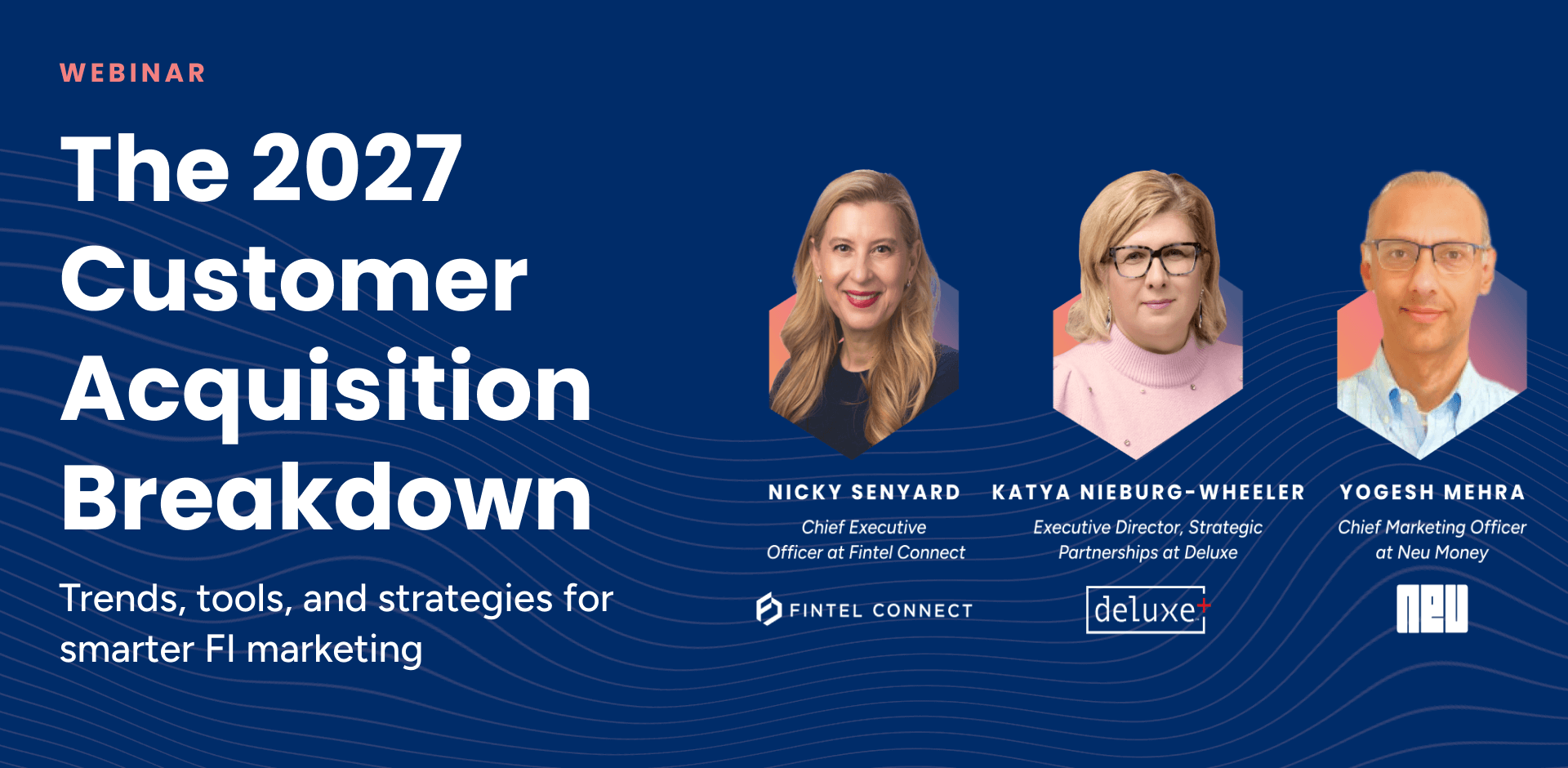
Fintel Connect CEO Nicky Senyard hosted the conversation with:
- Katya Nieburg-Wheeler, Executive Director, Strategic Partnerships at Deluxe
- Yogesh Mehra, Chief Marketing Officer at Neu Money
Key takeaway: CPA is a starting point, not the final measure of acquisition performance. Financial institutions need to consider customer value, payback period, incrementality, attribution, and the wider influence each channel has across the customer journey.
Why customer acquisition is getting more competitive
Financial marketing has changed significantly over the last 10 to 15 years.
Katya pointed to three shifts that have narrowed the gap between institutions:
- Marketing technology and optimization tools are more accessible
- Fintech growth has introduced more products and competition
- Consumers have more information and higher expectations
That makes differentiation harder. Financial institutions need stronger data to identify the right audiences and reach them when it matters.
Nicky added that this evolution has also created the conditions for channels like affiliate marketing to grow. More consumers are comfortable researching and choosing financial products online, while affiliates often have a strong understanding of where audience demand is moving.
The implication for marketers: access to channels is no longer the main differentiator. How effectively you use data, targeting, and timing increasingly determines performance.
Why growth discipline is back
Yogesh highlighted a clear shift away from the “growth at all costs” mindset that shaped parts of the startup market.
Marketing leaders are asking more disciplined questions:
- Is the channel producing the economics we expected?
- What return are we generating?
- Is the growth incremental?
- How does the investment affect the overall P&L?
AI adoption is another major focus. Yogesh expects the institutions that embed AI into workflows and systems, rather than using it only for isolated tasks, to create greater operating efficiency and speed.
The common thread is discipline. New technology can create opportunities, but acquisition still has to support the economics of the business.
Why rising CPA doesn’t automatically mean weaker performance
Fintel Connect’s latest financial affiliate CPA benchmarking data and insights shows CPAs rising gradually across many U.S. financial product categories as competition increases.
The discussion followed the release of and explored what financial marketers need to consider beyond the headline CPA. Katya explained why that headline number needs context. More fintechs, more product choices, and higher acquisition costs are putting pressure on financial institutions. At the same time, some products are taking longer to generate a return.
Credit cards are one example. Katya noted that the payback period that may once have been around 18 months can now stretch into years once acquisition incentives, operating costs, and competitive pressures are considered. That makes the objective behind the campaign critical.
Before evaluating CPA, ask:
- Are you optimizing for short term or long-term growth?
- What customer behavior creates value for the institution?
- How quickly does the investment need to pay back?
- What type of customer does each channel produce?
A more expensive channel may still create better economics if it brings in customers with greater long-term value.
What financial marketers should measure beyond CPA
Yogesh described CPA as “just the starting of the journey.” When evaluating acquisition, he focuses on three broader areas.
1. Customer economics
Look beyond the acquisition event at what happens afterward:
- Return on investment
- Delinquency
- Payback period
- Longer term customer performance
2. Incrementality
Ask whether the channel created a customer you would not otherwise have acquired.
A useful question is: Could we have acquired this same customer at better economics through another channel?
The answer can materially change how you allocate budget.
3. Strategic compounding
Some channels create value beyond their directly attributed conversions.
Yogesh used affiliate visibility as an example. A consumer may see Neu Money alongside established card issuers on an affiliate site, remember the brand, and search for it later. That exposure can increase branded search, awareness, and consideration even when the affiliate does not receive the final conversion credit.
Nicky refers to this wider influence as the halo effect.
Why paying a higher CPA can create better economics
One of the clearest examples from the session challenged the assumption that lower acquisition costs always mean better performance.
Yogesh shared an example where an underperforming channel was not cut. Instead, the team changed the audience selection and ultimately paid approximately 20% more in CPA.
The result was a stronger customer mix and the higher upfront cost was offset by better downstream customer value, making the channel more economically attractive than before.
The lesson: reducing CPA is not always the right optimization. Sometimes the better decision is to pay more for the customers who create greater value.
How to diagnose an underperforming acquisition channel
When a channel underperforms, Yogesh’s first response is not automatically to cut it. Start by identifying the root cause.
Common problems include:
- Funnel leakage: customers are dropping out before conversion
- Weak messaging: the offer is not resonating with the audience
- Poor audience selection: the channel is reaching customers who are less likely to perform
- Placement issues: the offer is appearing in a context that produces weaker customers
- Product weakness: the value proposition itself is not competitive enough
Once the problem is clear, change the relevant variable and give the channel enough time to prove whether the fix worked.
For credit cards, Yogesh noted that this may mean waiting around 90 days to evaluate payment behavior after changing audience selection. Other financial products will require different evaluation periods.
Nicky compared the process to a data science experiment: form a hypothesis, change a variable, observe the result, and continue refining.
Recommendation: diagnose before you cut. A weak headline metric may be the symptom, not the underlying problem.
Why last-click attribution tells only part of the story
The panel repeatedly returned to one challenge: channels don’t operate independently.
A consumer may receive direct mail, see an email, research a product through an affiliate, and later convert through Google. Last click attribution gives the final channel the credit, even though several touchpoints helped create the outcome.
Katya recommended looking at channels more holistically through disciplined testing and control groups.
Depending on the campaign, a channel may act as:
- The primary acquisition channel
- A supporting channel
- A validation point
- A halo channel that strengthens another channel’s performance
This is why an apparently expensive channel should not automatically be dismissed. In combination with other channels, it may be creating incremental value that last click attribution misses.
“The potential mistake in general is to think that each channel has to stand on its own.” — Katya Nieburg-Wheeler, Deluxe
How AI is making attribution even harder
AI search adds another layer to an already complex customer journey.
A consumer might discover a financial brand through an AI answer, see the brand mentioned by an affiliate, and later search for it directly on Google. Traditional attribution may credit Google even though the earlier AI or affiliate exposure created the demand.
Nicky noted that new AI visibility tools are making part of this halo effect easier to measure by showing:
- How often a brand appears in AI answers
- How often it is cited
- How its visibility compares with competitors
Yogesh recommended adding this type of measurement to the marketing analytics stack and paying closer attention to how channels interact.
For affiliates in particular, this may reveal value that traditional attribution understates.
A consumer who sees a brand on an affiliate site and converts later through another channel may still have entered the consideration set because of that affiliate exposure.
What smaller financial institutions can do first
Smaller financial institutions may not have the internal teams or technology resources of national banks, but the panel identified several practical starting points.
1. Strengthen your own funnel first
Nicky recommended making sure your website, paid media, content, messaging, and conversion journey are working before adding more external acquisition channels.
2. Use data to narrow your audience
Katya recommended focusing limited resources on the customer segments most likely to create value rather than trying to reach everyone.
3. Bring in specialist partners where needed
External expertise can help smaller teams fill gaps in analytics, execution, or specific channels without building every capability internally.
4. Test with discipline
Use control groups and incrementality testing where possible to understand what each channel is actually adding.
Key takeaways for financial marketers
The conversation reinforced that customer acquisition performance can’t be reduced to one number.
- Treat CPA as the beginning of the analysis, not the final answer
- Evaluate acquisition against ROI, payback period, customer quality, and long-term value
- Test incrementality to understand whether a channel is creating genuinely new growth
- Don’t assume a lower CPA produces better economics
- Diagnose underperformance before cutting a channel
- Evaluate channels together, not only through last click attribution
- Account for the halo effect created by affiliates, AI visibility, and other upper funnel touchpoints
- Give optimization tests enough time to reveal downstream customer behavior.
As acquisition becomes more competitive and customer journeys become less linear, stronger measurement will matter just as much as stronger marketing.
Explore Fintel Connect’s latest CPA benchmarking report to compare acquisition costs across financial product categories and understand the factors influencing CPA.


 English
  Français