
What Are the Most Effective Marketing Channels for Financial Services in 2026

In this article
Related articles
For banks, credit unions, and fintechs, one question keeps coming up in budget conversations: what are the most effective marketing channels for financial services?
That question matters more now because growth is harder won, acquisition costs remain high, and executive teams want clearer proof that marketing investment is driving real business outcomes. Financial institutions are under pressure to do more than launch campaigns. They need to show how marketing contributes to funded accounts, deposit growth, loan volume, and long-term customer value.
That is what makes the findings in The Marketing ROI Gap in Banking so timely. Based on a survey of 126 senior executives at U.S.-based banks and credit unions, the report offers a useful benchmark for how financial institutions are spending, what channels they believe perform best, and where they still struggle to measure results.
The short version is this: financial institutions are investing real dollars into marketing, but many still cannot confidently prove which channels are delivering the strongest return. That leaves a gap between spend and certainty, and it creates a real opportunity for teams willing to rethink where they invest and how they measure success.
Key stats from the report
- Financial institutions spend an average of 10 basis points of assets annually on marketing (0.10% of assets).
- 56% primarily set marketing budgets by adjusting the prior year’s budget.
- 60% say their core or CRM system limits their ability to measure marketing ROI.
- 28% say they do not have reliable attribution.
- 31% believe they are crediting the wrong source more than a quarter of the time.
- 46% say paid search is one of the two channels taking the largest share of budget.
- 48% say email marketing delivers the strongest ROI.
- Only about a third of institutions use affiliate or partner marketing, yet 21% call it their most underleveraged channel.
The marketing ROI gap in financial services
The report points to a familiar problem in financial services marketing: institutions often know where they are spending, but they do not always know which channels are creating the most value.

Paid search commands a large share of budget. Email marketing is more likely to be seen as a top ROI performer. Affiliate and partner marketing scores well on lead quality and overall effectiveness, but adoption remains relatively low. In other words, spend and perceived performance are not always aligned.
That matters because channel decisions in financial services are rarely only about visibility. They are about efficiency, compliance, quality of traffic, downstream conversion, and the ability to connect marketing activity to real financial outcomes. If a bank is spending heavily in channels that are familiar but harder to optimize, while underinvesting in channels that show stronger intent or better economics, that is not just a channel mix issue. It is a growth issue.
| Channel insight | What the report shows |
|---|---|
| Paid search | Takes the largest share of spend for many institutions |
| Email marketing | Most frequently rated as the strongest ROI channel |
| Affiliate/partner marketing | Highly rated, but still underused across the market |
| Organic search / AI-driven discovery | One of the top channels institutions would invest more in if budgets increased |
Which marketing channels look most effective for financial services?
Based on the report, three categories stand out when thinking about effective marketing channels for financial services.
Email marketing continues to outperform expectations
Email marketing was rated the strongest channel for ROI and earned the highest overall channel rating in the study. It also scored highest on three of four channel attributes measured. That is a strong reminder that owned channels still matter, especially when financial institutions want cost efficiency, measurable performance, and the ability to engage existing audiences.
Paid search remains heavily funded, but not without questions
Paid search still absorbs a major share of spend, which makes sense from an accessibility and scale standpoint. But the report suggests that heavy spend does not automatically equal strongest return. For financial institutions competing against megabanks and aggressive fintechs, search can quickly become expensive, especially in categories where acquisition costs are already high.
Affiliate marketing deserves more attention
This is one of the most notable findings in the report. Affiliate and partner marketing ranked second overall in channel ratings, was viewed as strong on customer and lead quality, and was identified by one in five respondents as the most underleveraged channel in their institution.
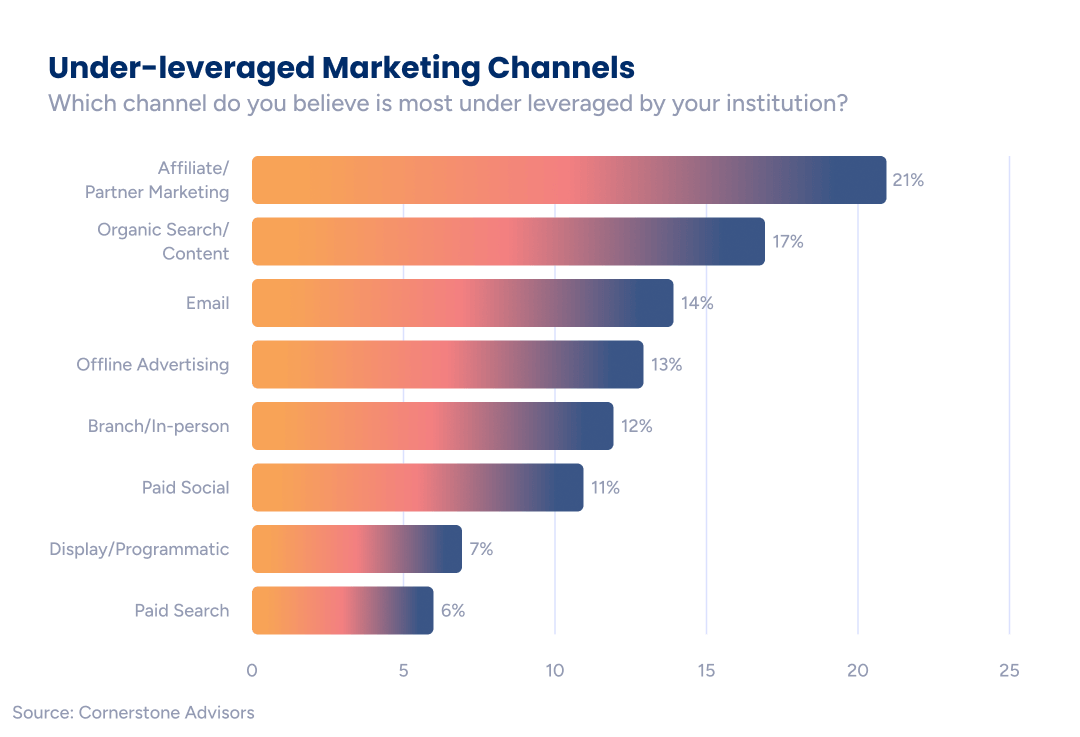
For financial brands, that should stand out. Consumers often discover financial products while researching, comparing, and validating options across publisher and partner environments. That makes affiliate marketing especially relevant for regulated categories where trust, education, and intent matter. It also helps explain why more institutions are asking whether they need an affiliate marketing agency or specialized affiliate partner to help build and manage this channel more effectively.
Why affiliate marketing is becoming a bigger part of the conversation
The report does not position affiliate marketing as a silver bullet, but it does make the case that it is underappreciated relative to its performance profile. Compared with channels that rely on auctions, impressions, or broader paid exposure, affiliate and partner marketing can align more closely with how financial institutions want to manage risk and return: pay for outcomes, reach high-intent audiences, and build presence where consumers are actively researching products.
That is also where the role of a specialized affiliate marketing agency becomes more relevant. In financial services, affiliate success is rarely just about recruitment. It depends on partner fit, compliance readiness, measurement, offer alignment, and ongoing optimization. Institutions may recognize the opportunity in the channel but still lack the internal bandwidth or expertise to scale it well. That is often where outside support becomes valuable.
| Why affiliate marketing stands out | Why it matters in financial services |
|---|---|
| High lead-quality perception | Supports growth goals beyond cheap clicks |
| Performance-based model | Can align spend more closely to outcomes |
| Consumer research environments | Captures high-intent audiences comparing products |
| Underleveraged by many institutions | Creates whitespace for brands looking to diversify acquisition |
The bigger issue: measurement still lags channel complexity
The report’s most important message may be that channel performance cannot be separated from measurement maturity. Financial institutions are trying to evaluate increasingly complex journeys with data infrastructure that often was not designed for modern marketing attribution.
Six in ten respondents say their core or CRM system limits ROI measurement. More than 30% cite identity resolution challenges and long conversion cycles. Not one institution surveyed said it could reliably attribute all outcomes measured in the study back to source.
That means the debate over the most effective marketing channels for financial services is not just about channels. It is also about whether the institution can measure performance well enough to spot what is truly working.
Why this report matters now
For senior marketers at banks, credit unions, and fintechs, this report is a useful benchmark because it captures a real market tension. Teams are expected to show growth, improve efficiency, and defend spend, even as attribution remains incomplete and channel decisions are often shaped by legacy planning habits.
It also points to where opportunity may exist. Email continues to perform. Organic search and AI-driven discovery are attracting interest. Affiliate and partner marketing appears stronger than its adoption rate suggests. For institutions rethinking channel mix, that is worth paying attention to.
If your team is evaluating growth strategy, channel investment, or whether to work with a specialized affiliate marketing agency, this report offers a helpful starting point grounded in what financial institutions themselves are saying about spend, performance, and ROI.
FAQ
What are the most effective marketing channels for financial services?
Based on this report, email marketing is viewed as the strongest ROI performer, while paid search remains a major spend area and affiliate marketing stands out as an underleveraged channel with strong perceived value.
Why is affiliate marketing relevant for banks and fintechs?
Affiliate marketing can help financial brands reach consumers in high-intent research and comparison environments, often with a performance-based model that aligns spend more closely to outcomes.
When should a financial brand consider an affiliate marketing agency?
A financial brand may consider an affiliate marketing agency when it sees opportunity in the channel but lacks the internal resources, publisher relationships, compliance processes, or optimization expertise to build the program effectively.
Why is proving marketing ROI still difficult in financial services?
The report shows that many institutions still struggle with CRM and core integration, identity resolution, inconsistent attribution, and long conversion cycles, all of which make ROI harder to prove.
What should marketing leaders take away from this report?
Marketing leaders should look beyond familiar channels and focus on whether budgets, measurement, and channel mix are actually aligned with performance and growth goals.



 English
  Français