
Webinar Recap: From Budget Guesswork to Provable ROI for Bank and Credit Union Marketers in 2026

- Last Updated: June 8, 2026
Bank and credit union marketers are under growing pressure to prove what their spend actually returns. The problem is that the data they need to make that case has been hard to find. There is plenty of research on how much financial institutions spend, but very little on which channels are actually working.
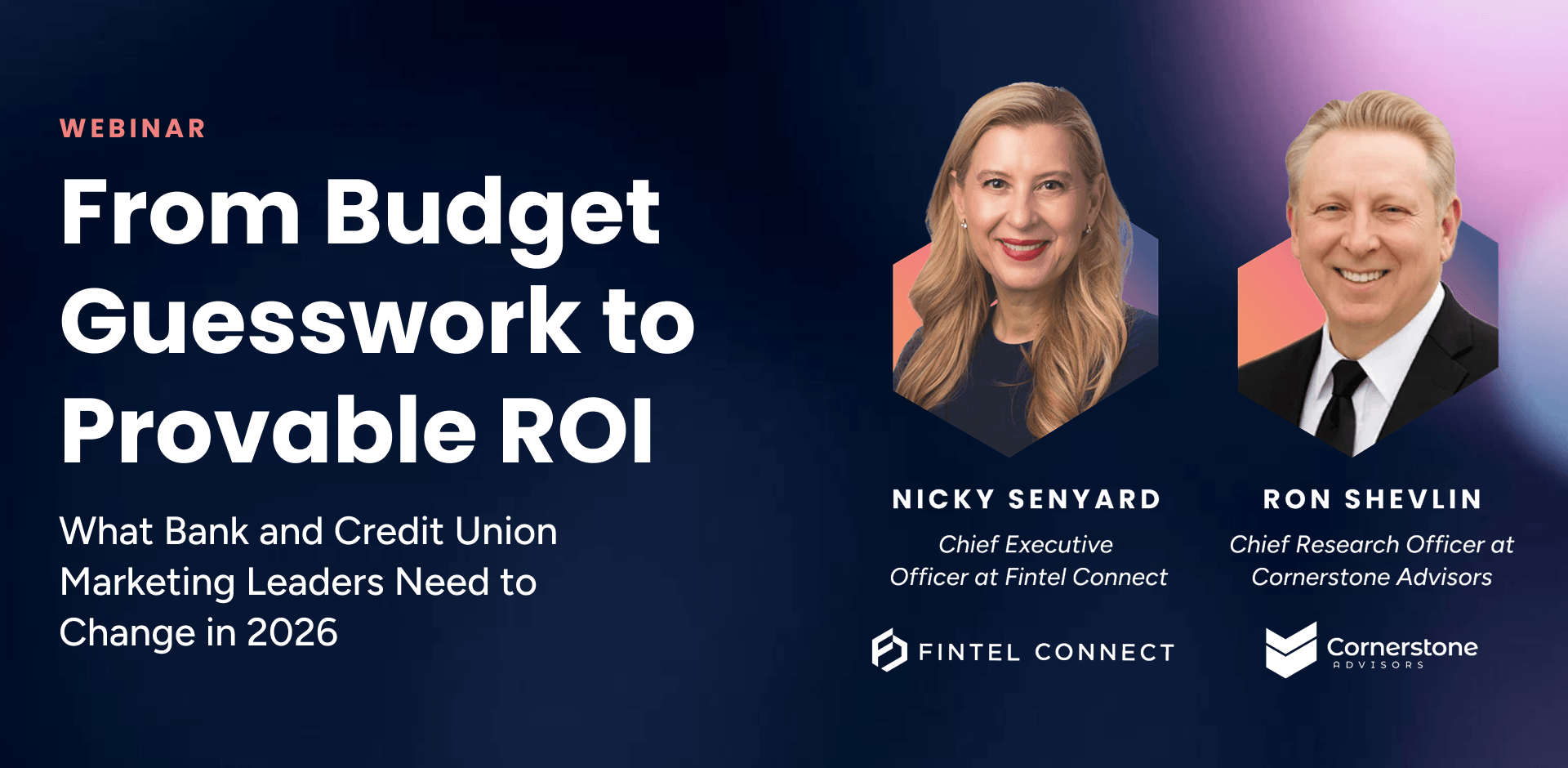
A new report from Cornerstone Advisors, The Marketing ROI Gap in Banking, commissioned by Fintel Connect, set out to close that gap. The study surveyed 128 senior bank and credit union marketing on spend, channel effectiveness, and budgeting. To unpack what it found, our CEO Nicky Senyard sat down with Ron Shevlin, Chief Research Officer at Cornerstone Advisors.
“I don’t think I’ve ever seen anything that has really focused on perceptions of channel effectiveness to go along with the spending and the technology investments,” he said. “The goal was to understand where the effort is going, not just the dollars, but the channels, goals, and objectives behind them.”
— Ron Shevlin, Chief Research Officer at Cornerstone Advisors
Why growth appetite, not size, separates the leaders
The survey included a wide range of institutions, from large banks and credit unions to smaller community players. The expectation going in might be that larger institutions are more sophisticated and smaller ones are behind. However, the data told a different story.
What set institutions apart wasn’t size, it was appetite for growth. Smaller institutions weren’t necessarily less informed, and in some cases they were pushing harder. “It isn’t size that’s driving it. In fact, you can make an argument that it’s the other way around, that a smaller institution has to spend more in order to keep up,” Ron said.
He also noted a pattern in who tends to lean into this work. Most of the institutions he talks to prioritize growth, while plenty of others are content to keep doing what they’re doing and aren’t aggressive about it. The report reflects the views of institutions that put a high priority on growing.
The takeaway for marketers: stop measuring yourself against the size of the institution down the street. The real question is how serious your institution is about growth.
Why budget guesswork is holding marketers back
Many banks and credit unions have a real appetite for growth, but their internal budgeting processes make change difficult. Ron described the friction as “the hardening of the arteries” inside financial institutions. The strategy may be clear, but the ability to move budget, test new channels, and respond quickly slows down.
“Stuff doesn’t move through,” he said. Part of the cause is a disconnect between strategy and execution. There is appetite for growth, but the gap between that ambition and the organization’s ability to respond as fast as it would like.
It shows up most clearly in budgeting. CFOs are asking where the return is, and it’s easy to point to total spend against revenue or new member growth. The harder questions sit a level down: what did this channel deliver, and what did that campaign deliver?
When those questions go unanswered, budgets stay flat and existing spend doesn’t move because no one can prove one channel is more effective than another.
The trap of last-year budgeting
Nicky added that the survey showed budgeting was largely retrospective. Allocations tracked what had been done before rather than where the institution was trying to grow, and the correlation with channel effectiveness often wasn’t there.
When budget is built on last year instead of where you want to grow next, it gets harder to:
- Reallocate spend toward higher-performing channels
- Test new acquisition channels
- Prove which campaigns are driving business impact
- Move budget away from channels that are becoming less efficient
The result is a gap between growth ambition and budget reality.
Why measurement is the real budget problem
The clearest theme in the conversation was that budget challenges are usually measurement challenges. Without clear answers on what each channel delivers, budgets stay flat, new channels are hard to justify, and existing spend is hard to move.
The questions that actually matter sit below total spend:
- What did this channel deliver?
- Which campaigns contributed to growth?
- Where should budget shift next?
As Nicky put it, measurement is what earns marketing a place at the table. “A key element to earning the place at the table is measurement, because measurement allows you to inform strategy,” she said.
Affiliate marketing has an edge here. It’s digital and easier to track, as long as the technical team feeds the data back, which is why tracking is almost always the first concern when institutions test it.
For marketers, the better question isn’t how much you spent, but where spend is actually helping you grow. The metrics that matter, in Nicky’s words, come down to three: volume, quality, and cost effectiveness.
How do you introduce a new channel to leadership?
Ron discussed how you introduce any new channel to executives, and it comes back to making marketing more strategic. He framed it through an analogy from economics. Just as there is microeconomics and macroeconomics, there is micro marketing and macro marketing. Micro marketing is figuring out what an individual customer wants and reaching them. Macro marketing is reading where the environment is moving, which channels matter most, and how to reach customers by product and segment. Too many teams over-index on the micro and underinvest in the macro.
That’s why you can’t simply walk into a board or executive meeting and announce a new channel. A stronger strategic story that earns marketing the right to introduce a new channel covers:
- How your current channels are performing
- How that performance has changed over time
- What’s working and what isn’t
- The plan for shifting budget
- The plan for building capability in the new channel
Even when execution is outsourced to a third party, the senior marketing leader still owns accountability for the results, which means knowing whether that provider is doing a good job.
The report gave this urgency. One key finding was that most respondents simply aren’t happy with the search results they’re getting. Search is becoming more competitive and more expensive, and the national players will always outspend you.
Why affiliate marketing deserves a closer look
Affiliate marketing stood out in the research because the channel:
- Ranked second only to in-branch signups for quality of new members and customers
- Ranked second only to email for volume
- Is seen as a very underutilized channel
- Is results-based and built on tracking, making it measurable
That combination matters, because many banks and credit unions are looking for channels that drive measurable acquisition without leaning harder on increasingly expensive paid search.
Affiliate results can be a consistent and sustainable acquisition channel. Nicky pointed to Coast Capital, a regional credit union in Canada, where affiliate marketing now contributes 18% of new members. See the full impact of affiliates in the Coast Capital case study.
She shared a second example as well. A U.S. community bank built a digital brand around a high interest savings account, then doubled down on the product and a strong onboarding path. In the first six months, it allocated another 300% of budget to the channel, because it was working and the team had transparency into the results.
What it takes to make the change stick
Ron offered a framework for what actually makes this kind of change work. There are four components: technology, process, money, and people.
- Technology comes first, and it’s usually the easy part. The channel has to map back to the products and the target audience.
- Process is second. Even when execution is outsourced to a partner like Fintel Connect, the institution still needs internal processes for strategy, execution, measurement, and managing change.
- Money is third. The budget shift has to happen, and the change has to be enabled.
- People is the piece many institutions overlook. Someone inside the marketing department has to manage the work and understand the channel or capability, even when it’s outsourced.
Nicky added what she sees in clients that get this right. The teams that succeed share a willingness to change, prepare, and take a risk. There’s trust in the strategy and the people driving it. And there’s alignment between the ambition to grow and the operational readiness to do it, which comes back to whether the skills exist in-house.
Why historical budgeting needs to change
When the survey asked what accounted for changes in the budget during the year, the main answer was an executive asking for something different. Ron said this can be a sign that someone is initiating change and willing to shake things up.
His suggestion for CEOs and CFOs was a simple but powerful question to put to their marketing leaders: “If you were building the marketing budget from scratch, how would you do it and what would it look like?”
That question shifts the conversation away from defending last year’s spend and toward building around growth goals. It forces the institution to think about what would actually be different.
To start that exercise, the report gives useful reference points on the quality and volume institutions are seeing from different channels and where the majority of budget is going. If you’re rebuilding from zero, it helps to see what others have found effective.
Ron flagged one finding that stood out to him. When respondents rated the importance of various performance factors, like volume, customer quality, and brand impact, speed to market landed at the bottom. He sees that as a real misperception. “I think there’s nothing more important than speed to market these days, especially when we think about the potential impact of AI and AI agents in marketing and compliance,” he said.
What financial marketers can do next
Change is hard, and people resist it. But it’s often what growth requires, especially when teams are telling Nicky that last year’s playbook isn’t delivering the same impact for the same spend.
Drawing on 25 years in digital marketing, from before Google existed, through the rise of social media, to AI emerging as a visibility tool, Nicky’s through-line was consistent. Marketers are managing more channels than ever, and the fundamentals still hold. You need an objective and a goal, you need to be able to measure it so you know whether you’ve made an impact, and experimentation is crucial.
The conversation pointed to a clear set of next steps:
- Audit your current budget mix. Look at where spend is going today and whether it reflects your growth priorities rather than last year’s habits.
- Measure quality, not just volume. Volume, quality, and cost effectiveness are the metrics that tell the real story.
- Strengthen your tracking. If tracking is inconsistent, every downstream report becomes harder to trust.
- Build the strategic story before introducing a new channel. Show how channels are performing, what’s working, what’s not, and how the new channel will be tested and measured.
- Bring leadership in early. Marketing can’t solve measurement alone, so the CEO, CFO, and CIO relationships matter from the start.
- Make room for experimentation. Growth requires testing, with clear goals and accountability behind it.


 English
  Français