
Webinar Recap: Is SEO Dead? AEO and AI Search Strategies for Financial Marketers in 2026

- Last Updated: April 24, 2026
SEO isn’t dead, but its role is changing. Financial marketers need to maintain strong SEO foundations while adapting their content and measurement strategies for Answer Engine Optimization (AEO) and AI-driven visibility.
One theme that continues to come up in conversations with financial marketing leaders is growing uncertainty around visibility. Organic traffic is shifting, AI platforms are becoming a primary discovery channel, and teams are being asked to explain performance in ways that don’t map cleanly to traditional metrics.
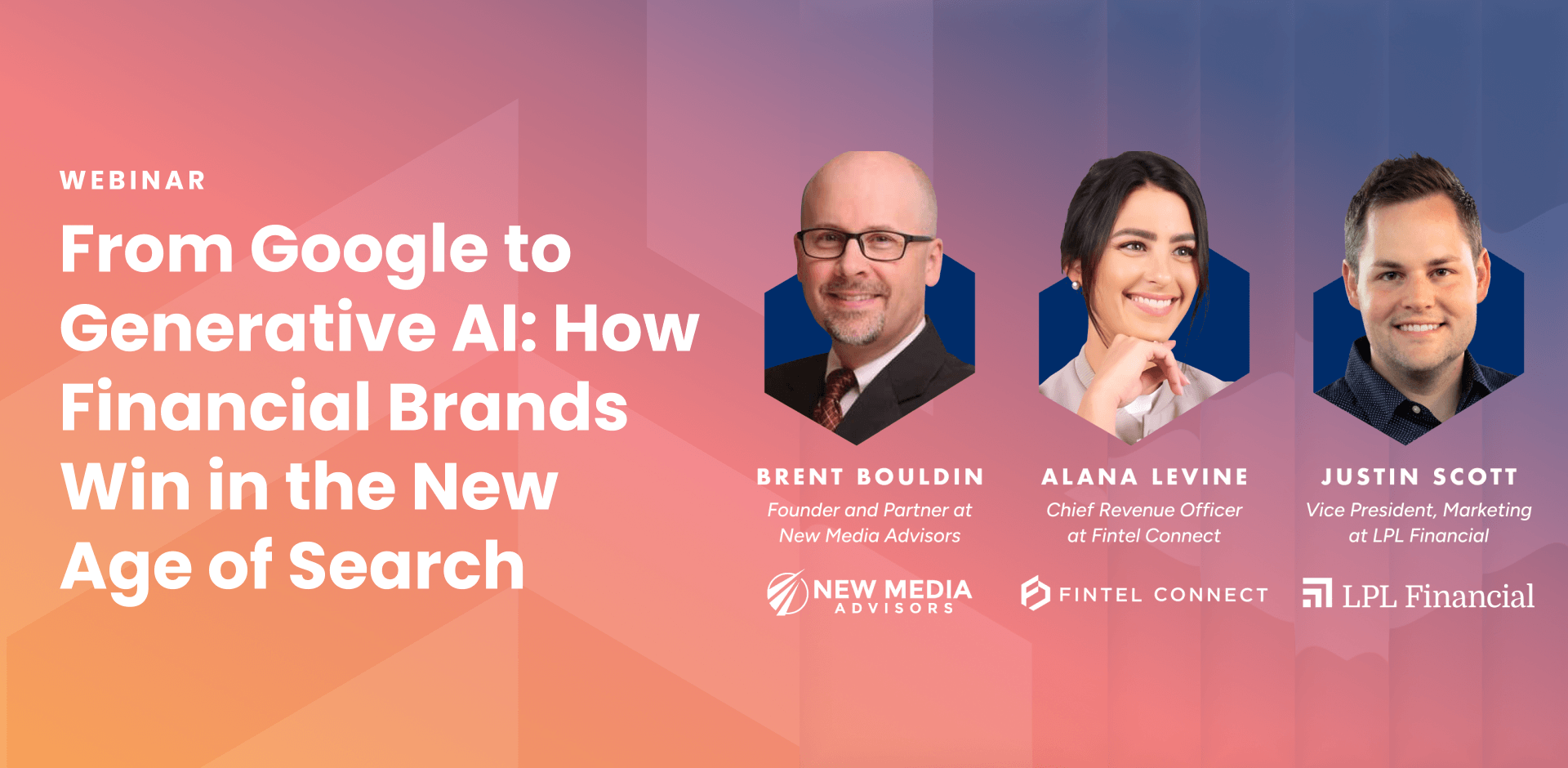
To unpack what this shift means in practice, Alana Levine, Fintel Connect’s CRO, gathered insights from industry experts:
- Brent Bouldin, Founder and Partner, New Media Advisors (Former SVP, Bank of America)
- Justin Scott, Vice President of Marketing, LPL Financial
The discussion focused on a core question many teams are asking right now: how should financial marketers evolve their strategy as AI-driven discovery changes how consumers research and evaluate financial products?
Is Traditional SEO Dead?
SEO is still critical for conversion-driven traffic, but AI search is increasingly influencing how consumers research and compare financial products early in the decision-making process.
The idea that “SEO is dead” often comes up in executive conversations right now, which is understandable given shifting traffic patterns and the rise of AI-generated answers that reduce the need to click through to websites.
What financial marketers need to understand, however, is that AI is not replacing SEO. As Brent summarized during the discussion, this is not a choice between SEO and AI optimization. It’s an expansion of the search ecosystem.
SEO + AEO Strategy: Why This Is a “Both, Not Either” Approach
Traditional search still plays a critical role in capturing high-intent, conversion-ready users. What’s changing is where discovery begins. AI platforms are increasingly shaping top-of-funnel research by answering questions, comparing options, and helping users narrow their options before they ever visit a brand’s website.
For financial marketers, this means:
- SEO remains critical for bottom-of-funnel conversion
- AI visibility becomes critical for top-of-funnel influence
- Success depends on how well both are integrated
The most effective strategies focus on areas that benefit both channels:
- Clear, structured content
- Strong authority signals
- Third-party validation
- Alignment with real user intent
| Aspect | Traditional SEO | AI Search / AEO |
|---|---|---|
| Primary goal | Drive clicks | Provide answers |
| User behavior | Click-through | Zero-click / assisted |
| Content focus | Keywords | Questions + intent |
| Measurement | Rankings, traffic | Visibility, citations |
| Authority signal | Backlinks | Third-party mentions |
| Timing | Immediate indexing | Delayed or variable |
How AI Search Is Changing Financial Product Discovery
AI-driven discovery behaves differently from traditional search. “The more complex the product, the more likely it is to show up in AI,” Brent said. Products such as mortgages, insurance, loans, and retirement planning tend to perform well in AI search because they are better suited to conversational, research-driven queries.
At the same time, the sources AI platforms rely on are shifting. Rather than prioritizing brand-owned content, LLMs frequently cite third-party publishers, affiliates, and comparison sites. This has significant implications for how financial brands approach partnerships and content distribution.
How Smaller Financial Brands Can Win in AI Search
While national players still tend to perform better, AI search creates more room for smaller financial brands to compete where they have a clear point of relevance. Regional institutions and niche providers can stand out by building content around specialized products, defined audiences, or specific markets, whether that means physician loans, specialty lending, or local queries like “banks in Atlanta” or “credit cards in San Francisco.”
The opportunity is strongest when content is highly specific and directly answers the question being asked. For smaller brands, that means:
- Prioritizing niche or specialty products
- Building content for local markets
- Answering long-tail queries clearly and directly
Why Third-Party Content and Affiliate Partnerships Drive AI Visibility
For financial brands, this shifts affiliate marketing from a performance channel to a core visibility driver in AI search.
AI platforms consistently favor:
- Independent publisher content
- Comparison articles and listicles
- Third-party validation over brand messaging
If your brand isn’t being discussed in trusted third-party environments, it’s less likely to appear in AI-generated answers.
This also introduces a strategic consideration around investment. As Brent noted, some budgets historically allocated to paid media may need to shift toward digital PR, partnerships, and content placements that influence how brands are represented across the broader ecosystem.
Recommended Practices for Answer Engine Optimization (AEO)
While AEO is still evolving, a few clear patterns are starting to emerge based on how teams are seeing it perform in practice.
1) Answer questions directly and early
AI systems prioritize content that delivers clear, immediate answers. Avoid burying key information deep within long-form content.
2) Structure content for extraction
Use:
- Question-based headings
- Short, direct answer paragraphs
- Bullet points and summaries
This improves both readability and the likelihood of being cited.
3) Use schema and structured data
Schema is behind-the-scenes code that helps search engines and AI tools understand what’s on a page, such as FAQs, articles, or products. Adding it can make content easier to interpret and improve visibility across both traditional search and AI.
4) Optimize for conversational queries
Users are increasingly asking longer, more natural questions. Content should reflect how people speak, not just how they search.
5) Include summaries and “TL;DR” sections
These provide clear entry points for both users and AI systems and increase the chances of being surfaced in answers.
6) Cover related questions (query expansion)
AI models often break a single query into multiple sub-questions. Content that addresses these related angles performs better.
As discussed in the session, LLMs are effectively identifying and prioritizing content that most directly answers the user’s question, rather than content that simply ranks for a keyword.
Measuring AI Impact and Visibility
Challenges of Tracking AI Impact
Measuring AI impact is more complex than traditional search because results aren’t stable or standardized. The same prompt can return different answers within hours, influenced by factors such as timing, personalization, or prior search behavior.
There are also limitations in how performance can be tracked today:
- Inconsistent outputs: The same query may generate different responses, making benchmarking difficult.
- Limited tool coverage: Most tools only track major platforms like ChatGPT, Gemini, and Perplexity.
- Platform differences: Each AI system operates differently. Some rely on training data while others pull from live web results.
- Delayed impact: Content may take months to be reflected in training-based models.
For financial marketers, this means AI visibility should be monitored across multiple platforms and over time, rather than treated as a single, fixed metric.
Approaches to Measuring AI Impact and Visibility
Both Justin and Brent described a shift away from measuring AI performance through clicks alone and toward a broader view about whether your brand is showing up, being cited, and shaping the conversation in the moments that influence decision-making.
Brent uses tools like Scrunch to track how often brands appear across a defined set of prompts and how that changes over time. At LPL, Justin’s team is continuously measuring not just whether the brand appears, but how it is represented, whether it is being cited, and where content gaps exist. He also mentioned Brandlight as another AI visibility tracking option.
A practical approach includes:
- Tracking visibility across priority prompts over time
- Monitoring how your brand is positioned in AI responses
- Identifying where your content is being used but not cited
- Reviewing how AI tools crawl and interpret your site content
How to Help Leadership Teams Rethink AI Visibility and Measurement
Many leadership teams are still trying to understand whether AI signals the end of search or SEO. In reality, AI-driven discovery is still a small portion of overall search behavior, but its influence is growing.
Ultimately, educating leadership is less about proving immediate ROI and more about helping leaders move away from traditional expectations around rankings and clicks and toward a broader view of visibility and influence.
A practical approach to education includes:
- Reframe the role of AI: Position AEO as an extension of SEO, not a replacement.
- Reset expectations on measurement: AI doesn’t provide consistent rankings like traditional SEO. The same prompt can generate different answers depending on timing, personalization, or context. Performance should be viewed in aggregate over time.
- Introduce the concept of “visibility over clicks”: AI may reduce traffic but still influence decision-making. Users often return later when they are ready to convert.
- Normalize uncertainty: Leaders need to get comfortable with some “gray space” as the ecosystem evolves.
What Should Financial Marketers Do Next?
AI is already influencing how financial products are discovered. The question is no longer whether it matters, but how quickly teams can adapt.
Immediate actions
- Audit how your brand appears across high-value AI prompts
- Identify where you aren’t showing up or being misrepresented
- Update key pages to deliver clear, answer-first content
Medium-term priorities
- Expand presence across trusted third-party publishers
- Align SEO, PR, and affiliate strategies around visibility, not just traffic
- Structure content to improve how it is interpreted and cited by AI systems
Long-term strategy
- Evolve measurement beyond clicks to include visibility and influence
- Build AI visibility into core acquisition planning
- Continuously test, monitor, and adapt as platforms evolve



 English
  Français