
What are the top digital marketing tactics to drive deposit growth?


The top digital tactics to grow deposits are affiliate marketing, AEO, SEO, paid search, social media advertising, and email and in-app marketing. These strategies help financial institutions attract high-intent users, personalize outreach, and streamline the path from awareness to funded account, but only if you can actually measure which ones are driving funded outcomes rather than just clicks.
Quick answer
- The nine core digital tactics for deposit growth are SEO, paid search, social media, email and app marketing, incentives, financial education content, affiliate marketing, conversion rate optimization, and behavioral personalization, plus a tenth that’s now essential: AEO and AI search visibility
- 2026 The Marketing ROI Gap in Banking survey of banks and credit unions found 60% say their core CRM integration limits their ability to measure marketing ROI, and nearly 1 in 3 believe they’re crediting the wrong source for digital acquisition
- CPA is a starting point, not the final measure: paying a higher CPA can produce better economics if it brings in customers with stronger long-term value
- Track every tactic on three things: volume, quality (do accounts fund, stay, and grow at 30, 60, and 90 days), and efficiency (is the cost sustainable relative to customer value)
- Ivy Bank grew from zero customers to over $1.2 billion in deposits by using downstream customer data, not just click volume, to guide which channels to scale
The top 10 digital marketing tactics to drive deposit growth
1. SEO: boost local visibility and organic traffic
SEO helps attract high-intent local users and builds long-term visibility and trust.
- Incorporate relevant keywords naturally within page titles, meta descriptions, headings, and body text
- Create location-specific pages for each branch with local information, directions, and customer reviews
- Use schema markup for product pages to improve click-through rates in search
2. Paid search and programmatic display: fast, targeted acquisition
- Reach users actively searching for savings products.
- Bid on keywords such as “high-interest savings account” or “top CD rates”
- Geo-target campaigns to users near branches or service areas
- Run remarketing and programmatic ads through platforms like Google Ads or Bing
3. Affiliate and influencer marketing: leverage trusted voices, and their halo effect
Affiliate partner marketing taps into high-intent audiences to extend reach and build credibility, and its impact often reaches further than last-click attribution shows.
- Collaborate with influencers in finance or lifestyle to reach niche audiences
- Use affiliates like NerdWallet or Bankrate to promote your offers
- Build in content compliance monitoring for financial promotion rules to protect brand trust
Account for the halo effect: a consumer who sees your brand on an affiliate site may still convert later through another channel, meaning affiliate marketing’s real contribution is often larger than direct attribution alone shows
Example: Grasshopper Bank grew approved accounts by 250% through a strategic affiliate expansion, with large-scale affiliates driving 87% of approvals and long-tail affiliates the remaining 13%, all on a CPA-only structure that let the bank add partners without upfront cost.
4. AEO and AI search visibility: show up in AI-generated answers
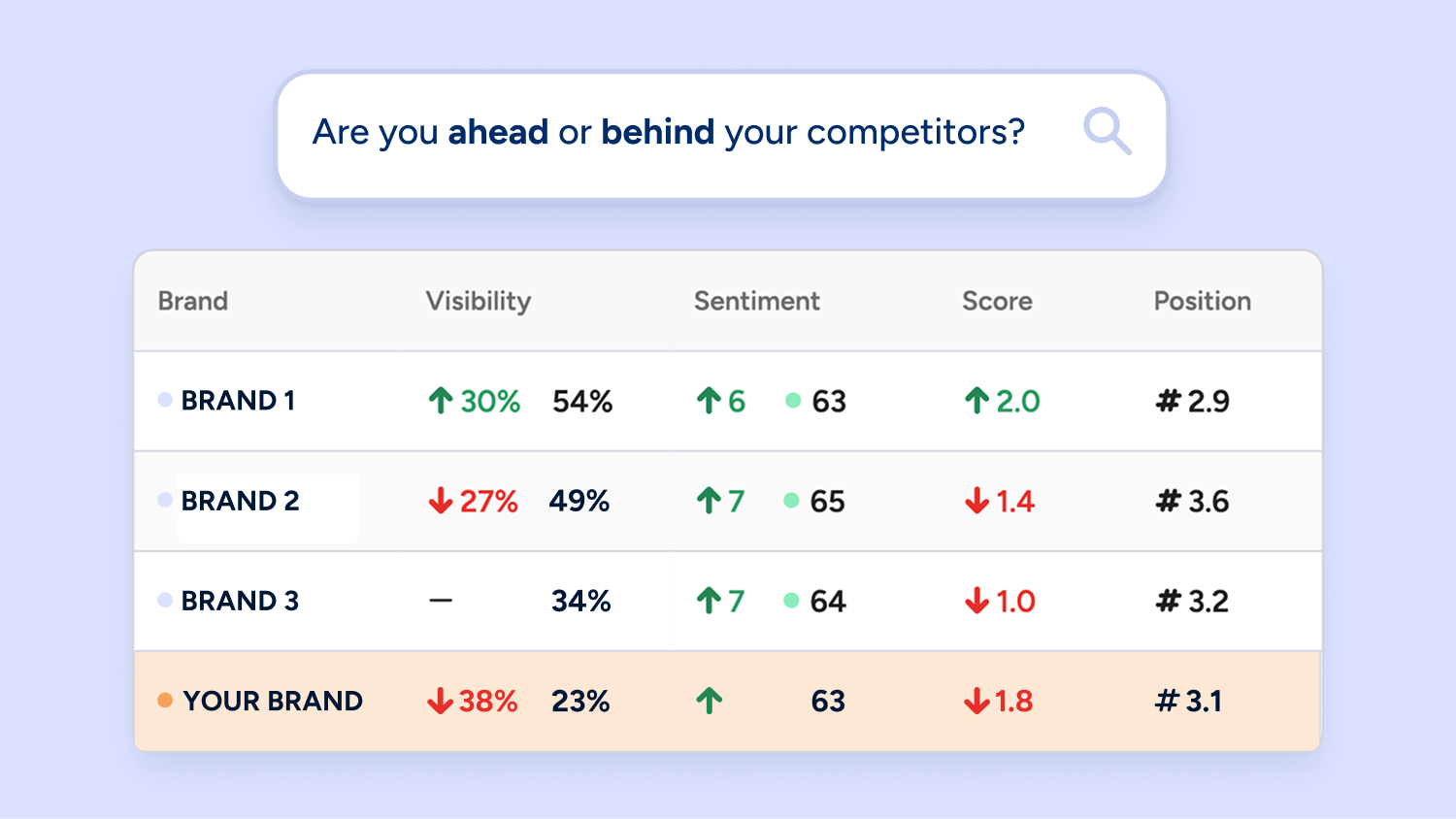
Consumers increasingly research deposit products through tools like ChatGPT, Gemini, and Claude before ever reaching a bank’s website.
- Structure FAQ content around the exact questions your audience asks, pulled from call center logs, chatbot conversations, and branch inquiries
- Work with affiliates already trusted by AI platforms for financial content, since credible third-party citations are the primary driver of AI visibility, more so than a brand’s own website content alone
- Audit how your brand currently appears across the AI prompts that matter most to your product lines before investing further
5. Social media marketing: granular targeting on Meta and LinkedIn
Social platforms allow precise segmentation by age, income, interests, and more.
- Run Meta lead-gen ads promoting high-yield accounts
- Use LinkedIn for business banking or high-net-worth audiences
- Retarget site visitors or use lookalike audiences
- Review current marketing compliance requirements for financial services ad targeting before launching, since platform ad policies change often
6. Email and mobile app marketing: drive engagement with personalization
Use first-party data to send timely, relevant communications by email or mobile notification.
- Trigger emails or in-app messages based on behaviors like abandoned applications
- Segment users by lifecycle stage or deposit potential
- Send push notifications to prompt funding or new account setup
7. Incentives and referral programs: drive short-term deposits
Create urgency and incentivize sharing.
- Promote special interest rates or limited-time CDs by email, social, or in-app channels
- Cross-sell or bundle deposit products with checking or investment accounts
- Launch referral campaigns offering cash bonuses or rewards
8. Financial education content: build trust and organic reach
Educational content helps potential customers understand their needs and your value, and it doubles as raw material for AI search visibility.
- Publish content like “how to build an emergency fund,” sourced from the actual questions your call center, chatbot, and branch staff hear most often
- Create videos explaining deposit options and their benefits
- Offer downloadable guides or host webinars
9. Conversion rate optimization: maximize funnel efficiency
Make every visitor more likely to convert.
- Build mobile-friendly, fast-loading landing pages with clear CTAs
- Offer calculators for savings or CD returns
- Streamline account opening and funding workflows
- Add AI-powered chatbots for live guidance
10. Hyper-personalization with behavioral analytics
Use customer data to deliver dynamic, relevant experiences.
- Use CRM and CDP insights to show personalized content and recommendations
- Reward behaviors with gamification, such as challenges for increasing deposits
- Suggest upsells, like CDs, for users with high balances
How do you know if these tactics are actually driving deposit growth?
The tactics above only drive real deposit growth if you can see past clicks and leads to funded outcomes. The 2026 Marketing ROI Gap in Banking survey of 126 bank and credit union marketing executives, commissioned by Fintel Connect and conducted by Cornerstone Advisors, found 60% say their core CRM integration limits their ability to measure marketing ROI, nearly 1 in 3 believe they credit the wrong source for digital acquisition, and 25% believe they’re crediting more than one source for the same outcome.
Two recent panel discussions hosted by Fintel Connect’s CEO, Nicky Senyard, with leaders from Ivy Bank, Consumers Credit Union, Deluxe, and Neu Money, point to the same conclusion: CPA and click volume are a starting point, not the final measure of whether a tactic is working.
Track every tactic on three things:
- Volume: enough acquisition activity to see real patterns, not just a handful of data points
- Quality: whether the accounts a tactic drives actually fund, stay, and deepen the relationship, tracked at 30, 60, and 90 days after opening, not just at approval
- Efficiency: whether the cost to acquire those customers is sustainable relative to their long-term value, not just whether CPA looks low on paper
A lower CPA can also be misleading on its own. In one recent example shared on the panel, Neu Money‘s marketing team paid roughly 20% more for a channel after changing its audience targeting, which produced a stronger customer mix and better downstream economics than the cheaper version of the same channel had.
The panel also pointed to a halo effect: a consumer who sees your brand on an affiliate site or in an AI-generated answer may still convert later through a different channel, which means last-click attribution alone can understate what tactics like affiliate marketing and AEO are actually contributing.
Ivy Bank, a digital-only bank that grew from zero customers to over $1.2 billion in deposits, used exactly this kind of downstream data to notice its early customer base skewed older and higher-balance, then deliberately shifted acquisition strategy to also attract younger customers who would grow with the bank over time. More than half of its customers are now millennials and Gen Z.
Before cutting a tactic that looks like it’s underperforming, diagnose the actual cause rather than assuming the channel itself is the problem. Common root causes include funnel leakage, weak messaging, poor audience selection, weak placement, or a product that simply isn’t competitive enough. Change one variable, give it enough time to show downstream results (around 90 days for credit-driven products), and then evaluate again.
How to ensure your digital marketing strategy actually grows deposits
- Offer a competitive product: Without a standout offering, even the best marketing won’t convert. Ensure your rates, fees, and bonuses beat or match competitors.
- Measure quality, not just volume: Track funded outcomes and long-term balance or account lifespan, not just approved applications.
- Allocate budget smartly: Channels like affiliate and paid search are pay-per-performance but require enough investment to compete, and budget should follow performance data rather than last year’s plan.
- Test your funnel: A strong campaign fails if onboarding is clunky. Optimize for speed, clarity, and user experience.
- Build strategic partnerships: Work closely with affiliates or media partners to share feedback, unlock premium placements, and benefit from the halo effect they create beyond direct conversions.
Frequently asked questions
What’s the most cost-effective way to increase customer deposits digitally?
Affiliate marketing, when well-managed, often delivers the strongest cost-per-funded-account, especially through a specialized partnership marketing platform. Its real contribution can be even larger than direct attribution shows, once you account for the halo effect on other channels.
How long does it take to see results from digital deposit campaigns?
Paid channels can deliver results in days. SEO, content, and AEO typically take 3 to 6 months to show measurable returns, since they depend on earning trust and citations over time rather than buying placement.
Can banks use AI in digital marketing?
Yes. AI enhances personalization, predicts customer needs, supports real-time engagement through chatbots, and is increasingly how consumers discover financial products in the first place, which is why AEO now belongs on this list alongside SEO.
Is influencer marketing content compliant for financial institutions?
Yes, if disclosures are clear and the affiliate or influencer follows applicable advertising and content compliance rules, such as FTC endorsement guidance and FFIEC expectations in the U.S., or Competition Bureau and FCAC guidance in Canada.
Which marketing tactic yields the fastest deposit growth?
Paid search and programmatic display typically generate the quickest wins, provided your site and funnel convert efficiently. But the fastest channel isn’t always the most efficient one once you measure quality and long-term value, not just speed.
How do you know if a deposit growth tactic is actually working?
Track it on volume, quality, and efficiency together, not CPA alone. Quality means whether accounts fund, stay, and grow at 30, 60, and 90 days post-acquisition. A channel with a higher CPA can still be the better choice if it produces customers with stronger long-term value.
By integrating these tactics and measuring them with the same rigor Ivy Bank, Consumers Credit Union, Deluxe, and Neu Money now use, banks and fintechs can drive deposit growth that holds up past the first click.


 English
  Français