
7 financial services marketing trends for 2026


The biggest financial services marketing trend for 2026 is the shift from ranking in search results to earning a place inside AI-generated answers, alongside growing pressure to prove marketing ROI and rethink CPA strategy as affiliate economics change. Banks, credit unions, and fintechs that adapt their content, measurement, and partnership strategies around these shifts will outperform those still optimizing for a search landscape that’s already changing underneath them.
Seven shifts stand out this year:
- AI-powered discovery is changing how consumers find financial products
- CPA strategy is becoming a business decision, not just a rate to negotiate
- Marketing ROI measurement is under more scrutiny, and most institutions aren’t ready
- AI-driven personalization is moving from novelty to baseline expectation
- Structured, question-led content is outperforming traditional formats
- Budget scrutiny is consolidating marketing channels around what’s provably working
- Embedded finance partnerships are opening new acquisition surfaces
Trend 1: why does AI-powered discovery matter for marketing financial services?
Consumers are increasingly starting financial research in AI tools instead of traditional search engines. A NerdWallet survey found more than a quarter of Americans (26%) have used an AI chatbot for personal finance questions, and separate research from J.D. Power puts the figure even higher, with 40% of consumers saying they’d sought AI help with a financial decision in the past three months.
Fintel Connect’s own research confirms this is already reshaping visibility. In our study, Competing for Visibility in the Age of AI, we analyzed how ChatGPT, Gemini, Perplexity, and Copilot answer real consumer questions about credit cards and high-yield savings accounts. Affiliate and third-party content, not brand-owned websites, made up roughly 70% of cited sources on average across products and platforms.
That share varies significantly by platform:
- Perplexity and Copilot lean heavily on affiliate content, with 74% to 80% of cited links coming from affiliate sites rather than financial institutions directly
- Gemini favors owned content more, sourcing about 72% of its citations from financial institutions’ own websites
- ChatGPT sits in between, citing the widest range of sources overall
What to do about it:
- Strengthen on-domain content with clear formatting, FAQs, and schema markup to support platforms like Gemini that favor owned sources
- Build and maintain relationships with affiliates that consistently appear in AI answers, since ChatGPT, Perplexity, and Copilot collectively hold the majority of GenAI market share and rely heavily on that content
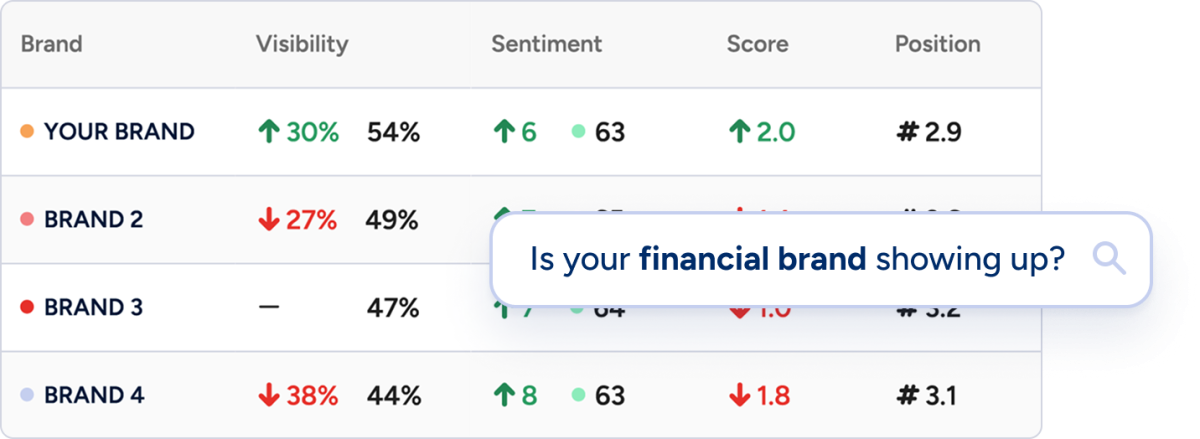
- Start tracking where your brand is being discussed and how it’s represented across AI platforms and community sources, not just whether it converts on the last click
Trend 2: how is affiliate cost per acquisition (CPA) strategy changing for financial affiliate marketing?
The question financial brands used to ask, “what are other brands paying?”, is being replaced by a better one: what business outcome are you actually optimizing for? Our 2026 Cost Per Acquisition (CPA) Guide to Affiliate Customer Growth in Financial Services report shows CPA is no longer just a number to negotiate down.
Several forces are pushing CPA higher across many product categories in 2026:
- Affiliates are investing more in search engine marketing, email, and owned channels to offset declining organic traffic, which raises their cost of acquiring customers, and in turn, raises CPA expectations
- Competition for premium placements (comparison tables, editorial features, newsletter sponsorships) is intensifying as AI-driven discovery increasingly surfaces the same trusted, top-ranking content
- The U.S. and Canada are moving at different speeds. The U.S. market saw greater CPA movement in 2026, while Canadian benchmarks stayed relatively stable outside of lending
What to do about it:
- Compare your product against what’s already featured beside it in affiliate content before raising CPA. A stronger offer often moves the needle more than a higher commission
- Choose a conversion event that reflects real customer value (funded account vs. submitted application, for example) and confirm your tracking can support it
- Review CPA quarterly, and treat major shifts in rate environment or affiliate performance as triggers for an off-cycle review
Trend 3: why is proving marketing ROI getting harder for banks and credit unions?
Financial marketing leaders are under growing pressure to demonstrate ROI, and most say their current tools aren’t up to the task. Deloitte’s CMO Survey found 58% of marketing leaders report increased pressure from CEOs and boards to prove marketing’s value.
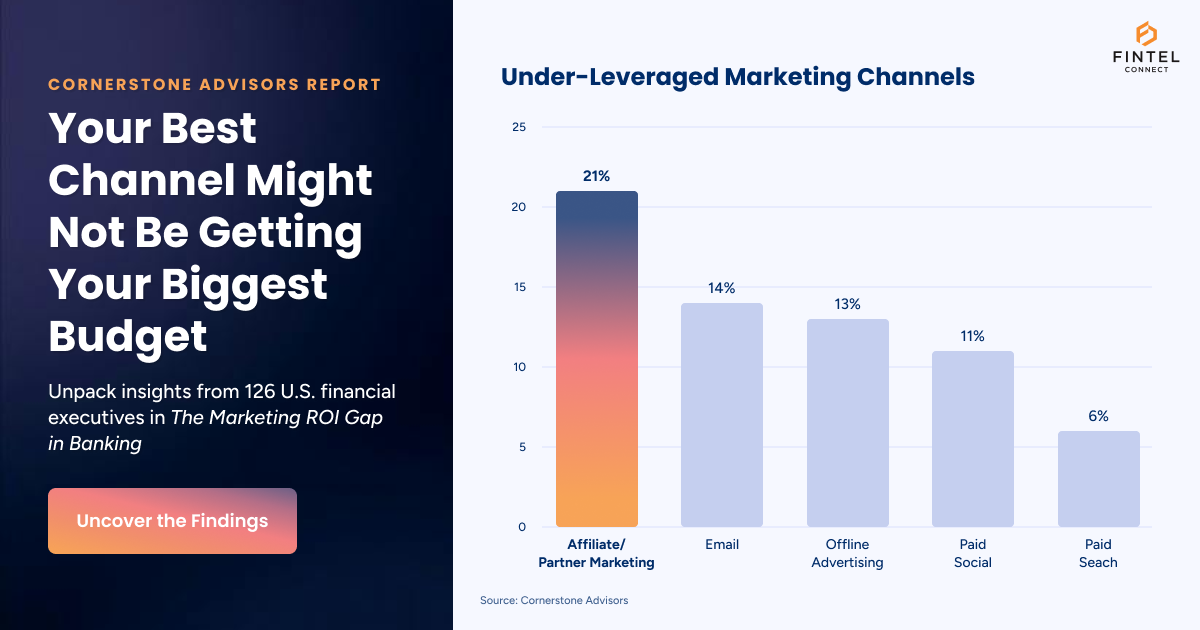
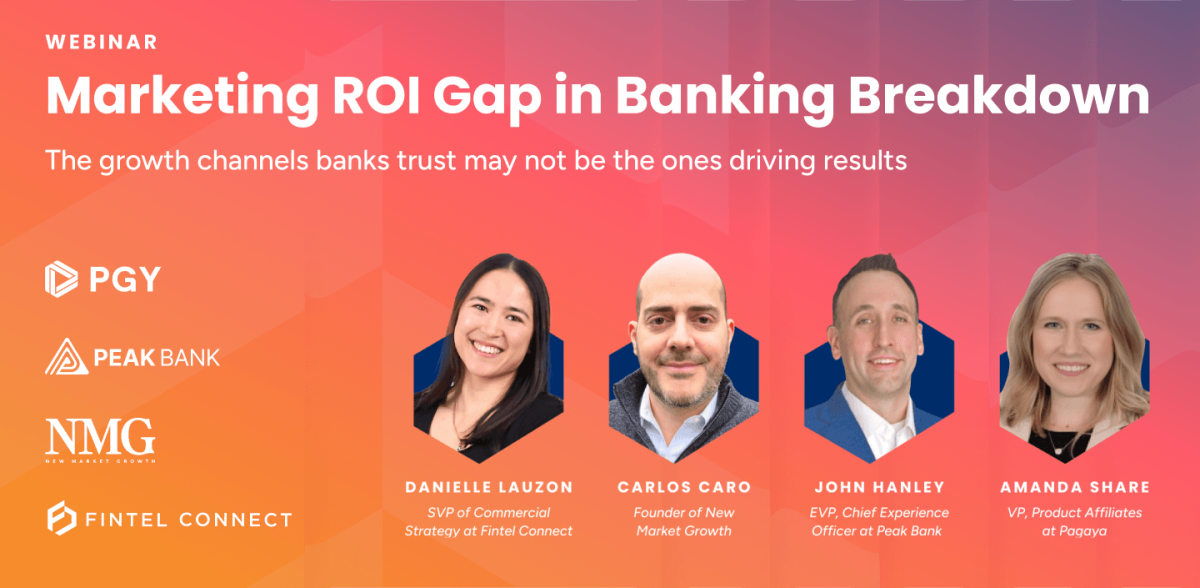
In The Marketing ROI Gap in Banking study of 126 senior U.S. bank and credit union executives conducted with Cornerstone Advisors, 60% said their core or CRM system limits their ability to measure marketing ROI, even as 80% of credit unions and 54% of banks now invest in six or more marketing channels.
The same research surfaced a significant spend-to-performance mismatch:
- Paid search receives the largest share of budget (46%), yet only 38% of executives rank it among their strongest ROI channels
- Email marketing is the reverse story: just 12% of budget, but cited by 48% as the strongest ROI channel
- Affiliate and partner marketing is called the most under-leveraged channel by 21% of executives, more than any other channel, despite only about a third of institutions actively using it
- Affiliate marketing ranked second among all channels for customer and lead quality, ahead of paid search
What to do about it:
- Audit whether your budget allocation actually matches where your best ROI is coming from, not just where spend has historically gone
- If affiliate marketing isn’t part of your current mix, treat that as a specific gap worth testing, given how consistently executives flag it as underused relative to its performance
- Push for attribution and reporting tools that can measure quality (funded accounts, deposit retention) rather than just volume
Trend 4: how is AI transforming personalization in financial services marketing?
AI-powered personalization is moving past chatbots and basic email tailoring into real-time, anticipatory experiences. A 2026 Harris Poll found that 74% of consumers, across every generation from Gen Z to Boomers, want more personalized banking, and J.D. Power found close to 60% of consumers now use AI for financial tasks at least occasionally, often specifically because they can describe their exact financial situation and get a tailored response back.
That last point matters for financial brands specifically: a general AI model starts from a blank page and knows nothing about a consumer’s actual finances. Institutions that already hold that first-party relationship, especially community banks and credit unions, have a real advantage if they can put it to use in personalization rather than treating it as a data privacy liability alone.
Financial institutions are already applying this in practical ways, such as targeted push notifications that connect existing customers to relevant new offers based on their account activity, helping reduce churn during uncertain economic periods.
What to do about it:
- Prioritize first-party data infrastructure before investing further in personalization tools, since the data foundation determines what’s actually possible
- Keep a human-in-the-loop on AI-generated personalization to catch inaccurate or off-brand outputs before they reach customers
- Balance personalization with a human touch. Consumers respond less favorably to content they perceive as purely AI-generated
See how financial institutions can make smarter customer acquisition decisions in 2027.
Trend 5: which content formats are winning in marketing financial services right now?
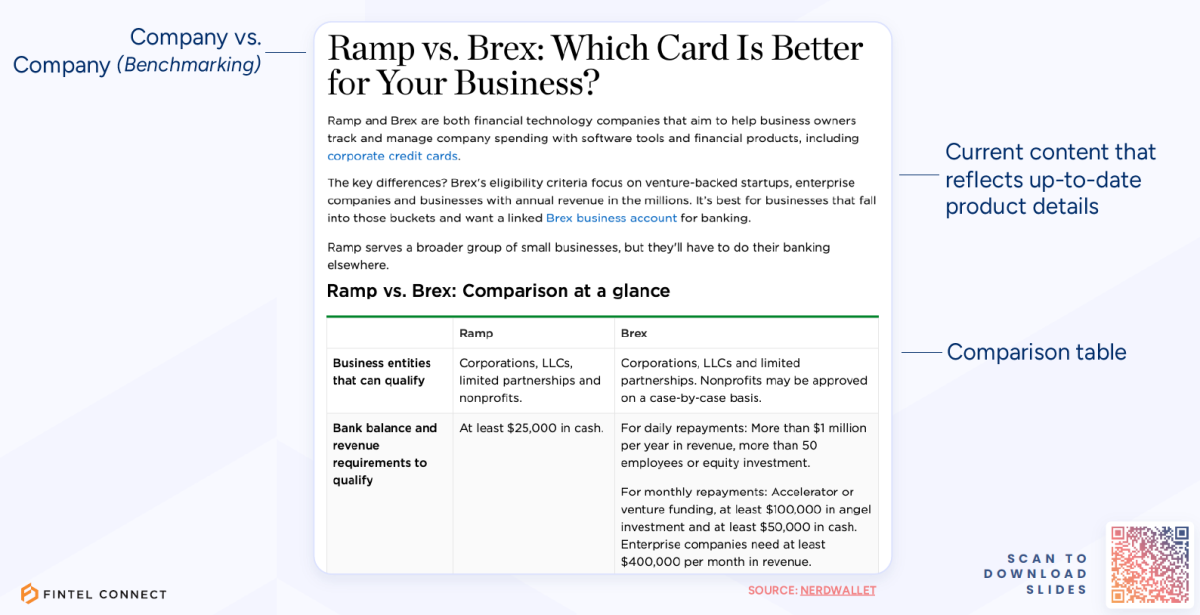
Content structure now matters as much as content authority. Fintel Connect’s AI visibility research found that listicles and comparison tables appeared in more than 70% of all AI-generated responses analyzed, making them the single most consistently cited format across platforms.
Independent research backs this up at scale: an analysis of nearly 400 million LLM citations across 25,000 URLs found that 63% of citations point to listicle pages, and 44.2% of all citations are pulled from just the first 30% of a document.
- Listicles (like “Best Student Credit Cards” or “Top High-Yield Savings Accounts”) let AI models extract structured information without ambiguity
- Educational articles are also frequently referenced, typically to provide supporting context alongside a direct recommendation
- FAQPage schema markup improves AI citation rates by roughly 30% on average, according to third-party structured-data research, reinforcing what our own findings show about question-led formatting
- iFrame-based promotional content did not appear in any AI-generated response in Fintel Connect’s study, despite being present on 12% of cited websites, confirming that embedded ads simply aren’t consumed by these platforms
Prompt intent also shapes what gets surfaced. Informational questions (“How does a high-yield savings account work?”) tend to pull from financial institutions and educational sources, while comparative questions (“What’s the best credit card for students?”) overwhelmingly generate affiliate-driven listicles.
What to do about it:
- Use question-style headers that mirror how customers actually phrase prompts to AI tools, and answer directly in the first few sentences of each section
- Build both comparison-style and educational content, since the two formats win visibility for different types of customer questions
- Add FAQPage schema to existing content rather than treating it as a net-new project. It’s one of the highest-leverage, lowest-effort structural changes available
- Avoid leaning on iFrames or embedded promotional widgets for anything you want AI platforms to be able to cite
Trend 6: why are financial brands consolidating marketing channels in 2026?
Budget scrutiny has intensified, and tolerance for underperforming or unmeasurable channels has dropped. A workable paid media mix increasingly runs around 60% search, 25% social, and 15% display and retargeting, with offline spend increasingly reserved specifically for brand and community work rather than acquisition.
At the same time, generative AI adoption inside marketing teams is accelerating quickly. Cornerstone Advisors’ research found that 59% of credit unions have already deployed generative AI tools, with content creation, audience segmentation, and campaign work among the top use cases, and credit unions are currently outpacing banks on adoption.
What to do about it:
- Reassess channels that can’t be clearly tied to funded accounts or approved loans, not just clicks or impressions
- If your team hasn’t adopted AI tools for content or segmentation yet, this is quickly becoming a competitive gap rather than an experiment
- Reserve offline and brand spend deliberately, rather than letting it compete directly with measurable acquisition channels, since brand and direct response often work together rather than against each other
Learn the key trends performance marketing leaders are seeing and best practices in customer acquisition.
Trend 7: How are embedded finance partnerships expanding customer acquisition?
Embedding financial products directly into another company’s customer experience is gaining traction as a way to reach new-to-brand audiences in a highly targeted environment. Bain & Company’s research estimates embedded fintech products will carry more than $7 trillion in U.S. transaction volume by the end of 2026, up from $2.6 trillion in 2021, and separate market research puts the global embedded finance market at roughly $94 to $115 billion in 2026 alone, growing at a double-digit rate industry-wide.
A bank offering financing options at checkout on a hardware retailer’s site, for example, reaches small business customers exactly when they need the product, not through a separate, disconnected campaign.
This approach is expanding beyond simple product placement into more creative structures. Turndown partnerships are one example: when a small business doesn’t qualify for a loan, instead of ending the relationship, a lender can refer that customer to another financing option or partner lender, preserving the value of the interaction instead of losing it entirely.
What to do about it:
- Identify complementary, non-competing businesses whose customers already need your product at a specific moment in their journey
- Consider referral structures for declined applicants rather than treating a “no” as a dead end
- Expect these partnerships to take time to structure correctly, and factor in the added compliance oversight now required of bank-fintech partnerships specifically. The strongest embedded finance deals are built deliberately, not rushed
How can banks and fintechs act on these trends with affiliate marketing?
Partnership marketing is one of the most direct ways to act on all seven trends at once, and it’s where Fintel Connect focuses exclusively for financial services.
- Industry-specific expertise. Working closely with financial affiliates gives visibility into which products and messaging are resonating with real audiences, informed by direct relationships with financial affiliates and publishers across the U.S. and Canada.
- A vetted network built for financial services. Access to 6,000+ affiliate partners familiar with financial products, from established publishers to niche influencers, bloggers, and fintech partners.
- Built-in tracking and content compliance. Financial services-specific tracking software paired with Fintel Check, an AI-powered compliance monitoring tool, so your team isn’t manually reviewing every partner page for accuracy.
- Strategic guidance on what to prioritize. From helping structure embedded finance partnerships like turndown referrals to advising on go-to-market strategy for new products.
If your program is already running, a program audit can identify what’s working against financial industry benchmarks and where quick wins are available.
Case studies: how a bank and fintech are adapting to financial marketing trends
Three very different financial institutions are already putting these trends into practice, each solving a different challenge with affiliate marketing.
Grasshopper Bank
A digital-first bank for founders and small businesses, needed to scale its affiliate program beyond a small, manually managed group of partners without losing sight of compliance or partner quality. By building a strategic mix of large-scale and long-tail affiliates on a performance-only model, Grasshopper grew approved accounts by 250% while keeping acquisition cost-efficient, proof that a diversified partner mix, not just bigger spend, drives sustainable growth.
See the full financial affiliate case study.
Coast Capital Credit Union
Canada’s largest credit union by membership, faced a different problem: expanding beyond a regional footprint without the affiliate expertise to forecast ROI confidently. A geo-targeted, data-driven approach to affiliate placements helped Coast Capital reach the right regional audiences on trusted personal finance sites, driving a 650% increase in new account acquisitions and a 12.5% reduction in cost per acquisition, a clear example of AI-favored, trusted third-party content translating directly into acquisition results.
See the full financial affiliate case study.
Qtrade Direct Investing®
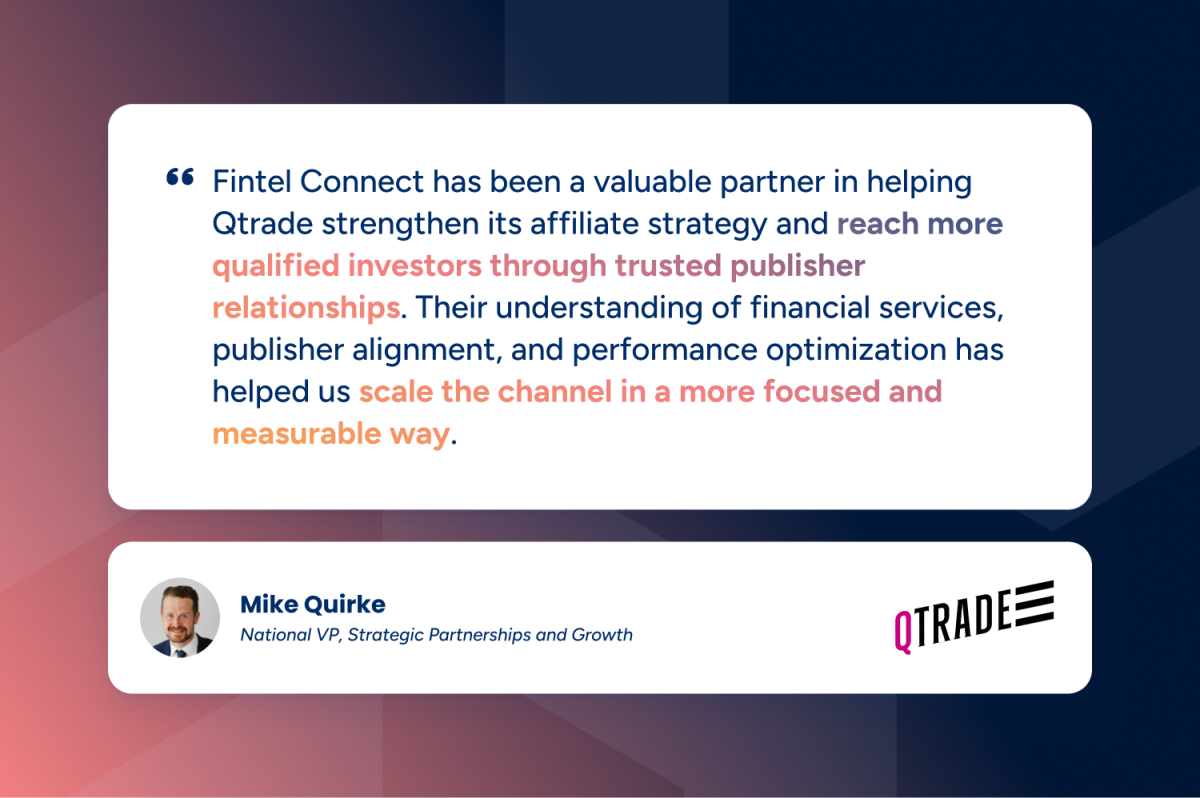
Qtrade, One of Canada’s top-ranked online brokerages, was fighting for visibility in an increasingly crowded comparison environment where investors evaluate multiple platforms side by side. Keeping affiliate partners consistently updated on Qtrade’s latest offer and expanding into a broader affiliate mix helped reduce reliance on any single partnership, growing approved accounts by 127% and clicks by 113%, underscoring how quickly outdated affiliate content can undercut an otherwise strong product.
See the full financial affiliate case study.
Across all three, the common thread lines up with the trends already covered here: diversified partnerships, accurate and current content, and outcomes measured by funded accounts and approved applications, not just clicks.
2026 is full of change and opportunity
These shifts can feel like a lot to navigate at once, but each one points toward the same underlying move: pairing strong, structured content with the right partnerships, and measuring both by real business outcomes rather than vanity metrics.



 English
  Français