Tag: Credit Unions

What Ron Shevlin’s Take on Bank Marketing ROI Means for Affiliate and Partner Marketing

What Ron Shevlin’s Take on Bank Marketing ROI Means for Affiliate and Partner Marketing

Ron Shevlin’s recent Forbes take on the marketing ROI gap argues that many banks and credit unions are still defending familiar marketing channels without enough confidence in what actually drives growth. For financial institutions, the bigger opportunity is to rethink performance marketing around measurable, high-quality acquisition channels, including affiliate and partner marketing.

Bank and credit union marketers are under growing pressure to prove what their budgets are doing. That pressure is not new, but the gap between spend, measurement, and confidence is becoming harder to ignore.

In The Marketing ROI Gap in Banking report, Ron Shevlin doesn’t simply say financial institutions need better attribution. His argument is sharper than that. The industry’s marketing budget process is often built on historical spend, executive pressure, competitive reaction, and familiar channels rather than clear performance data.

That’s the real issue. If a financial institution can’t reliably connect marketing activity to funded accounts, deposits, loan volume, or long-term customer value, then budget allocation becomes less of a growth strategy and more of an annual negotiation.

Paid search is the clearest example of the gap

The most striking part of Ron’s take is his critique of paid search.

Paid search accounts for the largest share of marketing budgets. In the Cornerstone report, 46% of respondents named paid search as one of the top two channels by budget allocation. Yet when executives were asked which channels deliver the strongest ROI, email marketing ranked first at 48%, while paid search was ranked second at 38%.
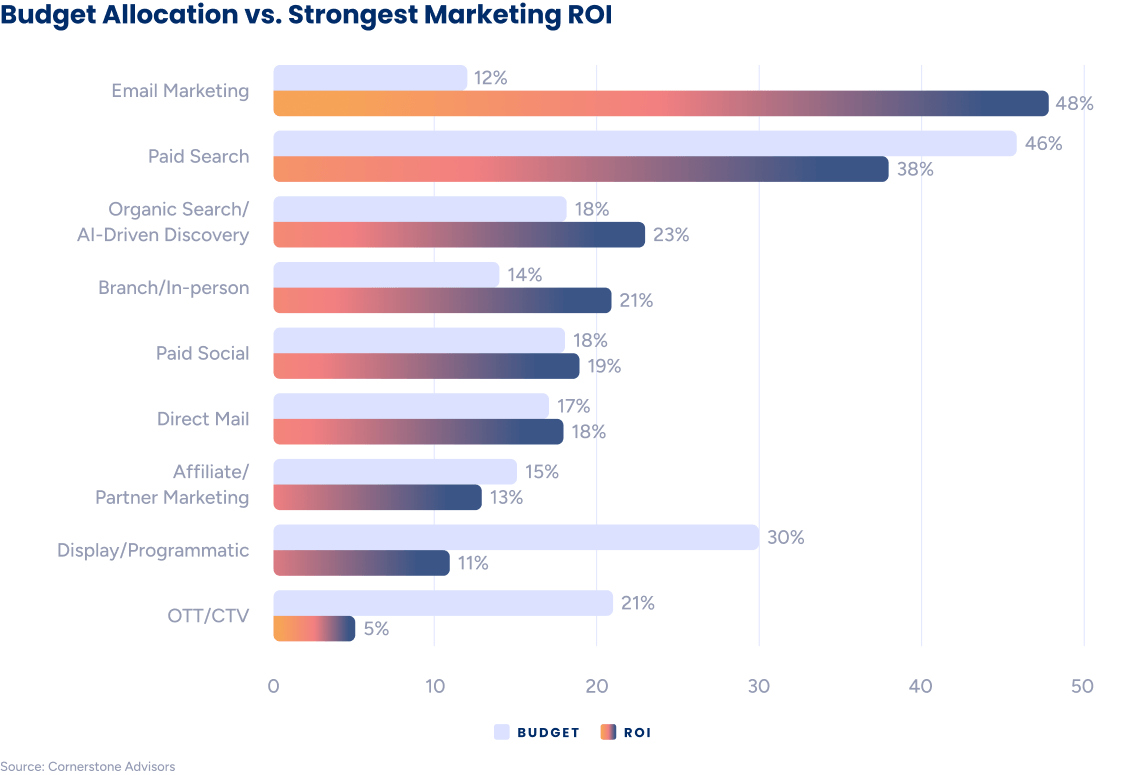
Horizontal bar chart titled “Budget Allocation vs. Strongest Marketing ROI.” It compares budget percentage (light blue) to ROI percentage (gradient) across marketing channels. Email Marketing shows 12% budget vs. 48% ROI (highest ROI). Paid Search: 46% budget, 38% ROI. Organic Search/AI-Driven Discovery: 18% budget, 23% ROI. Branch/In-person: 14% budget, 21% ROI. Paid Social: 18% budget, 19% ROI. Direct Mail: 17% budget, 18% ROI. Affiliate/Partner Marketing: 15% budget, 13% ROI. Display/Programmatic: 30% budget, 11% ROI. OTT/CTV: 21% budget, 5% ROI (lowest ROI). The chart highlights that Email Marketing delivers the strongest ROI relative to its budget, while Display/Programmatic and OTT/CTV have high budgets but low ROI. Source: Cornerstone Advisors.

The performance gap becomes clearer when channels are rated across cost efficiency, volume potential, customer or lead quality, and scalability. Email marketing ranked highest overall. Affiliate and partner marketing ranked second. Paid search ranked fourth.

Ron’s point isn’t that paid search has no role. It’s that many institutions continue to lean heavily on it because it is visible, familiar, and easy to explain internally, even when executives themselves rate other channels more favorably.

The marketing budget process is working backward

The Cornerstone Advisors report, commissioned by Fintel Connect, found that nearly 6 in 10 institutions determine their marketing budgets by adjusting the previous year’s budget. Only 18% set budgets from the bottom up by initiative or business case.

That matters because last year’s budget is only useful if last year’s results were clearly understood. In many institutions, they were not.

The report found that 60% of institutions say core or CRM integration limits their ability to measure marketing ROI, while 28% say they don’t have reliable attribution. Not a single respondent said their institution could reliably attribute all six customer-level outcomes evaluated in the study.

Ron’s Forbes article turns that into a simple but uncomfortable point: if the data is unreliable, then the budget baseline is unreliable too. The result is a cycle where marketing teams adjust spend based on what is familiar, defensible, or requested by leadership, rather than what is proven to perform.

Affiliate marketing is still underused, despite its performance profile

This is where the report becomes especially relevant for financial marketers.

Only 32% of institutions surveyed actively invest in affiliate or partner marketing, making it the least-used channel in the study. Yet 21% named it as their most underleveraged channel, and it ranked second overall across evaluated channel attributes.

Its strongest attribute was customer and lead quality. That should stand out to bank marketers because the report also shows that volume and customer quality are two of the most important marketing performance factors executives care about.

In other words, financial institutions say they want better-quality growth, but many are underinvesting in a channel that respondents associate with stronger customer and lead quality.

Cornerstone’s report makes the strategic point clearly: affiliate and partner marketing doesn’t operate like an auction-based channel. Instead of competing for attention in paid search, institutions can participate in ecosystems where consumers are already researching and comparing financial products. When structured correctly, these programs can create high-intent traffic and allow institutions to pay for performance rather than impressions or clicks.

Financial institutions need more than generalist performance marketing platforms

Recent movement in the broader performance marketing market shows where the category is heading. Affiliate and partner marketing is no longer being treated as a narrow referral tactic or a secondary acquisition channel. It’s becoming a more integrated growth ecosystem built around technology, services, partner relationships, tracking, attribution, incrementality, and performance-based outcomes.

That shift matters for banks and credit unions.

As the broader market moves toward larger, more connected partnership ecosystems, financial institutions should be asking a more specific question: not simply whether affiliate and partner marketing can scale, but whether it can scale in a way that reflects the realities of financial services.

Banks and credit unions aren’t marketing everyday consumer products. They are promoting regulated financial products that require accurate disclosures, compliant partner content, transparent publisher relationships, qualified applicants, funded-account tracking, and a clear understanding of how marketing activity connects to business outcomes.

That is where generalist platforms can fall short. Scale, automation, and marketplace access are valuable, but financial institutions need more than reach. They need a partner that understands the nuances of financial marketing, from product eligibility and rate language to compliance review workflows, partner vetting, and the difference between a lead, an application, and a funded account.

The broader market’s move toward integrated partnership infrastructure validates the importance of affiliate and partner marketing. But for banks and credit unions, the opportunity is not just to participate in a bigger ecosystem. It is to build a performance marketing strategy designed for the complexity, accountability, and compliance standards of financial services.

What Ron’s article highlightsWhat it means for bank marketersWhy affiliate and partner marketing matters
Budgets are often based on last year’s numberSpend may reflect habit more than performancePerformance-based channels create a clearer link between spend and outcomes
Paid search gets outsized budget attentionInstitutions may overinvest in familiar but highly competitive channelsPartner ecosystems can reach consumers in high-intent research environments
Attribution remains unreliableMarketing leaders struggle to defend budget decisionsAffiliate programs can be structured around trackable actions and funded outcomes
Marketing is often treated as a support functionMarketing needs a stronger role in growth strategyPartner marketing requires strategic decisions around audience, offer, publisher fit, and measurement

Where banks and credit unions should go from here

Recent movement in the performance marketing market shows that affiliate and partner marketing is becoming a more integrated, measurable growth channel and not just a referral tactic.

For banks and credit unions, that shift matters. The question is not only whether affiliate marketing can scale, but whether it can scale in a way that reflects the realities of financial services.

Unlike everyday consumer products, financial products require accurate disclosures, compliant content, transparent partner relationships, qualified applicants, funded-account tracking, and clear ROI measurement.

That is where generalist platforms can fall short. Scale and automation are valuable, but financial institutions need a partner that understands financial marketing nuances, from rate language and compliance workflows to partner vetting and funded-account outcomes.

The broader market validates the importance of affiliate and partner marketing. But for banks and credit unions, the real opportunity is to build a strategy designed for the complexity, accountability, and compliance standards of financial services.

FAQ

What is Ron Shevlin’s main point about the marketing ROI gap?

His main point is that many banks and credit unions are making marketing budget decisions without reliable performance data. That creates a cycle where historical budgets, executive pressure, and competitive reactions can outweigh actual measurement. 

Why does paid search receive so much criticism?

Paid search receives the largest share of marketing budgets, but executives rate other channels more strongly on ROI and performance attributes. The issue is not that paid search never works, but that many institutions may be overrelying on it because it is familiar and easy to defend internally.

Why is affiliate marketing relevant to bank marketing ROI?

Affiliate and partner marketing ranked second overall among evaluated channels in the Cornerstone report and was rated strongly for customer and lead quality. Yet only about a third of institutions currently invest in it, making it one of the clearest underused opportunities in the channel mix.

Why do banks and credit unions need a financial affiliate marketing specialist?

Affiliate and partner marketing can be a high-performing acquisition channel for financial institutions, especially when programs are built around customer quality, funded outcomes, and measurable ROI. But banks and credit unions need more than access to a broad affiliate marketplace. They need a specialist that understands financial products, content compliance requirements, partner vetting, disclosure language, and the difference between traffic, applications, and funded accounts.

A Look at Why Compliance Tools Are Crucial for Financial Institutions Launching Affiliate Programs

Affiliate marketing is becoming an increasingly popular channel for marketers in financial institutions. More and more, we’re seeing partnerships between financial institutions and third-party publishers or influencers that are helping them better reach their target audiences. 

As financial brands engage in this newer marketing model, it’s important to remember that these partnerships are subject to the same regulatory requirements as their in-house marketing efforts. Compliance tools are thus an integral part of a successful affiliate channel — one that needs to be incorporated from the get-go. 

In this article, we address the need for compliance tools as part of your affiliate marketing efforts, and share best practices for choosing the right solutions. 

Want to know more about how our tool, Fintel Check, can help your team save time and stay ahead of the regulators? Reach out to us here.

The Regulatory Landscape for Marketers in Finance

When it comes to marketing compliance, financial institutions have a lot to stay on top of. There are a number of rules, regulations, and guidelines from various regulatory bodies that exist to safeguard the interests of consumers and maintain integrity in the industry. These regulations, such as those imposed by the Securities and Exchange Commission (SEC), Federal Deposit Insurance Corporation (FDIC), and the Consumer Financial Protection Bureau (CFPB), outline the dos and don’ts of marketing practices in the industry.

Not complying with these rules can not only result in financial fines, they can also compromise your brand’s reputation and negatively impact its ability to build trust and generate deposits. As such, there’s a significant need for financial institutions to keep their marketing efforts within the confines of existing regulations.

Affiliate Marketing in Financial Institutions

Affiliate marketing has become an appealing channel for financial institutions for numerous reasons. Based on third-party relationships with publishers, influencers, or other brands in the same sphere of influence, affiliate marketing allows banks and other financial institutions to access an existing audience of target customers. Other benefits of affiliate marketing include: 

  • Increased diversification within the marketing strategy
  • A cost-effective approach to customer acquisition
  • Enhanced online presence 
  • Improved brand awareness
  • More refined target marketing efforts 

While the benefits are plentiful, affiliate marketing can also open the door to potential compliance risks. At the end of the day, if your third-party partner is producing and publishing the content for an affiliate campaign, your marketing team will inherently have less control over what is published. Your affiliates might not know about the various regulations your brand needs to adhere to, and they may post something that ultimately puts you in a position of non-compliance. 

This is where a marketing compliance tool — one that automatically checks any mention of your brand for compliance — is key. It can make or break the success of your affiliate marketing program.

Compliance Tools: What They Are and Why You Need Them

Marketing compliance tools are software solutions that have been crafted to help marketing teams keep their activities aligned with legal and regulatory standards and policies. These tools typically include automated or AI-driven compliance checks, real-time monitoring across specific web pages, and reporting functionalities that provide a central viewpoint into the regulatory health of a specific brand or family of brands. 

Without these marketing compliance tools, teams are left to manually check and review whether their messaging is compliant across the board, and that opens the door to frequent and costly human error. Instead, using a marketing compliance tool can help teams stay focused on their strategic initiatives while also having peace of mind that their brand is not at risk of non-compliance.

As financial brands operate in such a complex regulatory environment, compliance tools are particularly useful in this context. They vastly reduce the risk of human error and can catch content discrepancies before regulators do so that teams can act quickly to address them. Not only does this help build trust with regulators, it also ensures that your brand is communicating with customers in the most effective, ethical, and appropriate way. 

How to Choose the Right Compliance Tool

If you’re in the search for a marketing compliance tool for your financial institution, consider the following questions: 

  • Was the tool designed exclusively for financial institutions? As we discussed above, financial institutions have very specific marketing regulations that go beyond what other industries might have to navigate. Choosing a tool that was designed for the industry will ensure that you have broader and more specific coverage. 
  • Does it have a robust technology behind it? What type of software supports the solution? And are you able to set the frequency for your scans? Ideally, you’ll be looking for a rules-based engine that allows you to flexibly set your own rules for monitoring content (e.g., inclusion of disclosures). 
  • Does it monitor links outside your website? The best platforms automate the process of finding and reviewing your content, comprehensively scanning it to ensure it aligns with your brand guidelines and desired placements.
  • Does it include reporting capabilities? Are you able to pull a report of all your live campaigns to understand whether they are compliant? 

Other important factors to keep in mind as you make your decision will be the cost, scalability, ease of use, and the quality of the customer support. Once you’ve landed on the compliance tool that makes the most sense for your business and marketing efforts, you will be well-positioned to expand your affiliate partnerships and scale your program knowing you’ve got your content compliance covered. 

Financial institutions use Fintel Check to amplify their compliance team’s capacity and set their marketing programs up for long-term success. Reach out to our team to learn more.

How to Choose the Right Affiliates for Your Fintech, Bank, or Credit Union 

Picture this scenario,

You’re a forward-thinking fintech company, a bank, or a credit union, looking to increase your online presence and scale your digital growth You’ve developed innovative products and services, but now you face the challenge of reaching a wider audience and driving growth.

How can you achieve this?

Affiliate marketing is a powerful channel to leverage, and one major key to success is finding the right affiliate partnerships for your brand.

If you are a financial brand ready to kickstart your affiliate program, reach out to our team of experts and they’ll walk through the process of getting started.

In today’s competitive market, affiliate marketing has emerged as a game-changer, offering businesses like yours a powerful way to expand their reach and drive revenue growth.

According to recent studies, affiliate marketing spending is set to grow to approximately $14.3 billion in 2023 globally, $15.7 billion by 2024 and is expected to continue growing (influencer marketing hub). This showcases its effectiveness and growing popularity.

However, with countless potential affiliates out there, how do you ensure that you select the right ones to propel your financial institution toward success?

In this article, we will guide you through the steps of choosing the right affiliates and ensuring that your partnerships align with your business goals and target audience. 

Understanding Your Business Goals and Target Audience

– Identify Your Objectives

Setting clear goals for your affiliate programs is crucial for success. Suppose your fintech company aims to revolutionize payment solutions or your bank wants to enhance customer experience with cutting-edge digital banking services.

Identifying your goals is essential as they serve as the foundation for your affiliate program. 

– Identifying your Target Audience

Understanding your target audience is crucial. Are you catering to millennials seeking convenient financial management tools, or are you targeting small business owners searching for efficient payment processing solutions?

By defining your target audience, you can tailor your affiliate partnerships to effectively reach and engage the right people with relevant offers and promotions. 

– Seek Strategic Alignment with Affiliates

Ensure that the affiliates you choose have a strong alignment with your business objectives. Seek affiliates who have a pre-existing audience that matches your target audience.

Look for affiliates whose content, values, and messaging resonate with your target audience. 

Assessing Affiliate Program Performance Metrics

Evaluate performance metrics

– Determine Essential KPIs

To measure the success of your affiliate program, you need to assess key performance indicators (KPIs) that align with your goals.

Regularly track and analyze performance metrics to assess the effectiveness of your affiliates. 

– Track and Analyze Performance Metrics

Tracking and evaluating KPIs are essential for achieving above-average conversion rates.

For instance, you might track click-through rates, conversion rates, average order value, or customer lifetime value. These metrics provide valuable insights into the efficacy of your affiliates in driving results. 

– Leverage Data Analytics for Insights

Utilizing data analytics in your affiliate marketing strategies can lead to higher customer lifetime value and return on investment.

By analyzing the data collected from your affiliate program, you can identify which affiliates are driving the most valuable traffic and generating high conversion rates.

Armed with this information, you can make informed decisions to optimize your program and allocate resources effectively. 

Defining Affiliate Criteria and Selection Process

– Establish Affiliate Qualification

Partnering with relevant influencers has been successful for many marketers. Consider factors such as industry experience, audience relevance, brand alignment, and reputation.

For example,
partnering with a financial influencer or publisher like
NerdWallet or GoBankingRates who shares your values and caters to your target audience can be a winning combination.  

To help financial brands set themselves up for success and choose the right affiliates for their marketing needs, Fintel Connect has developed a comprehensive range of solutions.

Among these offerings is Fintel Performance, an exclusive network of affiliates and influencers tailored specifically for the financial industry.

The platform incorporates advanced affiliate management features, enabling financial brands to expand their reach effectively. 

– Set Clear Evaluation Criteria

Develop a systematic selection process that involves conducting background checks, reviewing websites and online presence, and assessing track records in affiliate marketing.

By following a structured approach, you can make informed decisions and select affiliates that align with your goals and values. 

Building and Managing Affiliate Relationships

Building affiliate relationshipsOnce you have identified potential affiliates, it’s time to establish and nurture those relationships. Here are ways you can do that.

– Personalize your Outreach Strategy

Craft personalized pitches that highlight the mutual benefits of collaboration. Reach out to reputable finance bloggers, industry experts, or social media influencers who can amplify your brand’s message and drive qualified traffic to your financial products or services. 

– Conduct Due Diligence

Thoroughly research potential affiliates, looking for any potential conflicts of interest, unethical practices, or questionable content that could harm your brand’s reputation.

It’s essential to establish partnerships with affiliates who uphold high standards and share your commitment to customer satisfaction. 

– Support Affiliates for Success

Provide affiliates with the necessary support and resources to ensure their success and, in turn, your own.

Offer marketing materials, tracking tools, and regular communication channels for smooth collaboration. Regularly evaluate their performance and provide constructive feedback to optimize their efforts. 

Choosing the right affiliates for your fintech, bank, or credit union requires a strategic approach.

By aligning your affiliate partnerships with your business goals and target audience, assessing performance metrics, defining criteria, and nurturing strong relationships, you can create a successful affiliate program that drives growth and enhances your brand’s reputation.

Remember, the right affiliates can be powerful allies in expanding your reach and achieving your financial institution’s objectives. So, take the time to choose wisely and embark on a rewarding affiliate journey.

Group of influencers dance in front of a recording phone

How Influencer Marketing Can Win Over the Next Generation of Members

Credit unions have increasingly faced the challenge of attracting new generations of members. In CUNA’s latest webinar, financial industry experts discussed ways to boost credit unions’ marketing strategies and attract new audiences through influencer partnerships.

At Fintel Connect, we’ve seen influencer marketing account for 30%-40% of customer acquisition – one of the best ways to reach younger generations. In a webinar hosted by CUNA earlier this year on “How Influencer Marketing Can Win Over the Next Generation of Members”, we heard from industry experts on how credit unions can provide value for Gen Z members and build brand credibility.

Here are the key takeaways from this session to help you boost your marketing strategy while engaging with a new audience.

Building strong relationships is the key to providing value for Gen Z

With so many different options for banking, younger generations often look for financial institutions with the best apps that can deliver instantaneous results. However,Joshua Kopac, VP of Sales at Prodege, pointed out that it’s not always about having a fancy app to provide value for the Gen Z generation. He mentioned that credit unions’ strongest advantage over other digital banks and FIs is their ability to create solid and lasting relationships with their members. Younger members need personalized support and guidance to make the right financial decisions, which many apps can’t provide. In addition to needing help managing their finances, Gen Zs look for brands that positively impact their community.

Becky Giannelli, Director of Integrated Marketing, Digital & Creative at PSECU, highlighted that credit unions are dedicated to the community they are part of and give back in ways that support their members – something important to younger generations.

Man playing with wood jenga

Influencer partnerships provide an authentic view of your brand

As many marketers know, word of mouth is one of the most effective forms of marketing. In fact, word of mouth is directly responsible for 90% of all purchase decisions. But how do you get people talking about your brand in an authentic way? Enter influencers. Apple Crider, Influencer and Co-founder of Creators Agency, mentioned that in the world of online media, Gen Zers look to influencers, like they would their friends, to recommend products/services. The reason is that younger generations will often trust a third-party review over direct marketing from a brand.

In addition, influencers value their relationships with their audience and will only partner with brands that are the right fit for them; they will give an authentic perspective on a brand they believe in.

Boost your digital impact and revenue

Learn how our comprehensive and fully integrated technology can help your business exceed its growth goals.

Influencer marketing won’t cannibalize your marketing mix; it’ll leverage it

When discussing how influencer marketing fits into your regular marketing mix, Nicky Senyard, CEO at Fintel Connect, noted that influencers are the cherry on top of your digital marketing mix because they provide valuable content across all channels. They are a powerful addition to your current strategy and will help drive new conversions at crucial touchpoints in the digital space.

Kopac of Prodege, also pointed out that influencers can provide instant data results that will give you complete transparency on how their content is performing, making it easy to understand what is working and what is not.

With this in mind, how do you budget for influencer partnerships? Senyard mentioned that most influencers work on either a flat-fee or cost-per-acquisition (CPA) model. She suggests spending 10% of your budget on experimental channels and testing to see what works best. Influencer partnerships require trial and error, so don’t be afraid to test and make changes as you go.

Yes, influencer partnerships can remain compliant

Compliance is always top of mind when experimenting with new marketing channels. The good news is that financial influencers understand compliance and will work with your brand to ensure those standards are met. Here are some tips from our experts on how to avoid issues with compliance when entering a new partnership:

woman holding a folder
  • Agree upon the terms & conditions for the partnership: be transparent with your partners and ensure that both parties agree on the terms and conditions before entering the partnership. Determine what the line of consequence is if those conditions aren’t met.
  • Give influencers your brand guidelines: giving influencers the tools they need will help ensure the accuracy of statements and representations of your brand.
  • Define a process for content sign-off: work out a process with the influencer for how content gets approved before it goes live. Reviewing content can help catch compliance mistakes before it’s too late.
  • Create a do-not-do list rather than a to-do list: it’s better to tell influencers what not to do rather than what to do. They will talk about your brand in their voice, so giving them a list of things to avoid will help them accurately speak about your brand while being authentic.

Do the research, have courage, and take the leap

There is no time like the present. With talks of the big “R” word lurking around the corner of the current economy, Kopac pointed out that there is no better time than now to try influencer marketing. As brands begin to pull back in their marketing spending, now is the time to get ahead by entering a less populated and competitive space.

However, leaping into something new can be daunting. It might not always work out right on the first try– but that’s okay! Building the right partnerships can take time. Senyard suggests that the best thing to do is to have the courage to explore this new channel and to do the research required to find out what will work for your brand.

Here’s how you can start:

  • Research whom other financial brands are partnering with
  • Ask your staff if they follow any financial influencers/creators
  • Talk to your network and ask if and how they have worked with influencers
  • Chat with your teams and get buy-in from leadership

If you want to learn more about influencer marketing strategies and how to enhance your bank marketing strategy through partnerships,get in touch with us or follow us on LinkedIn to keep up with the latest in affiliate marketing for financial services.

Last but not least, thanks to CUNA Councils for hosting an insightful conversation with industry experts who shared various perspectives on influencer marketing. If you want to follow some thought leadership accounts check out these experts:

Joshua Kopac – VP, Sales – Prodege
Apple Crider – Influencer/ Co-founder –Creators Agency
Becky Giannelli – Director of Integrated Marketing, Digital & Creative –PSECU
Nicky Senyard – CEO and Founder – Fintel Connect
LaShanta Green(moderator) – Director of Marketing & Community Relations – Dow Chemical Credit Union

Person analyzing data on a laptop in a coffee shop

Master the Growth Mindset: 4 Tactics to Drive Performance

In this article

Four key tactics to achieving a growth mindset at your company:

  1. Focusing on bottom-funnel attribution
  2. Leads: quality vs. quantity
  3. Referrals to scale your growth exponentially
  4. Choosing purposeful technologies

When it comes to identifying best practices, marketing can often be unpredictable.

With the pace of rapidly emerging trends, frequently shifting priorities, and the demands of an ever-evolving user landscape, brands are being challenged to keep up.

This leads to experimentation with various tactics to understand what sticks and generates sales.

Adopting a growth mindset is essential for brands looking to elevate their marketing performance. A growth-focused stand enables teams to plan at the highest logical level before implementing any tactical operations.

This is why we’ve seen such an increase in growth-specific marketing roles at leading companies. More than ever, the link between marketing and company growth is clear, and organizations worldwide are investing in experts who can lead the change.

Here are four ways to implement leading growth marketing strategies into your business.

1. Implement bottom-funnel attribution early

So, you’ve just launched a product with a waitlist and are collecting future customers into your pipeline.

They’re rearing and ready to go: they’ve joined your email list, are following your updates on social media, and are sharing with friends and family to join as well. Or are they?

Too often, early-stage companies leave potential customers to sit and stew, missing the critical period between sign-up and conversion.

This is the stage where founders may be looking at views, impressions, and clicks as a reflection of their marketing performance when they should be assessing the quality of leads and converting them as quickly as possible.

Man draws marketing funnel in a glass board

To achieve this result, focus on the lower-funnel metrics and attribute them as an indicator of marketing performance.

Bottom-of-the-funnel metrics could include incomplete account sign-ups, new users, webinar registrations, frequency of logins, or looking at users who create accounts but don’t purchase products (or whatever your desired next step is).

To help drive the growth of these types of high-intent users in a budget-friendly way, your brand may consider using a channel like affiliate marketing.

Affiliates and influencers often have earned trust and credibility with your target customers, and understand their needs and the problems they wish to solve.

Affiliate marketing can be applied to virtually any channel used by publishers and influencers, including TikTok, YouTube, Instagram and websites, and using tracking codes make bottom-funnel attribution simple.

Affiliate marketing for bottom-funnel lead gen

Learn how affiliate partners can drive customers to your website, delivering as much as 40% of your net new customers.

Let’s chat

2. Focus on quality as well as quantity

Suppose you’ve raised a pre-seed, seed, or Series A round. In that case, you may feel pressured to emphasize the exact number of users you’ve acquired in your investor reports, as this specific metric is often associated with growth.

However, as you shift to a growth mindset, consider showcasing the quality of your user-base rather than focusing on the quantity.

Balance golden scale

For example, if your model has both a freemium and paid structure, take a look at how your paid user activation rates compare to free users.

Is the activation of free users outpacing paid users? If not, ask yourself why then put yourself in your customer’s shoes.

You may find it could be a fragmented user experience on your app or users’ perception of your product value, among others. No matter the cause, a quality base of paying users is an essential signal for growth: customers that drive recurring revenue are more likely to satisfy investors.

In tandem, start to think about your user retention. It’s well-known that the cost to acquire a new customer is higher than to retain or upsell an existing one.

A growth mindset will combine a healthy new-user acquisition strategy with purposeful retention and upsell initiatives, ultimately nurturing your existing user base into brand evangelists.

To achieve this, try implementing real-time customer feedback mechanisms: they’ll enable your product innovation and create stickiness with your users, both free and paid.

Partnering with affiliates and influencers can ultimately help you scale customer referrals at exponential levels. The right partnerships can enable you to hone your message, expand your reach, and improve scale in a cost-effective, sustainable way.

3. Capitalize on referral at scale

“Refer your friends and family!” Do you remember hearing that from your local store? What if you could do that on a massive scale and grow your business at an unprecedented rate? Good news! You can.

Affiliate marketing can provide the same brand evangelism that a local store owner would get from their neighborhood customers.

For affiliates, influencers, and publishers, their “friends and family” are their followers -at a much larger, more trackable, and sustainable scale. It can put your company at the forefront of your industry through credible partners and adds ‘unseen’ bonuses such as customer research, brand growth, and positioning.

Partnering with affiliates and influencers can help you scale customer referrals at exponential levels. Facilitating 1:1 word-of-mouth referrals is powerful in driving the correct type of growth activity.

With the right partnerships in place, you can hone your message, expand your reach, and improve scale cost-effectively, sustainably.

Young people with computers having a conversation while sitting on a wood table

To ensure your partnerships give you a competitive edge, arm your partner with a unique offer tailored to their audiences—for example, a product, service, or discount that is only accessible via that relationship.

Additionally, look for partners with strong influence, such as extensive social media reach. Also, analyze their following against engagement; compare email lists relative to monthly page views, monthly unique visitors, and open and click-through rates.

Once your partner’s content is published, consider using paid ads for retargeting users that interact with the partner’s content.

This initial interaction can signal a level of intent with your product or offer, and it may be worthwhile to allocate a budget towards re-engaging them as they’re more likely to convert.

Finally, sharing these insights and performance with your partners can create cyclical insights that are mutually beneficial.

With a growth mindset, you can use tactics like these to take advantage of the referral opportunities presented to grow your business and partner relationships.

4. Choose purposeful technologies that match your business needs

Mastering the growth mindset means uncovering opportunities and anticipating and clearing out roadblocks.

When you have visibility into the friction points impeding your growth, you can tackle them head-on – especially if technology can solve them.

Knowing where your challenges lie allows you to choose and implement purposeful technologies that not only suit your business needs, they’ll make your life easier.

For selecting technology partners or solutions that meet your needs in the long term, here are some essential must-haves to consider that will help you maximize your growth:

  • Workflow tools to facilitate a smooth customer journey
  • Flexible solutions that can adapt to evolving regulatory requirements (CAN-SPAM, GDPR, and other regulations)
  • Analytics capabilities that fit your criteria for monitoring customer experience
  • Seamless API integrations with other best-of-breed tools

Conclusion

Mastering a growth mindset can take you from a start-up to a stand-out, and you don’t have to be an expert marketer.

When you’re focused on the right metrics, like attribution and quality of users, combined with referrals at scale and impactful technology usage, you can grow your business from the inside out.

Jumpstart your performance marketing

Our award-winning platform can take your acquisition marketing to the next level.

en_USEnglish