
What Ron Shevlin’s Take on Bank Marketing ROI Means for Affiliate and Partner Marketing

In this article
Related articles
Ron Shevlin’s recent Forbes take on the marketing ROI gap argues that many banks and credit unions are still defending familiar marketing channels without enough confidence in what actually drives growth. For financial institutions, the bigger opportunity is to rethink performance marketing around measurable, high-quality acquisition channels, including affiliate and partner marketing.
Bank and credit union marketers are under growing pressure to prove what their budgets are doing. That pressure is not new, but the gap between spend, measurement, and confidence is becoming harder to ignore.
In The Marketing ROI Gap in Banking report, Ron Shevlin doesn’t simply say financial institutions need better attribution. His argument is sharper than that. The industry’s marketing budget process is often built on historical spend, executive pressure, competitive reaction, and familiar channels rather than clear performance data.
That’s the real issue. If a financial institution can’t reliably connect marketing activity to funded accounts, deposits, loan volume, or long-term customer value, then budget allocation becomes less of a growth strategy and more of an annual negotiation.
Paid search is the clearest example of the gap
The most striking part of Ron’s take is his critique of paid search.
Paid search accounts for the largest share of marketing budgets. In the Cornerstone report, 46% of respondents named paid search as one of the top two channels by budget allocation. Yet when executives were asked which channels deliver the strongest ROI, email marketing ranked first at 48%, while paid search was ranked second at 38%.
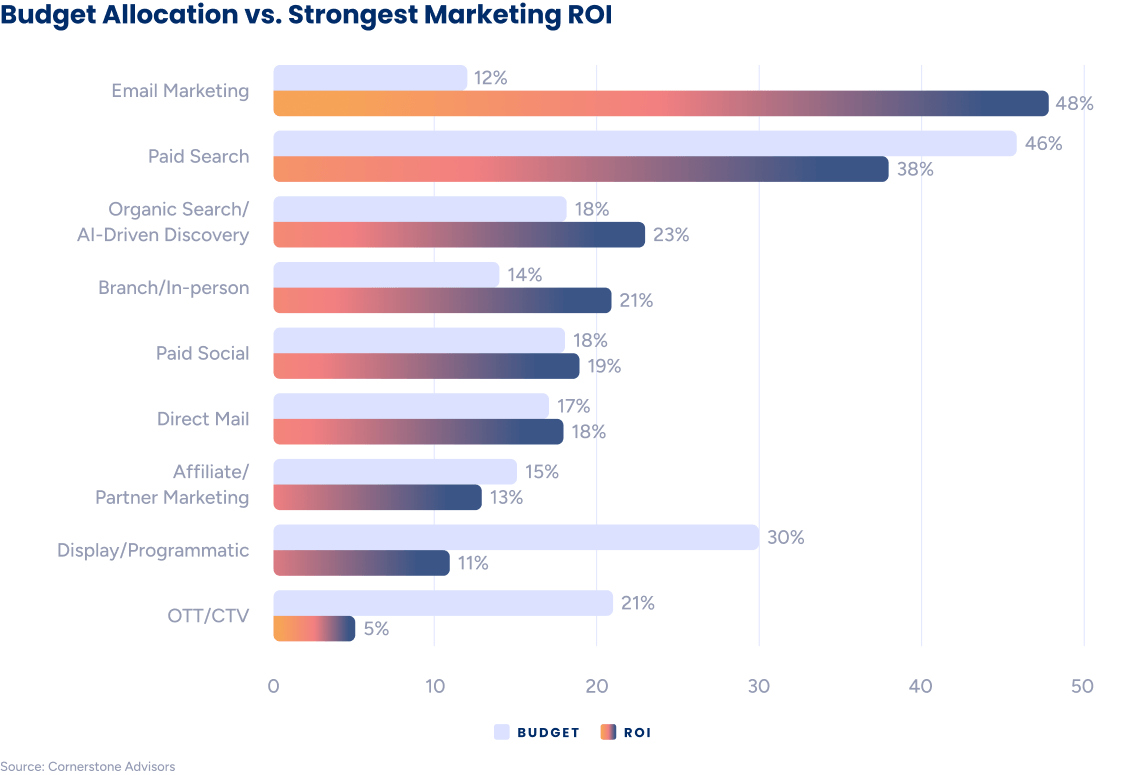
The performance gap becomes clearer when channels are rated across cost efficiency, volume potential, customer or lead quality, and scalability. Email marketing ranked highest overall. Affiliate and partner marketing ranked second. Paid search ranked fourth.
Ron’s point isn’t that paid search has no role. It’s that many institutions continue to lean heavily on it because it is visible, familiar, and easy to explain internally, even when executives themselves rate other channels more favorably.
The marketing budget process is working backward
The Cornerstone Advisors report, commissioned by Fintel Connect, found that nearly 6 in 10 institutions determine their marketing budgets by adjusting the previous year’s budget. Only 18% set budgets from the bottom up by initiative or business case.
That matters because last year’s budget is only useful if last year’s results were clearly understood. In many institutions, they were not.
The report found that 60% of institutions say core or CRM integration limits their ability to measure marketing ROI, while 28% say they don’t have reliable attribution. Not a single respondent said their institution could reliably attribute all six customer-level outcomes evaluated in the study.
Ron’s Forbes article turns that into a simple but uncomfortable point: if the data is unreliable, then the budget baseline is unreliable too. The result is a cycle where marketing teams adjust spend based on what is familiar, defensible, or requested by leadership, rather than what is proven to perform.
Affiliate marketing is still underused, despite its performance profile
This is where the report becomes especially relevant for financial marketers.
Only 32% of institutions surveyed actively invest in affiliate or partner marketing, making it the least-used channel in the study. Yet 21% named it as their most underleveraged channel, and it ranked second overall across evaluated channel attributes.
Its strongest attribute was customer and lead quality. That should stand out to bank marketers because the report also shows that volume and customer quality are two of the most important marketing performance factors executives care about.
In other words, financial institutions say they want better-quality growth, but many are underinvesting in a channel that respondents associate with stronger customer and lead quality.
Cornerstone’s report makes the strategic point clearly: affiliate and partner marketing doesn’t operate like an auction-based channel. Instead of competing for attention in paid search, institutions can participate in ecosystems where consumers are already researching and comparing financial products. When structured correctly, these programs can create high-intent traffic and allow institutions to pay for performance rather than impressions or clicks.
Financial institutions need more than generalist performance marketing platforms
Recent movement in the broader performance marketing market shows where the category is heading. Affiliate and partner marketing is no longer being treated as a narrow referral tactic or a secondary acquisition channel. It’s becoming a more integrated growth ecosystem built around technology, services, partner relationships, tracking, attribution, incrementality, and performance-based outcomes.
That shift matters for banks and credit unions.
As the broader market moves toward larger, more connected partnership ecosystems, financial institutions should be asking a more specific question: not simply whether affiliate and partner marketing can scale, but whether it can scale in a way that reflects the realities of financial services.
Banks and credit unions aren’t marketing everyday consumer products. They are promoting regulated financial products that require accurate disclosures, compliant partner content, transparent publisher relationships, qualified applicants, funded-account tracking, and a clear understanding of how marketing activity connects to business outcomes.
That is where generalist platforms can fall short. Scale, automation, and marketplace access are valuable, but financial institutions need more than reach. They need a partner that understands the nuances of financial marketing, from product eligibility and rate language to compliance review workflows, partner vetting, and the difference between a lead, an application, and a funded account.
The broader market’s move toward integrated partnership infrastructure validates the importance of affiliate and partner marketing. But for banks and credit unions, the opportunity is not just to participate in a bigger ecosystem. It is to build a performance marketing strategy designed for the complexity, accountability, and compliance standards of financial services.
| What Ron’s article highlights | What it means for bank marketers | Why affiliate and partner marketing matters |
|---|---|---|
| Budgets are often based on last year’s number | Spend may reflect habit more than performance | Performance-based channels create a clearer link between spend and outcomes |
| Paid search gets outsized budget attention | Institutions may overinvest in familiar but highly competitive channels | Partner ecosystems can reach consumers in high-intent research environments |
| Attribution remains unreliable | Marketing leaders struggle to defend budget decisions | Affiliate programs can be structured around trackable actions and funded outcomes |
| Marketing is often treated as a support function | Marketing needs a stronger role in growth strategy | Partner marketing requires strategic decisions around audience, offer, publisher fit, and measurement |
Where banks and credit unions should go from here
Recent movement in the performance marketing market shows that affiliate and partner marketing is becoming a more integrated, measurable growth channel and not just a referral tactic.
For banks and credit unions, that shift matters. The question is not only whether affiliate marketing can scale, but whether it can scale in a way that reflects the realities of financial services.
Unlike everyday consumer products, financial products require accurate disclosures, compliant content, transparent partner relationships, qualified applicants, funded-account tracking, and clear ROI measurement.
That is where generalist platforms can fall short. Scale and automation are valuable, but financial institutions need a partner that understands financial marketing nuances, from rate language and compliance workflows to partner vetting and funded-account outcomes.
The broader market validates the importance of affiliate and partner marketing. But for banks and credit unions, the real opportunity is to build a strategy designed for the complexity, accountability, and compliance standards of financial services.
FAQ
What is Ron Shevlin’s main point about the marketing ROI gap?
His main point is that many banks and credit unions are making marketing budget decisions without reliable performance data. That creates a cycle where historical budgets, executive pressure, and competitive reactions can outweigh actual measurement.
Why does paid search receive so much criticism?
Paid search receives the largest share of marketing budgets, but executives rate other channels more strongly on ROI and performance attributes. The issue is not that paid search never works, but that many institutions may be overrelying on it because it is familiar and easy to defend internally.
Why is affiliate marketing relevant to bank marketing ROI?
Affiliate and partner marketing ranked second overall among evaluated channels in the Cornerstone report and was rated strongly for customer and lead quality. Yet only about a third of institutions currently invest in it, making it one of the clearest underused opportunities in the channel mix.
Why do banks and credit unions need a financial affiliate marketing specialist?
Affiliate and partner marketing can be a high-performing acquisition channel for financial institutions, especially when programs are built around customer quality, funded outcomes, and measurable ROI. But banks and credit unions need more than access to a broad affiliate marketplace. They need a specialist that understands financial products, content compliance requirements, partner vetting, disclosure language, and the difference between traffic, applications, and funded accounts.


 English
  Français