
Why Financial Marketing Budgets Still Start With Last Year’s Number

In this article
Related articles
Here is a question worth raising in your next budget review: how was last year’s marketing number actually decided? In most financial institutions, the answer is surprisingly circular — it started with the year before that.
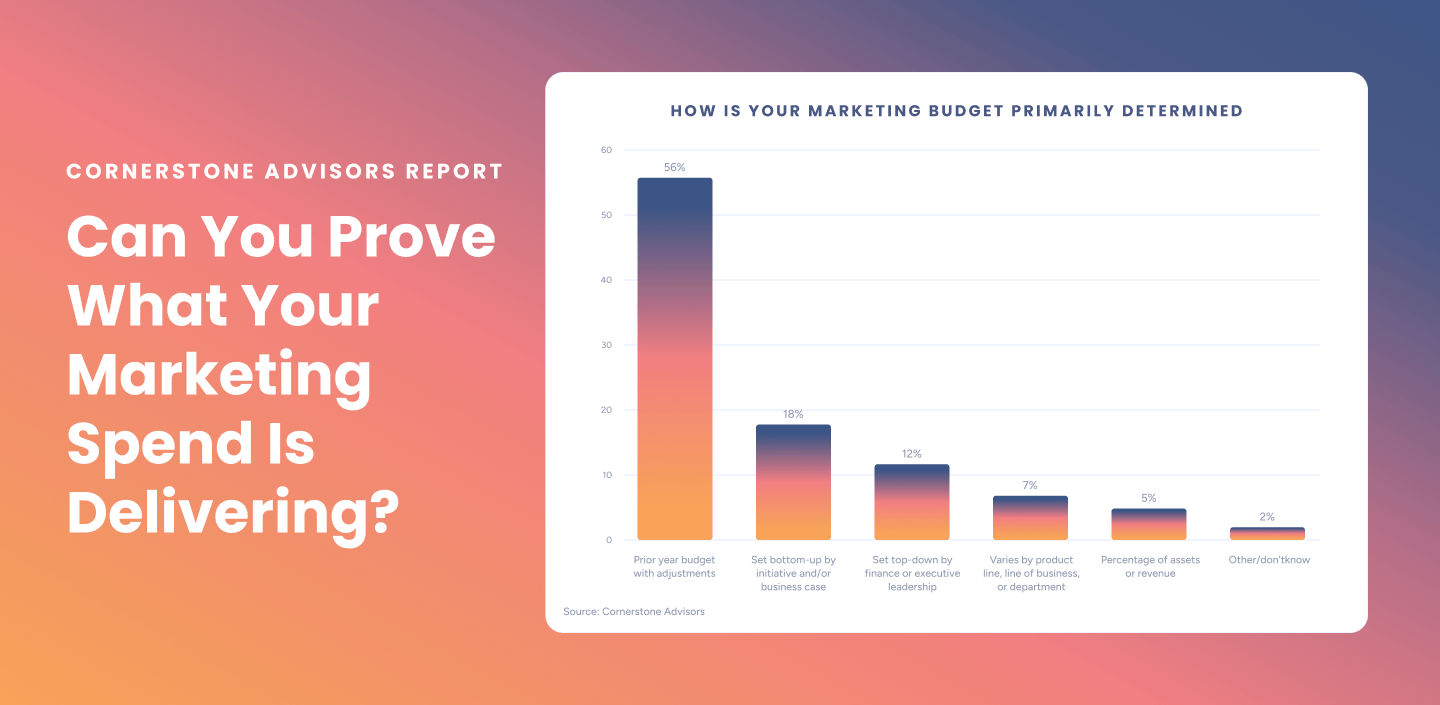
New research from Cornerstone Advisors, commissioned by Fintel Connect, surveyed 126 senior executives at U.S. banks and credit unions and surfaced a finding that should concern every CFO overseeing a marketing line item. Nearly 6 in 10 institutions determine their marketing budgets by simply adjusting the prior year’s figure. Only 18% build budgets from the ground up, using business cases and expected returns.
That is not a budgeting methodology. That is institutional inertia dressed up as financial planning.
Download the full report: The Marketing ROI Gap in Banking
The 10 Basis Point Illusion
The industry rule of thumb — that financial institutions spend roughly one-tenth of 1% of assets on marketing — has held essentially constant for a decade. To some, stability signals discipline. To the Cornerstone research team, it signals something more troubling: budgets that grow with the balance sheet but are never scrutinized for return.
As institutions doubled in average asset size over the past ten years, marketing budgets doubled alongside them. Not because evidence supported that level of investment. Not because attribution analysis justified the allocation. Because assets went up, and the percentage stayed fixed.
For a CFO, this should register as a capital allocation problem. The marketing budget is not small — at a $5 billion institution, 10 basis points represents $5 million annually. Across the industry, those are material dollars being deployed on the basis of historical precedent rather than prospective return.
Why the Cycle Perpetuates Itself
The research reveals a self-reinforcing loop that finance leaders are positioned to break — but must first understand.
Problem 1: Marketing ROI measurement infrastructure lags behind spend
Six in 10 marketing executives report that their core banking or CRM system directly limits their ability to measure marketing ROI. Nearly a third admit they have no reliable attribution at all. Another 27% rely solely on basic web analytics. Only 14% use marketing mix modeling — the methodology that would allow them to connect channel spend to funded accounts and loan volume.
When measurement is this weak, there is no data basis for a fresh-start budget. The only available reference point is what was spent before.
Problem 2: The wrong source gets the credit
The attribution problem is not merely technical — it is strategic. The research found that 31% of banks and credit unions believe they are crediting the wrong marketing source more than a quarter of the time. Another 26% are not sure. That means for at least half of all institutions, the channel performance data driving next year’s budget is materially unreliable.
In any other capital allocation context — lending, treasury, M&A — decisions made on data this unreliable would trigger an audit. In marketing, they become the baseline for next year’s plan.
Problem 3: Mid-year changes are driven by instinct, not insight
Seven in ten institutions regularly modify their marketing budgets mid-year. The top two triggers? Executive requests (53%) and competitive reactions (52%). Performance insights from analytics ranked third, cited by 45%. The implication is direct: reallocation decisions are more often driven by internal politics and reactive instinct than by what the data shows is working.
Where the Money Goes vs. Where the Returns Are
The research surfaces a striking mismatch between spend allocation and perceived effectiveness — one that the current budgeting approach obscures rather than corrects.
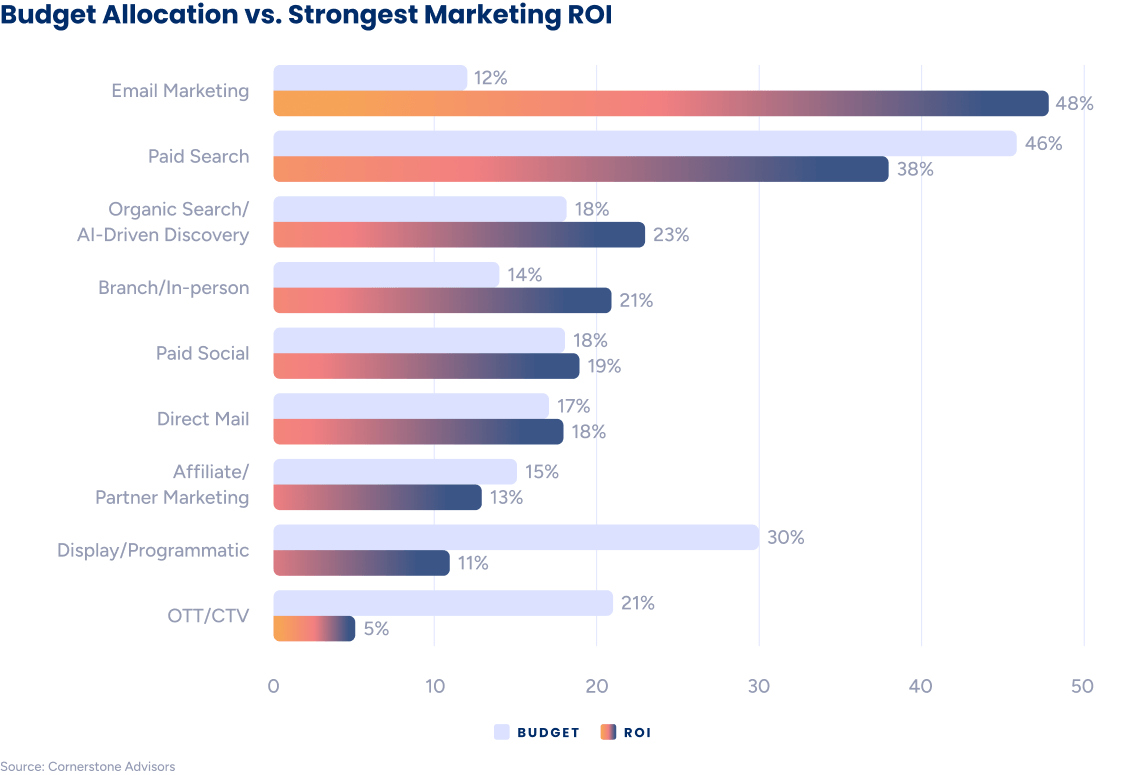
Paid search commands the single largest share of marketing budgets, cited by 46% of respondents as one of their two highest-spend channels. Yet when executives were asked which channels deliver the strongest ROI, email marketing ranked first (48%), with paid search second (38%). Email, meanwhile, ranks last for budget share.
A few additional disconnects worth noting for financial institution marketing budgets:
- Paid search is where large banks and fintechs hold structural advantages of scale. Community and regional institutions are competing in an auction they are mathematically unlikely to win at equivalent cost-per-acquisition.
- Email marketing — the top-rated ROI channel — scored highest on cost efficiency (4.12 out of 5) yet receives a disproportionately small share of the budget.
- Affiliate and partner marketing ranks second overall in channel effectiveness ratings and second only to branch banking for lead quality — yet only 32% of institutions invest in it. One in five identified it as their most underleveraged channel.
- Display and programmatic advertising absorbs 30% of top budget allocations yet earns an effectiveness rating of just 2.64 out of 5 — one of the lowest across all channels evaluated.
These mismatches persist precisely because budgets are anchored to history. If paid search received a large share three years ago, it will likely receive a large share this year — regardless of whether the return justifies it relative to alternatives.
Four Actions CFOs Can Take Now
The Cornerstone research is clear in its prescription: the marketing allocation problem begins with budgeting practice, not channel performance. Improving attribution alone will only partially solve it. If the starting point remains historical spend, even better measurement data will be applied to a structurally flawed baseline.
- Require outcome-based justification, not percentage adjustments. The shift from prior-year anchoring to business-case budgeting requires finance to set that expectation explicitly. Ask not “what did we spend last year?” but “what return did we generate, and what return do we expect this investment to produce?”
- Treat marketing measurement infrastructure as a capital investment. The reason 60% of institutions cannot connect marketing spend to funded accounts is a failure of technology infrastructure. Core systems, CRM platforms, and analytics tools are not exchanging data in ways that allow attribution. Closing that gap requires capital investment that finance must sponsor — not merely observe.
- Scrutinize mid-year reallocation triggers. When executive requests and competitive reactions drive mid-year budget changes more than performance data does, the organization is making capital reallocation decisions on intuition. A governance framework requiring data-supported rationale for mid-year shifts would meaningfully improve this dynamic.
- Benchmark channel allocation against effectiveness ratings, not industry convention. If your institution’s paid search allocation is significantly higher than its effectiveness rating would justify — relative to alternatives like email or affiliate marketing — that gap represents capital that could be better deployed. The research provides the benchmarks; finance is positioned to ask whether the allocations reflect them.
The Strategic Dimension
Beyond the mechanics of budgeting, the Cornerstone research raises a governance question that CFOs are uniquely positioned to address: Is marketing operating as a strategic function or a support function?
The data suggests the latter predominates. Only 39% of senior executives at financial institutions describe marketing as a critical contributor to strategic decision-making. Only 42% report that marketing’s relationship with finance is strong.
The institutions that close the marketing ROI gap will be those where finance and marketing operate with shared definitions of success — where funded accounts, deposit balances, and customer lifetime value are the agreed measures of marketing performance, and where the budgeting process reflects expected outcomes rather than historical habit.
That alignment starts with the CFO deciding to engage with marketing not as a discretionary cost center, but as a growth investment that deserves the same analytical rigor applied to any other capital deployment decision.
Get the Full Research
Download the complete Cornerstone Advisors report — channel-by-channel data on how 126 U.S. financial institutions spend, measure, and (struggle to) prove marketing’s value.
Source: The Marketing ROI Gap in Banking: How Financial Institutions Spend, Measure, and (Struggle to) Prove Marketing’s Value — Cornerstone Advisors, commissioned by Fintel Connect, January–February 2026.



 English
  Français