
7 Financial Services Marketing Trends for 2026


If you are a financial services marketer aiming to improve results in 2026, you’re probably looking for the latest marketing trends to understand:
- How to stay ahead of your competitors and market changes
- What’s the best way to launch a new product in this economic climate
- How to mitigate risks in your current marketing channels
Financial marketers will have a lot to contend with in 2026, as certain trends will raise questions about your overall strategies and how to attract new customers. Will you need to rethink and adjust your marketing approaches to stay effective and competitive?
To help financial services marketers see any changes as opportunities, we’ll cover six digital marketing trends, with direct insight from our network of financial services publishers and partners, and show you how to take advantage of them.
We’ll cover:
- 7 key marketing trends for financial services in 2026
- How banks and fintechs take advantage of these trends with partnership marketing via Fintel Connect
- How a national digital bank improved marketing efficiency and mitigated search engine changes by diversifying their strategy
If you are a financial services company in North America that wants to improve acquisition through affiliate marketing in 2026, contact us to see how Fintel Connect can help.
7 key marketing trends for financial services in 2026
As a financial services affiliate marketing agency with 20+ years of experience in highly regulated industries, we know how to help our clients forecast market changes and identify marketing trends to ensure they stay ahead of the curve.
Here are seven key trends we believe financial marketers will see in 2026, from market shifts to artificial intelligence (AI).
1. Adapting to the economic climate by choosing the right products to prioritize promoting
As a financial brand, staying nimble will keep you one step ahead of economic shifts, whether interest rates change or inflation remains sticky.
Financial consumers may respond to this uncertainty (and eventual market changes) by shifting their buying behavior, creating fluctuations in demand for financial products. So, promoting products that directly respond to customer needs can help steer your product development and shape marketing campaigns.
For example, we’ve recently seen financial services firms start to reintroduce mortgage campaigns into their strategies as consumer volume for home searches and refinancing continues to pick up momentum.
We’ve also seen that our financial publishers and influencers already know the value of staying in tune with their audience. Our recent survey of North American publishers shows that monitoring audience behaviour is just as important as revenue potential when deciding which products to promote.
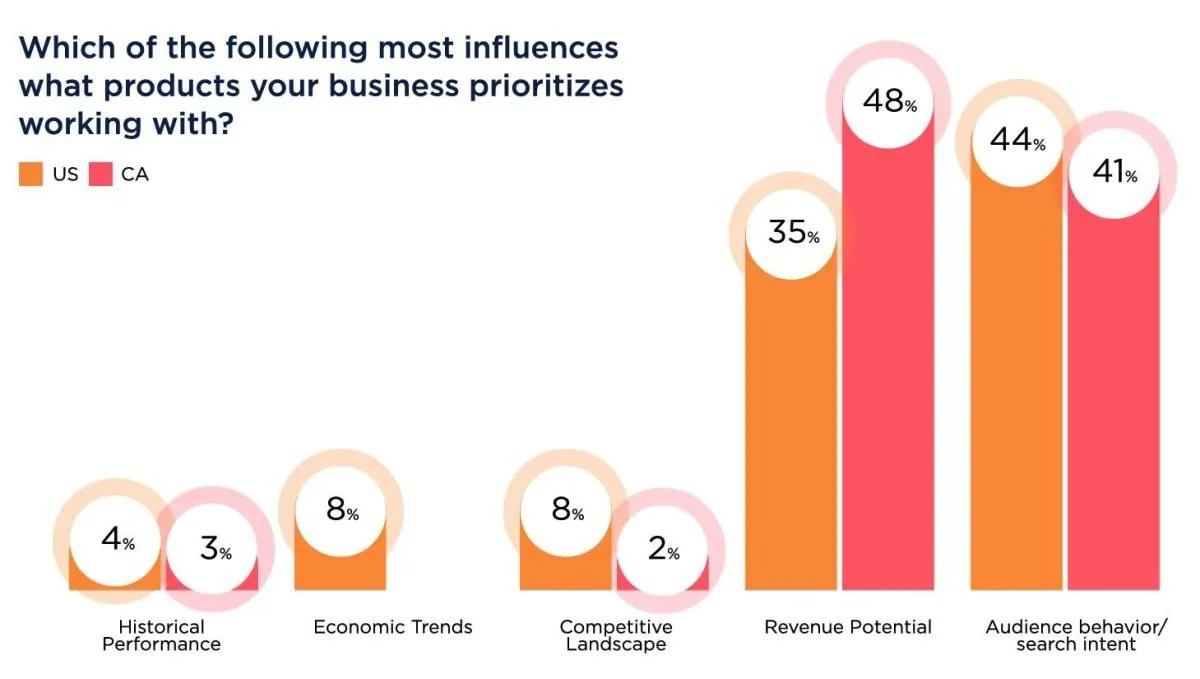
So, tracking and understanding consumer behaviour will continue to be a key differentiator for financial firms in 2026.
2. Powering up financial marketing productivity with AI
In 2024, many marketing teams felt pressure to work smarter not harder, especially with new or improved artificial intelligence (AI) tools. In fact, 93% of marketers said in a recent SurveyMonkey study that they used AI to speed up their content creation processes.(1) But AI can do more than just make you work faster.
AI can revolutionize workflows across multiple areas, from content creation, customer support and onboarding to adjudication within application funnels and marketing compliance monitoring.
As these AI tools mature, they can redefine how you work, shaping how your teams strategize, automate and innovate. Experimenting with AI can give you a competitive edge as best practices are still in the making.
3. Going beyond personalization to elevate the customer experience
Personalization isn’t new and is here to stay. But in 2026, AI-powered hyper-personalization is taking the financial customer experience to the next level, making interactions more predictive and even anticipatory. Instead of just responding to customer needs (e.g., chatbots for customer service queries) AI can shape experiences to boost customer engagement, satisfaction and loyalty.
For example, with AI you could tailor customer experiences across support materials, marketing messaging, and even product recommendations. AI also enables you to connect customers to relevant offers without a heavy lift, and customers have a smoother experience finding the products and services they want.
Hyper-personalization can also act as a buffer against unknowns during a volatile economic landscape, helping to reduce churn. And smart financial institutions are already using this approach. For instance, a regional bank sends push notifications to clients to contribute net new deposits to their existing investment account to get access to a limited-time promotional rate.
This entices clients to consider investing more, instead of cashing out or changing their investment choices because of market uncertainty.
4. Reaching the right customers through the right content types
The way consumers research financial products is evolving, with many now using a mix of text and video to find and evaluate products.(7) Using tactics and channels that leverage these mediums will help make sure your products are part of the consideration process.
While we’ve seen short-form video become dominant in the last three years, financial consumers are also looking for in-depth content and education around financial products. We’re seeing this customer engagement trend through how our publishers are testing more content types to reach audiences, especially investing in video and email marketing.
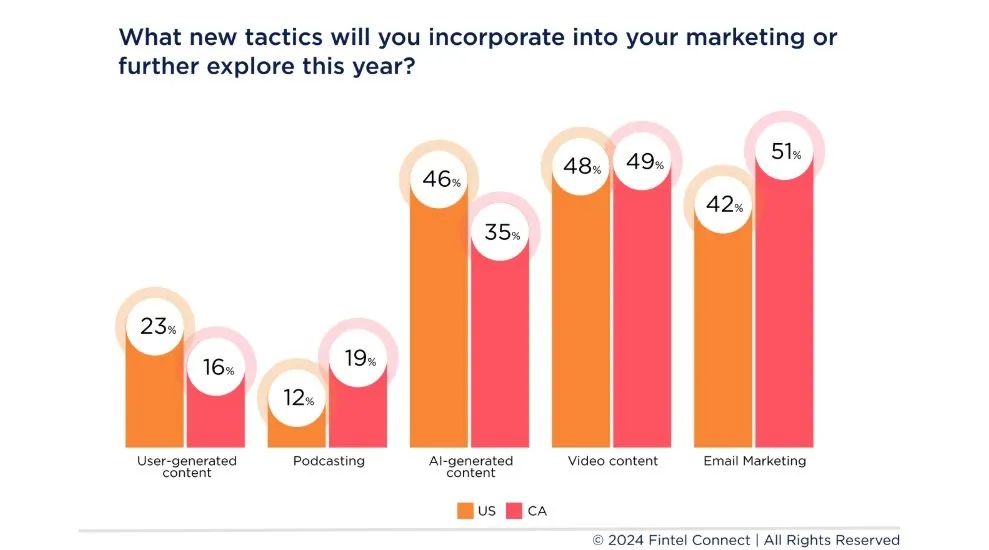
This means you may want to move towards deeper dives into product features rather than relying solely on comparisons on sites like NerdWallet or Bankrate. For example, we’ve found that influencers and in-depth product reviews are effective at capturing and helping audiences accelerate their buying decisions.
By exploring more content types, you’ll have more chances to experiment to see what works best in reaching your target audience.
5. Navigating digital platform changes, including Google’s AI Overviews and algorithm updates
Just as content types are shifting, so are the digital platforms consumers turn to for financial information. For example, our publishers marked search engine changes as one of the major challenges in 2024.

Google’s AI Overview is affecting traffic to well-ranking publisher pages, as its summaries may keep searchers from clicking through to the search results. Add to this the seven updates to Google’s algorithm in 2024, which also kept anyone investing in content marketing on their toes as ranking shifted.
We don’t see this trend disappearing anytime soon as more people are also beginning to use AI platforms, such as ChatGPT and Perplexity, for their information searches.
In addition to monitoring your SEO performance, even popular social media platforms are changing:
- Bluesky has increased users from 9 million in September 2024 to 27 million as of January 2025. (2)
- Threads grew by ~1 million signups per day, as of January 2025. (3)
- X’s daily active users were down by 20% in October 2024, and from October to December the site dropped a further 8.4% of its users in the US alone. (4)
- TikTok has been in the crosshairs of US legislation that threatens to ban the app, and an alternative, RedNote, saw millions of new US users in January. (5)
The current reality is that your potential customers may change their favourite social media apps in 2026, and formerly great places to connect with your audience can suddenly change. To mitigate this instability, diversify your channels, and plan a marketing budget that includes a contingency fund for experimenting with new platforms.
6. Focusing on user-generated content and relatability
One trend we’ve been discussing with financial services influencers and publishers is making digital marketing campaigns more relatable. This includes using investing in employee or user generated content (UGC) to build trust for financial brands.
A lot of discussion around relatability is coming at the same time as discussions on AI––and for good reason. New findings published in the Journal of Business Research in January 2025 show that when consumers believe something is AI-generated, they perceive it as less authentic. This leads to less customer loyalty and poor-quality word-of-mouth recommendations.(6)
Instead, consumers want behind-the-scenes content to know how people actually use products and services.
Klarna, the buy-now-pay-later fintech, does this particularly well. They interview internal stakeholders to understand new features and how they impact clients, creating excitement for their release. They also intersperse behind the scenes footage in educational content, making the presenters more relatable.
An example of behind the scenes content from the fintech, Klarna
You can produce this type of content in-house, or through community development, live video, or publishers and influencers. Focusing on UGC and relatable content offers an opportunity to diversify marketing spend with new strategies and partners.
So even if you’re using AI in your digital marketing processes, keep a human touch in your campaigns.
7. Embedding your financial products through strategic partnerships
One area that financial services providers may turn to more in 2026 is fostering partnerships that enable embedded finance solutions. This strategic partnership marketing embeds your financial products within an existing customer experience of another company that complements and enhances the overall customer value during purchases.
If your team has the goal of building brand awareness and reaching high-intent audiences, working with the right embedded finance partners can be a great option for your financial institution.
For example, if you’re a bank that wants to reach more small and medium-sized businesses (SMBs) nationally, you might partner with an online hardware store to offer financing options at checkout. This trend has the power to expose your brand to new-to-you audiences in a less traditional, though highly targeted environment, helping your net new customer acquisition and brand credibility.
How banks and fintechs can take advantage of these marketing trends with partnership marketing via Fintel Connect
Now that you know 2026’s financial marketing trends, how do you take advantage of them? And which trends do you prioritize to make the most of these insights?
We’ve already covered some ways to stay on top of these trends above. But we know from experience that partnership marketing can help you implement these trends in a cost effective way that brings results in achieving customer acquisition targets and KPIs.
Here’s how partnership marketing via Fintel Connect can help you stay on top of these trends to improve your marketing performance in 2026.
1. Get access to industry-specific expertise and audience insights to stay on top of market shifts and trends
We work with financial services companies in Canada and the US, and have our pulse on the North American financial market. And, because we work so closely with our affiliate network—a direct conduit to financial services customers—we also have audience insights that many other affiliate management agencies do not.
This means we’re uniquely positioned to foresee market shifts and know which products to promote so you can remain competitive during changing customer behaviour.
These unique insights can also work beyond your affiliate campaigns to improve your general product and marketing strategies. For example, we’re helping clients expand and diversify their program offerings based on the demand publishers are directly seeing from their audiences.
If you’re already investing in the affiliate channel and are not sure how to improve results, our program audit can help identify what is and isn’t working. This includes an analysis of your product competitiveness and comparing your affiliate marketing results against financial industry benchmarks, so you can find areas of improvement with confidence.
Curious to know how to optimize your affiliate program? Book an audit with Fintel Connect today
2. Work with vetted financial publications and influencers to craft campaigns that resonate with your audience
Affiliate partners can be a powerful tool to connect with the right audiences in a relatable way over an array of content mediums and platforms.
With Fintel Connect, you’ll have access to a network of 5,000+ fully vetted affiliate partners—from publishers and influencers to bloggers and vloggers—who know how to work with financial services companies.
Partnership marketing via Fintel Connect’s network enables you to:
- Tap into established audiences. You can expand your audience reach, whether it’s through comparison articles, UGC videos, or in-depth product reviews. Fintel Connect can help you build relationships with the influencers and publishers who produce the type of content your audience responds to.
- Build relatability. Partner content can be a great way to give audiences the authenticity and behind-the-scenes feel they seek. Fintel Connect can serve as a guide to finding the affiliates your audience trusts to create relatable content, from influencer product demos to newsletter takeovers.
- Diversify content strategy. The affiliate landscape is much more than product placements and links. Fintel can help you use tactics that go beyond traditional affiliate marketing for financial services, like social media campaigns or paid and organic SEO strategies, to amplify your brand presence.
- Implement hyper-personalization. We work with you and your publishers to share data you both need to craft more relevant, targeted content for your future customers.
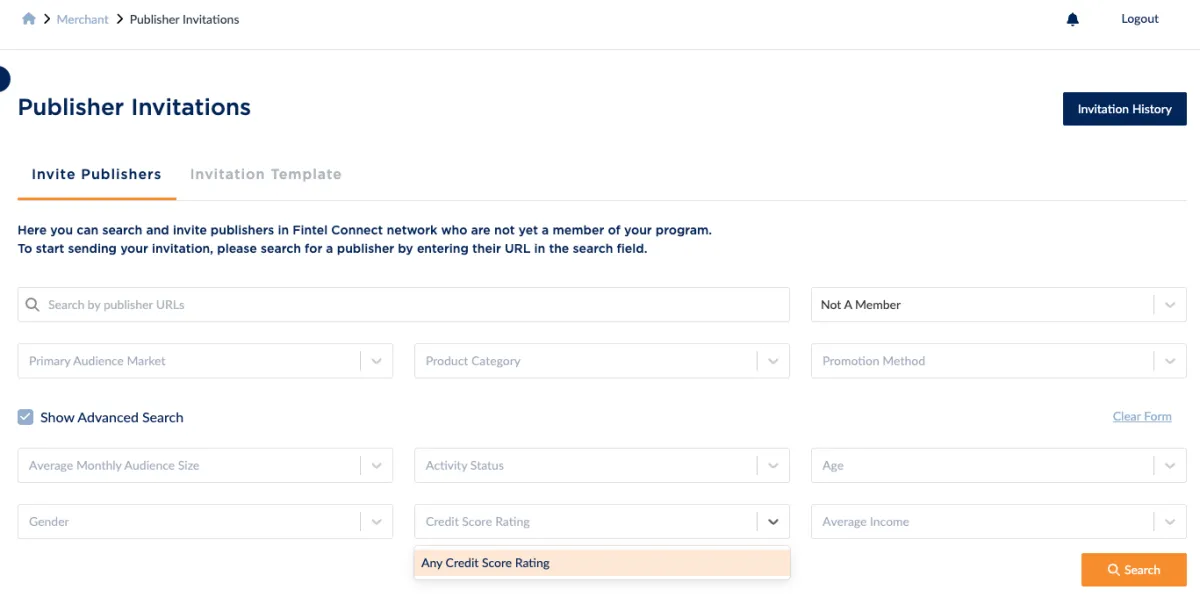
By partnering with a breadth of publishers and influencers, you can reach your target audiences more effectively through personalized campaigns that resonate with them.
3. Improve efficiency with industry-specific affiliate tracking and marketing compliance monitoring software
With Fintel Connect, you’ll get an all-in-one platform that offers financial services-specific software for partnership marketing.
You can improve marketing efficiency with our affiliate tracking software. It gives your team and your publisher partners the granular information they need to accurately assess ongoing products and campaigns, as well as historical data, for comparisons and reporting. So, it’s easy to identify the parts of your program that are underperforming, and where to double down.
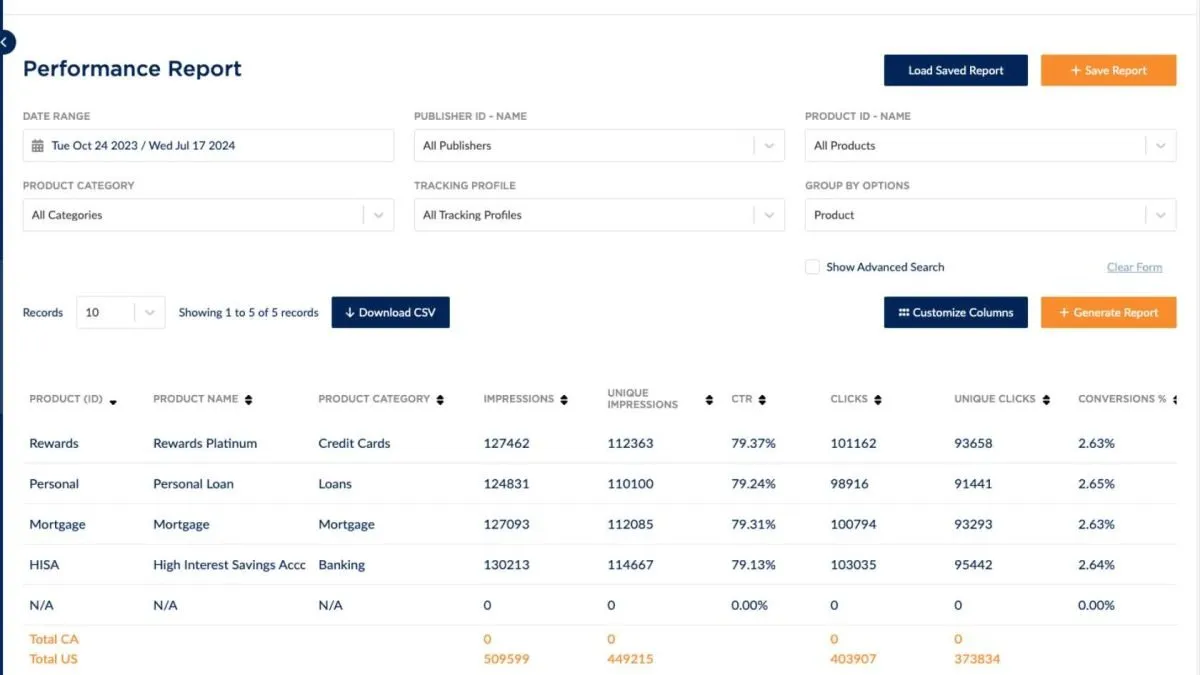
We’ve also got your marketing compliance monitoring covered. We developed Fintel Check, our AI-powered marketing compliance monitoring engine, because we know firsthand how inefficient and time consuming manual checks can be.
Whether you’re a sponsor bank looking to streamline your fintech partners’ marketing compliance or a financial services firm wanting to ensure compliance in your affiliate campaigns, Fintel Check can help you automate much of the tedious monitoring work and reduce human errors.
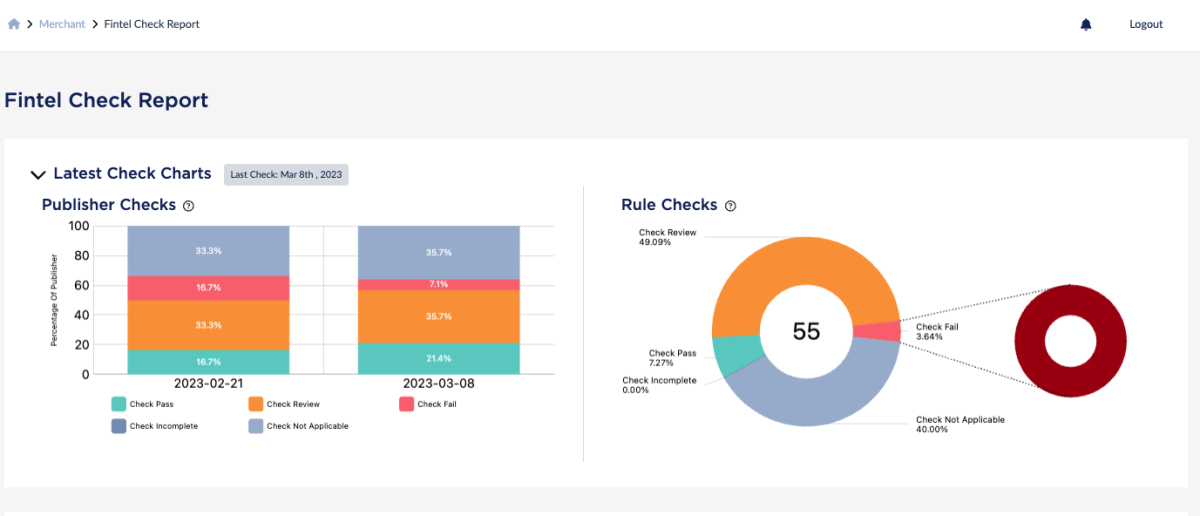
With Fintel, you can optimize performance and get the transparency you need more efficiently.
4. Know which trends to prioritize with strategic support
When you partner with Fintel Connect, you’ll receive personal, expert attention. Our financial expertise enables us to act as an extension of your team, from providing you with campaign-level advice to guiding your product and go-to-market strategies because we invest heavily in deeply understanding the competitive and market landscape.
For example, we’ve successfully helped our lending clients set up creative embedded finance partnerships, like turndown opportunities. If a small business doesn’t qualify for a loan, instead of ending the customer relationship, the lender can refer the customer to other financing options or even another lender that’s more likely to approve their application.
This increases the value provided to the customer, while lenders can expand their ecosystem of financing options, rather than just losing that potential business.
While these partnerships can be an amplifier for brands and products, it takes time to find the right match. Fintel Connect can help financial brands connect and design embedded finance agreements that make sense to both parties.
How a national digital bank improved marketing efficiency and mitigated search engine risk by diversifying their strategy
While partnership marketing is a results-based channel, where financial services firms will only pay for net new accounts, sometimes changing that model can bring unexpected, yet more cost-efficient results.
This happened to a national digital bank that wanted to improve their acquisition results. They were heavily invested in organic partner placements, which included listings and product reviews. But when Google’s algorithm changes started, we proposed diversifying their affiliate marketing strategy to include more paid search initiatives.
This meant shifting from a cost-per-acquisition (CPA) model to a cost per click (CPC) one. The bank could easily track results through our software and compare their previous ROI with a program that now included a CPC model.
Though the bank was hesitant initially, they soon found their CPC paid search campaigns more effective and in some cases more cost efficient from an incremental volume standpoint —so much so that they’ve doubled down on their investment.
Diversification not only helped the bank mitigate the risks of Google’s algorithm changes, it also offered them a new, more cost-effective way to acquire customers.
2026 could be full of change–and opportunities
Marketers have seen a lot of twists and turns in the financial services landscape over the last few years, and it would be easy to feel resigned about more uncertainty in 2026. But with some innovative thinking, solid analytics and expert help, we believe marketing teams will be able to surface new opportunities in this year’s marketing landscape.
If you’re a financial services company in North America that wants to strengthen your acquisition and diversify your marketing efforts, contact Fintel Connect today.
Sources
1. https://www.surveymonkey.com/mp/ai-marketing-statistics/
2. https://www.cnet.com/tech/how-to-join-bluesky-twitter-alternative-luke-skywalker-stephen-king-on-social-media-twitter-quitters/
3. https://techcrunch.com/2025/01/29/threads-adds-another-20m-users-since-december-reaching-320m/
4. https://mashable.com/article/elon-musk-x-declining-user-base-2025
5. https://www.reuters.com/technology/chinese-app-rednote-gained-millions-us-users-this-week-tiktok-refugees-joined-2025-01-16/
6. https://www.sciencedirect.com/science/article/abs/pii/S0148296324004880#:~:text=human-authored)%2C%20focusing%20on,of%20mouth%20and%20customer%20loyalty
7. https://www.pymnts.com/wp-content/uploads/2021/01/PYMNTS-Retail-Banking-Services-Paradigm-Shift-January-2021.pdf


 English
  Français