
Why Financial Brands Need a Finance-Focused Affiliate Marketing Agency

In this article
Related articles
The affiliate and performance marketing industry is changing quickly. Recent consolidation among major affiliate platforms has made one thing clear: many providers are getting broader, larger, and more generalized.
For some industries, that may be enough. For financial institutions, it creates a more important question: does a larger, cross-industry platform actually understand what banks, credit unions, fintechs, and insurers need to acquire customers responsibly and profitably?
Financial services marketing is not like retail, travel, ecommerce, or subscription marketing. A click is not the end goal. A lead is not always a qualified customer. A completed application is not always a funded account. A publisher mention is not always compliant. A channel that appears to drive volume may not be driving the right business outcomes.
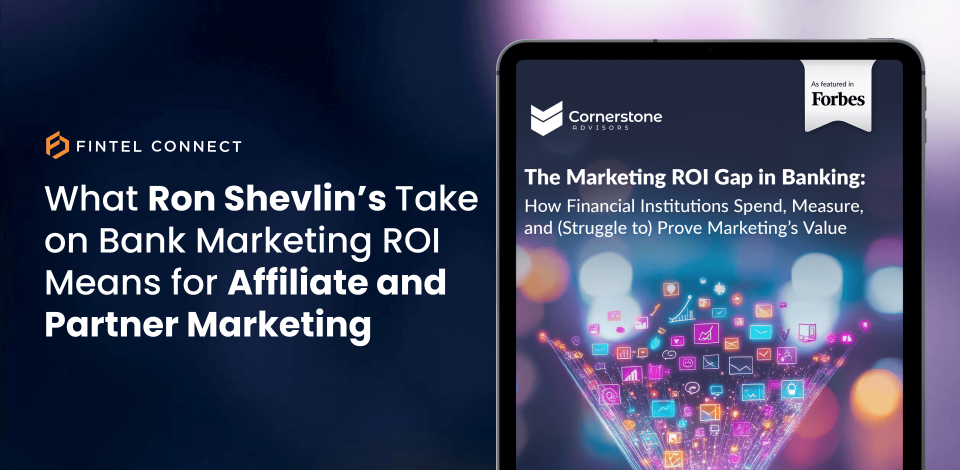
That is why the release of The Marketing ROI Gap in Banking: How Financial Institutions Spend, Measure, and (Struggle to) Prove Marketing’s Value, a new report from Cornerstone Advisors commissioned by Fintel Connect, comes at an important time for financial marketers.
Based on a survey of 126 senior executives at U.S.-based banks and credit unions, the report shows that financial institutions are under pressure to prove marketing’s value, yet many still lack the measurement infrastructure to clearly connect marketing spend to business outcomes. Nearly 6 in 10 senior marketing executives said their core or CRM system limits their ability to measure marketing ROI, while 31% believe they credit the wrong source more than a quarter of the time and another 26% are not sure. Not one institution surveyed said it could reliably attribute marketing results to all outcome measures evaluated in the report.
Affiliate marketing is becoming more important, but also more complex
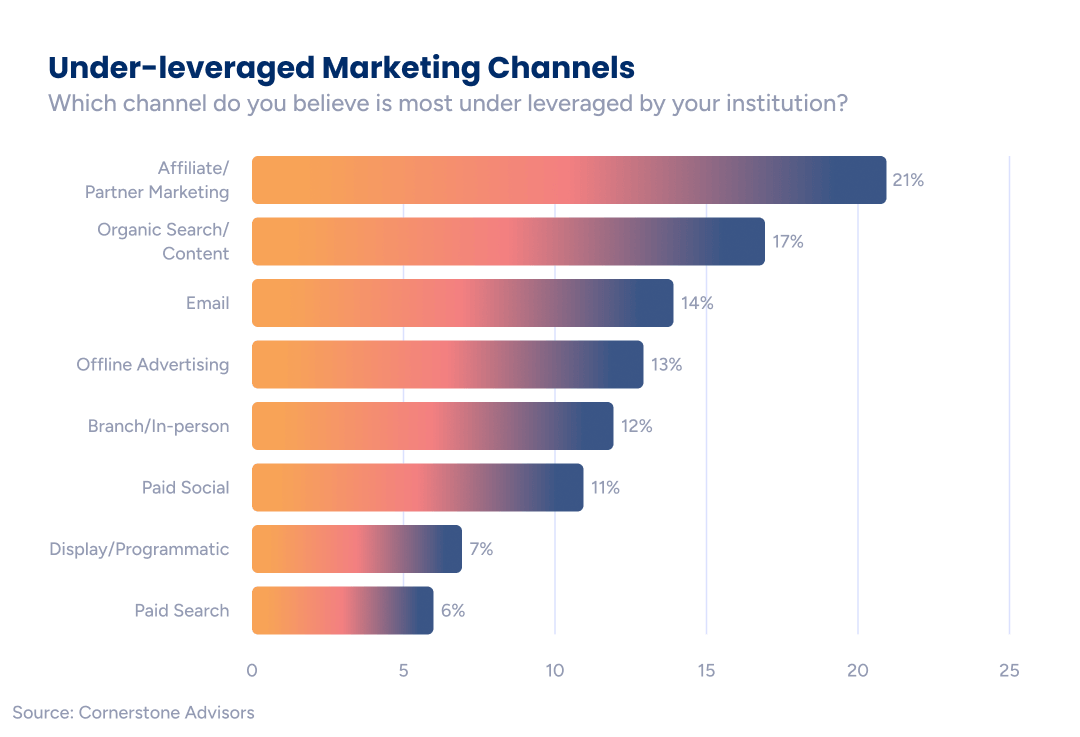
Affiliate and partner marketing has historically been underused by many financial institutions. According to the report, only about one-third of institutions surveyed actively invest in affiliate or partner marketing. Yet one in five respondents named it the most underleveraged channel in their organization, and affiliate/partner marketing ranked second overall among all channels evaluated. It also scored especially well for customer and lead quality.
That matters because financial marketers are not simply trying to generate more traffic. They are trying to reach consumers who are actively researching, comparing, and choosing financial products, whether that is a credit card, deposit account, loan, insurance product, or business banking solution.
Affiliate marketing can be a strong fit for this environment because it places financial brands within trusted decision-making moments. Comparison sites, financial education publishers, niche content partners, influencers, and other affiliates often reach consumers when they are closer to action than they may be in traditional awareness channels.
The challenge is that affiliate marketing in financial services requires a very different operating model than general affiliate marketing. It requires careful partner selection, product education, compliant messaging, offer accuracy, clear disclosures, strong tracking, publisher relationship management, and the ability to optimize toward funded accounts or approved customers instead of surface-level engagement.
Why industry consolidation should make bank marketers ask harder questions
Recent movement in the affiliate and performance marketing space reflects a broader shift toward scale, platform consolidation, and cross-industry reach. Major players are looking for ways to combine networks, data, technology, and publisher access into larger ecosystems. For many advertisers, that may sound appealing because it promises reach and operational efficiency.
For financial institutions, however, bigger does not automatically mean better.
When a platform serves every major industry, financial services can become one vertical among many. That can create gaps in strategy, support, compliance understanding, and channel execution. A general-purpose provider may understand affiliate mechanics, but that does not mean it understands how to help a bank acquire qualified applicants, monitor financial content, manage rate-sensitive offers, or assess whether a campaign is driving funded accounts rather than low-quality leads.
This is where specialization becomes important. Banks and credit unions operate in a regulated, high-trust environment. They need partners that understand the difference between traffic and acquisition, between application starts and funded accounts, and between content visibility and compliant product positioning.
The broader industry may be moving toward larger, more generalized ecosystems, but financial marketers need clarity, accountability, and category expertise. They need a partner that knows how financial products are researched, compared, promoted, measured, and regulated.
The case for an all-in-one affiliate marketing agency built for finance
An all-in-one affiliate marketing partner can help financial institutions close the gap between strategy, technology, publisher management, compliance, and performance measurement.
For many bank and credit union marketing teams, affiliate marketing is difficult to manage with internal resources alone. Teams may not have the time to recruit and vet publishers, manage relationships, monitor content, negotiate placements, review compliance issues, optimize offers, reconcile performance data, and report on results across products and campaigns.
A finance-focused affiliate marketing agency and platform can bring those pieces together. The value is not simply having software, and it is not simply having a network. The value comes from combining technology, publisher access, managed service, compliance workflows, performance strategy, and finance-specific expertise into one operating model.
| What Financial Brands Need | Why It Matters | How a Finance-Focused Partner Helps |
|---|---|---|
| Publisher quality | Not every traffic source is right for financial products. | Identifies, vets, and manages partners aligned to financial audiences. |
| Compliance oversight | Financial content must be accurate, current, and properly disclosed. | Supports monitoring, review workflows, and compliant publisher execution. |
| Performance measurement | Clicks and applications do not always equal profitable growth. | Helps optimize toward outcomes such as qualified leads, funded accounts, and approved customers. |
| Offer and product expertise | Rates, rewards, eligibility, and product terms can change quickly. | Helps ensure publishers understand the product and promote it accurately. |
| Strategic support | Many internal teams do not have dedicated affiliate expertise. | Acts as an extension of the marketing team with finance-specific guidance. |
Specialization matters when ROI is under scrutiny
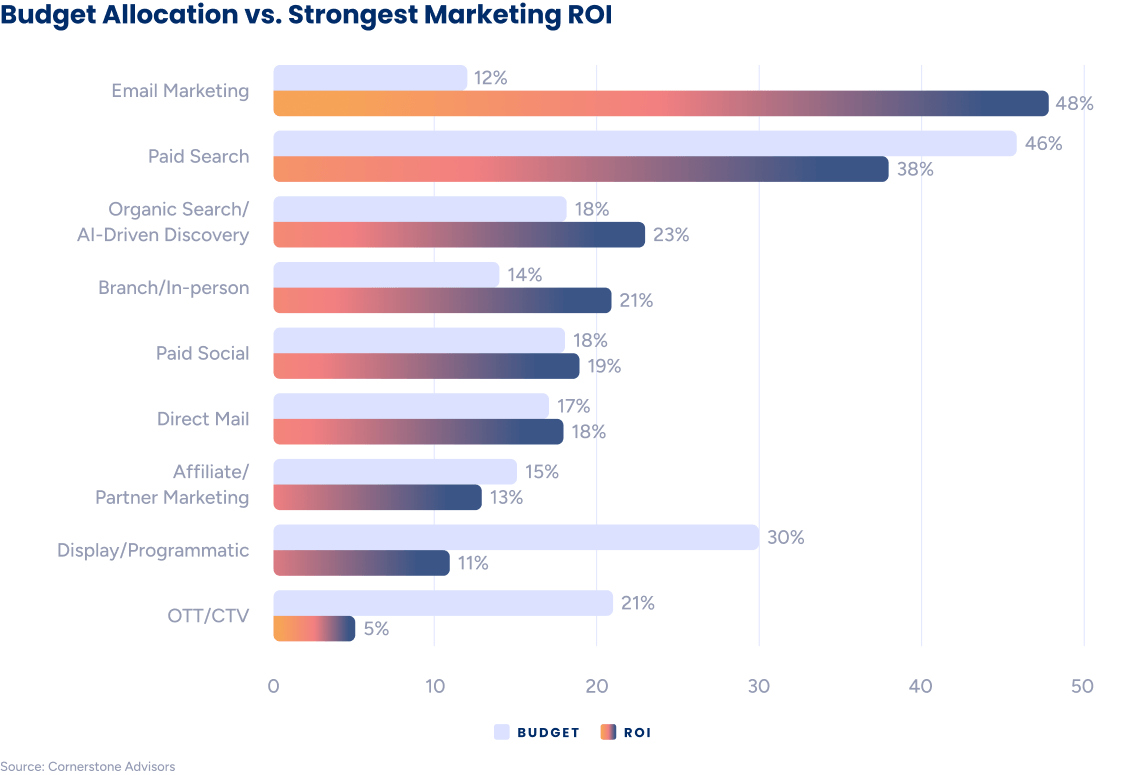
The Cornerstone report makes it clear that financial marketers are already facing a measurement problem. Many institutions are spending meaningful budget across channels but still struggle to prove which investments are working. The report found that financial institutions spend an average of 10 basis points of assets on marketing annually, yet many still determine budgets by adjusting the previous year’s spend rather than using a clear view of expected return.
That is a risky approach in a more complex performance marketing environment. As the affiliate industry consolidates and platforms become broader, financial institutions need to be even more disciplined about choosing partners that can help them measure, optimize, and defend marketing investment.
For a bank or credit union, the right affiliate marketing agency should not only help launch a program. It should help answer the questions executives care about: Are we reaching the right customers? Are we working with the right partners? Are we staying compliant? Are we paying for performance that actually contributes to growth? Are we improving our visibility where consumers compare financial products?
Those questions require more than a broad affiliate platform. They require financial-services expertise.
The bottom line for financial marketers
Affiliate marketing is becoming a more important part of the financial marketing mix, but the channel is also becoming more competitive, more data-driven, and more closely tied to consumer research behavior.
At the same time, the broader performance marketing industry is moving toward consolidation and scale. That creates a clear choice for financial institutions: work with a generalist platform built for many industries, or work with a partner purpose-built for the complexity of financial services.
For banks, credit unions, fintechs, and insurers that need qualified growth, compliant execution, strong publisher relationships, and clearer performance measurement, specialization is not a nice-to-have. It is the foundation of a successful affiliate program.
Want to see how financial institutions are spending, measuring, and evaluating marketing performance? Download the full Cornerstone Advisors report, The Marketing ROI Gap in Banking, to explore the data behind the marketing ROI gap and what it means for financial services marketers.
FAQ
Why is affiliate marketing different for financial services?
Financial services affiliate marketing involves regulated products, complex customer journeys, strict compliance requirements, and performance goals that often go beyond clicks or leads. Banks and credit unions need to measure outcomes such as applications, approvals, funded accounts, balances, and customer quality.
Why should a bank use a finance-focused affiliate marketing agency?
A finance-focused agency understands the specific needs of banks, credit unions, fintechs, and insurers, including publisher quality, compliance monitoring, product accuracy, attribution, and performance optimization. This helps financial brands build affiliate programs that are more aligned to real business outcomes.
What does “all-in-one” mean in affiliate marketing?
An all-in-one affiliate marketing partner typically combines technology, tracking, reporting, publisher relationships, compliance workflows, and managed service. For financial institutions, this can reduce internal complexity and give lean marketing teams access to specialized support.
Is affiliate marketing only useful for credit cards?
No. Affiliate and partner marketing can support a range of financial products, including deposits, loans, insurance, business banking, and fintech products. The right strategy depends on the product, target customer, offer, publisher mix, and measurement model.

 English
  Français