
CardCon Expo Recap: Why Affiliates Are Key to AI Visibility for Credit Cards

In this article
Related articles
At the 2026 CardCon Expo , Fintel Connect CEO Nicky Senyard took the stage to unpack one of the biggest shifts facing credit card marketers today: AI search is changing how consumers discover, compare, and choose financial products.
Her keynote, Winning AI Visibility for Credit Cards: The Cost of Invisibility in Affiliate-Driven AI Answers, focused on a clear message for credit card issuers and financial marketers: if your brand is not showing up in AI-generated answers, you may be losing influence before a consumer ever reaches your website.
The session explored how AI search platforms like ChatGPT, Perplexity, Copilot, and Google AI Overviews are reshaping product discovery, why affiliate publishers are increasingly important to AI visibility, and what credit card brands need to do now to stay visible in high-intent consumer searches.
AI search is expanding where consumers make financial decisions
One of the core points from the presentation was that AI is not replacing search entirely. It is expanding where and how search happens.
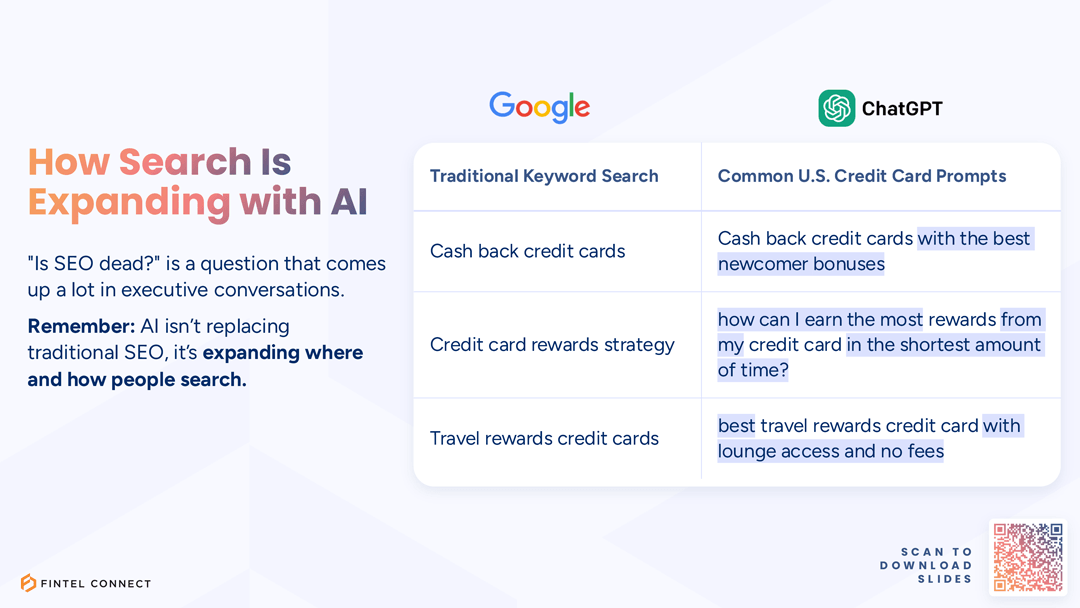
Traditional search behavior is often keyword-led. A consumer may search for “cash back credit cards” or “travel rewards credit cards.” In AI search, that same consumer may ask a more specific, decision-oriented question, such as:
- “What are the best travel rewards credit cards with lounge access and no annual fee?”
- “How can I earn the most rewards from my credit card in the shortest amount of time?”
- “Which credit cards have the best newcomer bonuses?”
These prompts are more conversational, more specific, and often closer to a purchase decision. For credit card brands, that means visibility is no longer only about ranking on a search results page. It is also about being included, cited, and accurately represented in the answer itself.
The risk is not just losing traffic. It is losing presence.
AI invisibility should be framed as a strategic risk for credit card brands because AI-generated answers can remove brands from the consumer’s consideration set entirely.
When a consumer asks an AI platform for a recommendation, the answer may include only a handful of brands, publishers, or product options. If your credit card is not part of that answer, you are not simply ranking lower. You may not be present in the decision journey at all.
The presentation highlighted three major risks of being invisible in AI search:
- You lose presence, not just rank. AI answers can narrow the consumer’s decision set before they visit a website.
- You may pay more to replace lost traffic. Less organic visibility can increase dependence on paid acquisition and raise customer acquisition costs.
- Your story may be told without you. Competitors, publishers, and third-party sources may shape how your product is described, compared, or prioritized.
For credit card marketers, this creates a new visibility challenge. The question is no longer only, “Are we ranking?” It is also, “Are we being included in the answers that shape consumer consideration?”
Affiliate marketing is one of the most under-leveraged channels in financial services
A key data point from the keynote came from a research report conducted with Cornerstone Advisors in 2026. Among the 126+ senior executives at U.S. banks and credit unions surveyed, affiliate and partner marketing stood out as the most under-leveraged marketing channel.
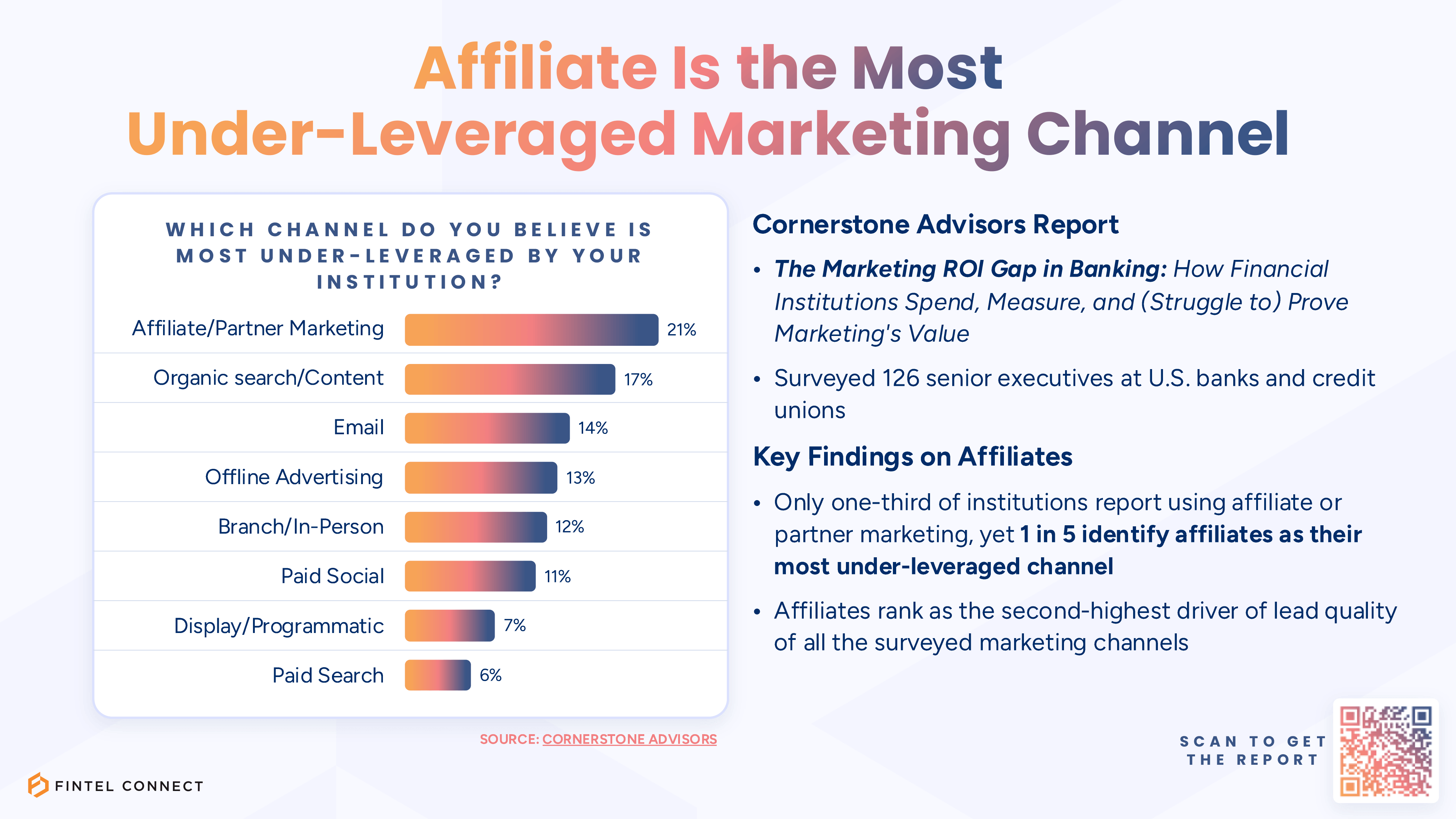
Only about one-third of institutions reported using affiliate or partner marketing, yet one in five identified it as their most under-leveraged channel. The research also found that affiliates ranked as the second-highest driver of lead quality among the surveyed marketing channels.
| Channel | Percentage Identifying It as Most Under-Leveraged |
|---|---|
| Affiliate / Partner Marketing | 21% |
| Organic Search / Content | 17% |
| 14% | |
| Offline Advertising | 13% |
| Branch / In-Person | 12% |
| Paid Social | 11% |
| Display / Programmatic | 7% |
| Paid Search | 6% |
This matters because affiliate marketing is no longer just a conversion channel. As AI systems increasingly summarize and cite third-party content, affiliate publishers can also influence whether a brand appears in AI-generated recommendations.
Affiliates are becoming AI visibility gatekeepers
The central theme of the keynote was that affiliates are becoming AI visibility gatekeepers.
Affiliate publishers already create the kind of content AI platforms tend to read and summarize: comparison tables, “best of” lists, product reviews, FAQs, rankings, and clear product explainers. This type of structured content makes it easier for AI systems to understand, extract, and cite information.
For credit card brands, this creates a halo effect. A strong affiliate presence can help drive direct response performance, while also increasing the likelihood that the brand appears in AI-generated answers through trusted third-party content.
As Nicky’s presentation highlighted, affiliate content sits between paid and earned media. It is commercially connected to brands, but it often looks and functions like third-party editorial content. That makes it especially relevant in a world where AI platforms rely heavily on external sources to generate answers.
Fintel Connect’s research shows affiliate content dominates AI citations for credit card prompts
One of the most important findings from the keynote came from our AI visibility research report for credit cards.
Across ChatGPT, Copilot, and Perplexity, 88% to 91% of AI answers for credit card prompts cited affiliate content over brand websites. Gemini showed a more balanced split, but affiliate and publisher content still played a meaningful role.
| AI Search Platform | Share of Credit Card Answers Citing Publisher / Affiliate Content | Key Takeaway |
|---|---|---|
| ChatGPT | 88% | Affiliate visibility is critical for appearing in recommendation-style answers. |
| Copilot | 89% | Publisher content plays a dominant role in cited answers. |
| Perplexity | 91% | Third-party content is especially influential in answer citations. |
| Gemini | 41% | Platform behavior varies, so brands need to tailor their AI visibility strategy by channel. |
The implication is clear: to appear in AI recommendations, credit card brands need visibility within the affiliate ecosystem. Owned content still matters, but it is not enough on its own.
AI visibility requires a different measurement model
Traditional marketing teams often track clicks, traffic, rankings, and conversions. Those metrics are still important, but AI search introduces new questions.
Credit card marketers now need to understand:
- How often their brand appears in AI answers for high-intent prompts
- Which sources AI platforms cite when describing their product
- How the brand is ranked or positioned against competitors
- Whether the answer accurately reflects current rates, fees, rewards, eligibility, and product terms
- Whether sentiment and positioning are aligned with the brand’s intended strategy
In the keynote, Nicky shared an example of how a national bank analyzed prompt-level visibility for its credit card. The analysis showed where the bank had strong visibility, such as prompts related to fees and APRs, and where competitors were stronger, such as travel rewards and other differentiating use cases.
This kind of prompt-level analysis gives marketers a more specific view of where they are visible, where they are losing ground, and which content or publisher relationships may need attention.
Credit card brands need to structure content for AI extraction
Another major takeaway from the session was that AI visibility is not only about publishing more content. It is about publishing content that AI platforms can easily understand and extract.
Nicky highlighted three foundational areas for credit card offers:
| AI Visibility Foundation | What It Means | Why It Matters |
|---|---|---|
| Accuracy | Keep rates, fees, eligibility, product names, and offer details current and consistent. | AI systems need reliable, up-to-date information to confidently summarize and recommend financial products. |
| Structure and Format | Use scannable page structures, clear URLs, FAQs, comparison tables, and natural-language explanations. | Structured content makes it easier for AI platforms to extract and cite product information. |
| Trust Signals | Include transparent disclosures, citations, sourcing, compliance language, and third-party validation. | Trust signals can strengthen credibility and reduce the risk of inaccurate or unsupported AI-generated positioning. |
For financial services, this is especially important because consumers are making high-consideration decisions. Credit cards involve fees, rates, rewards structures, eligibility requirements, and potential long-term financial impact. AI visibility strategies need to reflect that complexity with clear, accurate, and compliant information.
Average vs. Great AI visibility strategies
Nicky closed the keynote by contrasting average AI visibility strategies with stronger, more mature approaches.
| Average Approach | Great Approach | Business Impact |
|---|---|---|
| Treats AI visibility as an SEO side project | Treats AI visibility as a distinct growth priority with ownership, budget, and executive focus | Moves AI visibility from experimentation to a repeatable growth lever |
| Tracks clicks, traffic, and rankings | Tracks citations, share of voice, sentiment, and prompt-level visibility | Shows how AI systems represent the brand, not just whether users visit the website |
| Uses one strategy across all AI platforms | Tailors strategy by platform | Improves consistency and coverage across different AI search experiences |
| Relies mainly on brand website content | Builds structured, AI-citable content across owned and trusted publisher channels | Expands the brand’s presence across the sources AI platforms use to generate answers |
| Treats affiliates only as conversion partners | Uses affiliates as both acquisition and AI visibility drivers | Turns affiliate partnerships into a broader visibility and acquisition strategy |
5 actions credit card marketers can take now
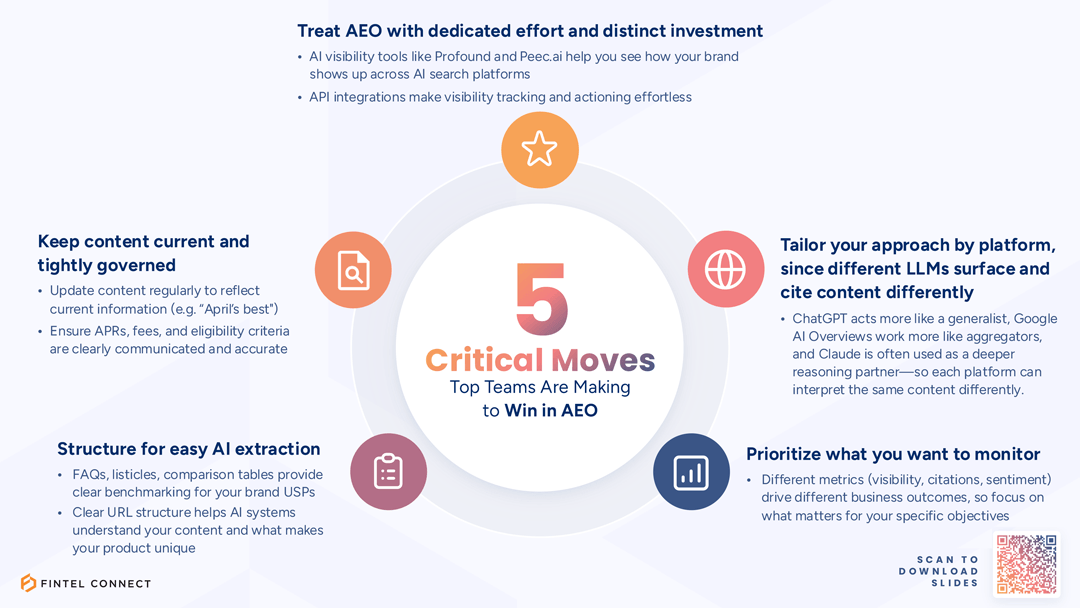
For teams looking to improve AI visibility, the keynote outlined five practical moves:
- Treat AEO as a dedicated growth priority. Assign ownership, budget, and executive attention rather than treating it as an informal SEO extension.
- Tailor your approach by AI platform. ChatGPT, Copilot, Perplexity, Gemini, Google AI Overviews, and Claude may retrieve, summarize, and cite content differently.
- Decide what you want to monitor. Visibility, citations, sentiment, share of voice, and prompt-level rankings each tell a different story.
- Structure content for easy AI extraction. Use comparison tables, FAQs, listicles, clear slugs, and product pages that explain who the card is best for.
- Keep content current and governed. Ensure APRs, fees, rewards, eligibility criteria, disclosures, and offer details are accurate across owned and affiliate content.
The bottom line: AI visibility is becoming a competitive issue
Nicky’s CardCon keynote made one thing clear: AI visibility is no longer a future-facing experiment for credit card brands. It is quickly becoming part of how consumers discover and evaluate financial products.
Affiliate publishers are already influencing how AI platforms answer high-intent credit card questions. For financial marketers, that means affiliate strategy, content governance, compliance, and AI visibility need to work together.
The brands that win in this environment will not be the ones that simply publish more content or chase traditional rankings alone. They will be the ones that understand where AI systems are getting their information, how their products are being represented, and which affiliate and publisher relationships can help them show up in the answers that matter.
When AI recommends a credit card, the question for issuers is simple: is your brand part of the answer?
FAQs
What is AI visibility for credit card brands?
AI visibility refers to how often a credit card brand appears in AI-generated answers for relevant consumer prompts, such as “best travel credit cards” or “credit cards with no annual fee.” It also includes how the brand is cited, ranked, described, and compared against competitors.
Why do affiliate publishers matter for AI search?
Affiliate publishers often create structured content such as rankings, reviews, comparison tables, FAQs, and “best for” pages. This content is easy for AI platforms to summarize and cite, which can make affiliate publishers influential sources in AI-generated financial product recommendations.
Is AI search replacing SEO?
No. AI search is expanding the search landscape rather than fully replacing traditional SEO. Credit card brands still need strong owned content, but they also need to understand how AI platforms retrieve and cite information from third-party sources.
What should credit card marketers track for AI visibility?
Credit card marketers should track prompt-level visibility, citations, share of voice, rankings, sentiment, and source domains across AI search platforms. These metrics help show whether the brand is being included and accurately represented in AI-generated answers.
How can credit card brands improve AI visibility?
Brands can improve AI visibility by keeping product details accurate, using structured content formats, strengthening affiliate and publisher relationships, adding clear disclosures and trust signals, and tailoring their strategy by AI platform.
Learn more
To explore how AI search is changing financial product discovery and what it means for affiliate marketing, visit Fintel Connect’s AI visibility resources and research here.


 English
  Français