
5 Common Tracking Challenges for Big Banks in Affiliate Marketing—and How to Tackle Them

Working at a larger bank often means more budget, more resources, and more opportunities to scale your affiliate program. But let’s face it – with that scale comes significant hurdles, especially when it comes to tracking performance. Legacy systems, complex compliance requirements, and managing multiple product lines can turn a straightforward affiliate marketing strategy into a maze of challenges.
Tracking is at the core of successful affiliate marketing, but for big banks, we know it’s not always smooth sailing. Which is why we’re covering the five common tracking issues that large financial institutions face—and ways to solve them.
What We’ll Cover in This Blog
In this blog, we’ll look at five common problems big banks (and credit unions) face in tracking their affiliate marketing efforts. We’ll also share practical solutions we’ve found can help address each challenge. We’ll cover:
- Wrestling with Inflexible Legacy Systems: How outdated infrastructures can hinder modern tracking and what steps you can take to overcome them.
- Navigating Data Security and Compliance Concerns: Balancing the need for robust tracking with stringent data privacy regulations, and how anonymization techniques can help.
- Dealing with Breaks in the Conversion Funnel: Ensuring seamless tracking from click to conversion by addressing breaks in data flow across multiple systems.
- Battling Siloed Affiliate Data: The importance of integrating affiliate data with broader marketing efforts to achieve a unified view of performance.
- Struggling with Lack of Granular Data for Optimization: Why detailed insights are crucial for campaign optimization and how to ensure your affiliates have the data they need.
Whether you’re dealing with legacy systems, ensuring compliance, or simply looking to optimize your data flow, the insights in this blog aim to provide you with the knowledge needed to make informed and practical improvements to your bank’s tracking approach.
Key Takeaways
- Big banks can modernize affiliate tracking without a complete system overhaul—small tech bridges like middleware and APIs go a long way.
- By using secure anonymization and data-mapping techniques, it’s possible to stay compliant while delivering the insights affiliates need.
- When affiliate data is integrated with broader marketing and CRM systems, it unlocks new opportunities to optimize, scale, and prove value across the organization.
Tracking challenges holding back your affiliate program? Fintel Connect can help. Contact us or tailored tracking solutions built for banks and fintechs.
1. Inflexible Legacy Systems
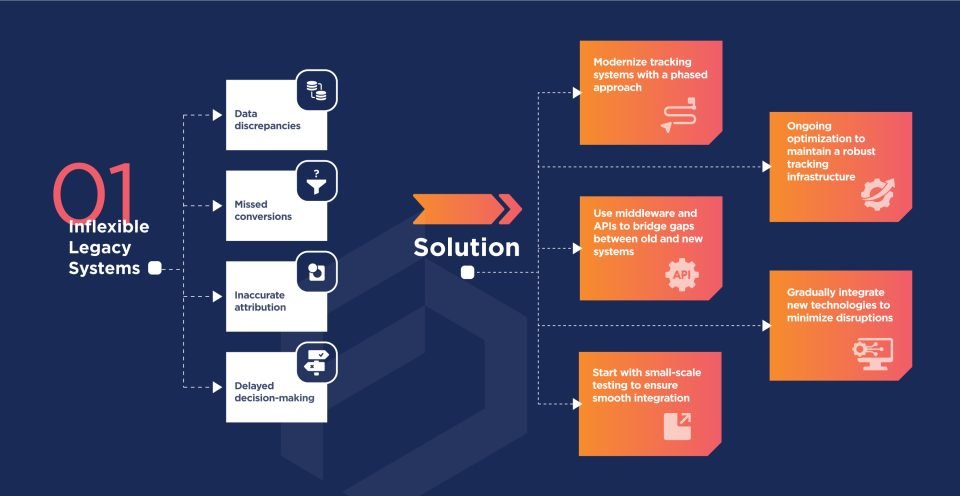
The Challenge:
Legacy systems are a reality for many large banks. These systems, while reliable and deeply integrated into a bank’s operations, were designed long before digital marketing became what it is today. As a result, they often lack the flexibility required to support the sophisticated tracking and attribution needs of today’s affiliate marketing programs. They also create challenges when it comes to passing tracking data between databases, making it hard to get a complete picture of the customer journey.
The lack of flexibility in these systems can make it difficult to integrate new technologies, leading to gaps in data capture and analysis. Marketers typically know what they need to succeed, but they may struggle to get that data from outdated systems or to work with internal teams to find effective workarounds. This incompatibility not only complicates data flow but also results in an incomplete view of the customer journey, further hindering efforts to optimize marketing strategies.
What This Means For You As A Marketer:
When your tracking systems can’t keep up with today’s fast-paced demands, you end up with data discrepancies, missed conversions, and inaccurate attribution. This doesn’t just weaken your affiliate program—it makes it harder to optimize and get the best ROI.
Timeliness and the amount of data you get are also big factors. Fintechs are often able to access conversion data in real time, while legacy bank systems might only give updates once a day, if you’re lucky. This delay can stop you from making quick decisions, leading to missed opportunities. Plus, if your system isn’t capturing enough data, you’re only seeing part of the picture, making it tough to really understand your customers and fine-tune your strategies. All of this adds up to a less effective affiliate program.
The Solution:
Banks can modernize their tracking systems with a phased approach, integrating new technologies gradually to minimize disruption while enhancing functionality. Utilizing middleware and APIs acts as a ‘bridge’ between outdated and modern systems, ensuring seamless data flow and robust tracking infrastructure. Middleware connects legacy systems with new digital marketing tools, enabling smooth communication, while APIs facilitate the accurate transfer of data between various software applications. These bridges ensure that information, like tracking data, can move from one system to another without getting lost or misinterpreted. This ensures that banks’ tracking systems are equipped to handle the complexities of affiliate marketing efficiently.
Here are our recommended steps to solve tracking challenges with legacy systems:
- Identify the Root of the Problem: We start by thoroughly assessing your existing systems to pinpoint where the data flow is breaking down. Understanding whether the issue lies with outdated infrastructure, security limitations, or incompatible systems is crucial to developing an effective solution.
- Lay Out All Available Options: Once the problem is clear, we present all possible solutions, from quick fixes to comprehensive overhauls. This includes evaluating the potential for middleware and APIs to bridge the gaps and enhance current systems without needing a full replacement. Resource availability is a key consideration – and often we take a “light lift” approach in the beginning, and work overtime to get to “ideal state.”
- Start with a Small-Scale Test: Before rolling out any large-scale changes, we recommend beginning with a pilot program. This allows us to test the new tracking solutions in a controlled environment, ensuring they integrate smoothly with existing systems and deliver the desired results.
- Gradual Integration: If the pilot is successful, we proceed with a phased integration of the new technologies. This minimizes disruption to daily operations while allowing time to address any unforeseen issues.
- Ongoing Optimization: Finally, we continuously monitor the system’s performance and make adjustments as needed. This ensures that the tracking infrastructure remains robust and capable of supporting the bank’s affiliate marketing efforts over the long term.
Case Example
We’ve worked with several banks facing the tricky task of upgrading their tracking systems while keeping their legacy infrastructure intact. Here’s how we’ve tackled similar situations:
Scenario:
One bank struggled with a legacy system that was ill-equipped to handle the demands of a modern affiliate program. Their reporting infrastructure lacked the ability to generate dynamic values, which are essential for tracking individual transactions throughout the affiliate process. This limitation meant that affiliates couldn’t get a clear view of what was driving conversions. Adding to the complexity, privacy concerns prevented the use of unique identifiers for each transaction, making it nearly impossible to match clicks to outcomes with precision.
The data the bank had was scattered across two separate systems, creating fragmentation that made it difficult to synthesize valuable information. This led to incomplete and inefficient reporting, which held the entire affiliate program back. Additionally, they couldn’t easily tie spend to return or map which campaigns were driving real long-term value.
How We Fixed It:
We stepped in to develop a solution that wouldn’t require any major overhauls to current systems but would give us greater granular view into campaign performance by mapping campaigns to specific conversions. . The key challenge was figuring out how to map the two existing reports, which lived in separate systems.
To find a solution, we asked a lot of questions and supported our main point of contact through multiple conversations to locate the right people who had the answers we needed. When working with a large company, it is common for our marketing contacts not to know who held the specific information we were looking for. We worked closely with these teams to identify what data was available, where it was stored, who owned it, and how we could leverage multiple sources.
In this case, to ‘map’ the reports together, our first step was understanding where all the pieces of data resided (which was no small task in a big company). Once we located the necessary data, and if it existed in multiple systems, we needed to understand what was in each report and identify any common data point that could map the same transaction across two reports. If there wasn’t a common data point, we explored whether it was possible to add another line item into the reporting and figured out how to feed data into one or both reports to get what we needed.
For this client, we identified a reference ID that was being used in both databases. Because this reference ID was considered PII and therefore couldn’t be shared with us externally, we chose to introduce a new parameter in lieu of an internal reference ID. This was our ClickID – a unique identifier generated for each unique campaign click. We built a script for the identifier to be collected and stored alongside the client’s reference ID, which then allowed the client to pass conversion-level data back to us to give affiliates the transparency they need to optimize campaigns.
This kind of solution allowed them to keep their affiliate program running smoothly without needing to overhaul their entire system.
2. Navigating Data Security and Compliance Concerns
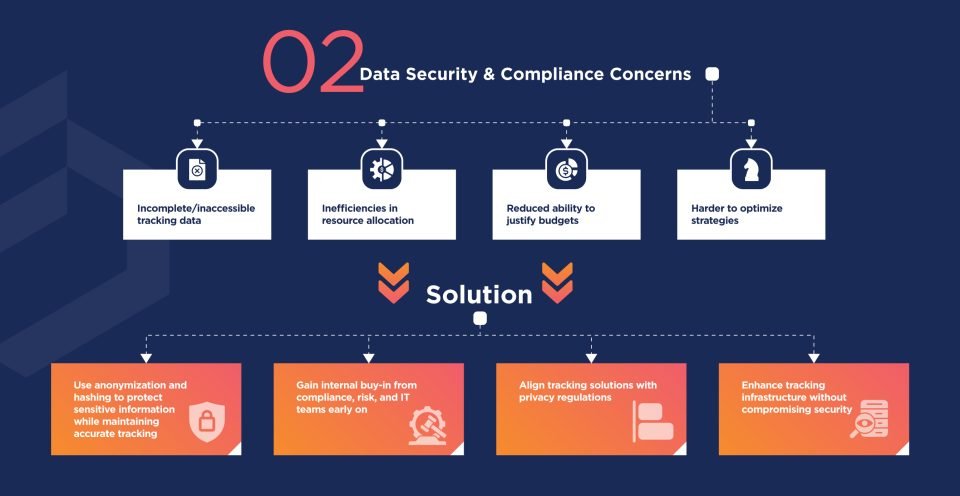
The Challenge:
Data security is paramount for any financial institution, and banks are subject to some of the most stringent regulations in this area. While these regulations are essential for protecting customer privacy, they can also complicate tracking efforts. Firewalls, internal security protocols, and concerns about data breaches often restrict the ability to share and utilize the data necessary for effective tracking and optimization.
What This Means For You As A Marketer:
When tracking data is incomplete or inaccessible due to security concerns, it can have a noticeable impact on the effectiveness of an affiliate program. Affiliates depend on detailed data to gauge the success of their campaigns and make necessary adjustments. Without access to comprehensive insights, their ability to optimize strategies is compromised, leading to inefficiencies where resources might be spent on less effective tactics.
This not only affects immediate results but also has broader implications for marketers. When marketers can’t fully demonstrate the value of the affiliate channel due to data limitations, it becomes challenging to justify the allocation of future budgets. The inability to provide clear evidence of the channel’s performance may lead to reduced funding, making it harder to scale the program or invest in new opportunities. Additionally, the lack of robust data can prevent marketers from showcasing the strategic importance of the affiliate program within the larger marketing mix, ultimately hindering their ability to secure the resources needed to drive growth and innovation.
The Solution:
To navigate these challenges, banks can employ anonymization and hashing techniques that protect sensitive information while still enabling necessary tracking. Here’s how:
Anonymization and Hashing:
Banks can address privacy and compliance challenges by using techniques to mask sensitive information. These methods are a light lift way to turn sensitive customer data into anonymized “headless” IDs. This keeps personal information (PII) secure while still allowing for accurate tracking and analysis. By removing identifiable details and adding an extra layer of security through hashing, banks can stay compliant with privacy rules without compromising the quality of their tracking. This approach not only protects data but also provides marketing teams with the insights they need to optimize campaigns and measure results.
Getting Internal Buy-In Early On:
It’s crucial to involve internal teams like compliance, risk, and IT— early on in the process. Engaging these teams early in the process helps secure their buy-in by showing that you’re not just focused on marketing outcomes, but that you understand the risks and are prepared to protect customer data and minimize identified risks. By clearly communicating how anonymized data and tracking solutions align with privacy regulations and organizational goals, you can create a collaborative environment. When these teams trust that you’ve accounted for risk, it becomes much easier to implement modern tracking solutions, resulting in better data insights and stronger overall performance.
3. Dealing with Breaks in the Conversion Funnel
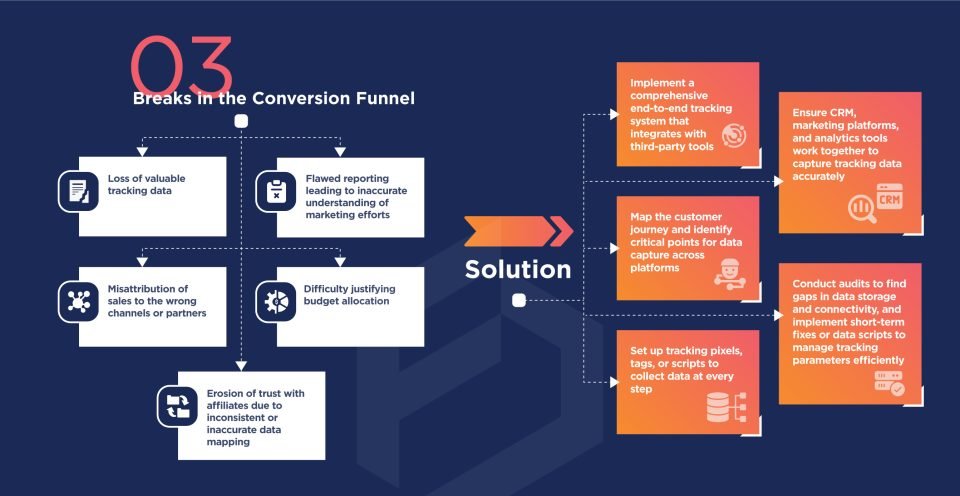
The Challenge:
A smooth conversion funnel is crucial for accurate tracking, but many banks run into problems when data doesn’t flow properly between different domains and systems. When there are breaks in this funnel, tracking data can get lost or corrupted as it moves from one stage of the customer journey to the next. Or worse – when it involves manual work, there is likelihood for human error. This can be a big issue, especially in affiliate marketing, where payouts are often made based on successful conversion events deep into the funnel.
What This Means For You As A Marketer:
When there are breaks in conversion funnel tracking, banks risk losing valuable data.
For starters, it leads to flawed reporting. Without accurate data, you can’t truly know which of your marketing efforts are working and which aren’t. This makes it hard to make informed decisions about where to invest your resources.
Even worse, it can result in misattribution—crediting the wrong channels or partners for sales, or not giving credit where it’s due. This not only skews your understanding of what’s driving results but also affects how you measure the success of your affiliate program. For banks, where every dollar counts, this kind of uncertainty can have a real impact on your bottom line.
Not only that, in the case of affiliates, without consistent or accurate data mapping, you risk losing partners if they feel their efforts are being inappropriately recognized. Inaccurate tracking is one thing that can seriously erode an affiliate’s trust.
The Solution:
The key to resolving these tracking challenges lies in implementing a comprehensive end-to-end tracking system that integrates seamlessly with third-party tools. Banks must first map out the entire customer journey, identifying critical points where campaign data needs to be captured (and stored) across platforms such as websites, mobile apps, and third-party channels. This involves setting up tracking pixels, tags, or scripts to ensure data is collected at every step.
Next, it’s crucial to ensure that internal systems—like CRM, marketing platforms, and analytics tools—work together to capture tracking data accurately. The most common challenges often come back to legacy databases – and not having available ‘fields’ to store the tracking parameters against customer accounts. Banks will conduct audits to identify where the gaps are in either connectivity or ability to store data. Sometimes it requires engineering work, but more often than not, we can find “free fields” that may be available for use as a short-term fix or ways to append data to existing parameters and use scripts we’ve written to tell the systems what to do with our tracking parameters.
Want to fix your conversion funnel gaps? Our team has helped dozens of banks restore visibility. Schedule a call to chat with our team!
Case Example
A bank was facing challenges tracking the full customer journey from initial click to account approval. Their legacy systems were disjointed, preventing them from accurately tagging unique customer journeys throughout the conversion process. Once an application was initiated from the landing page, the parameters that would be used to tag the journey were being dropped. The only parameter it would accept was a static “pre-defined field,” which would allow marketing campaigns to be tagged, but not at an individual “Click” level which is often what affiliates need to be able to properly optimize campaign performance. The issue was compounded by the use of multiple systems that were mapped using a sensitive reference ID (considered PII to the bank) that couldn’t be shared externally for security reasons. Not only were the systems disjointed and different data lived in different places, the one field mapping the data together was unable to be shared for tracking purposes.
How We Fixed It:
We took a multi-step approach to address the bank’s tracking challenges. First, we worked closely with the client to understand their data ecosystem. It turned out there was a field we could use in the application layer that we could append using our unique ClickID. We built a script that they placed on the landing page that allowed this parameter to get captured and stored against any applications that were initiated.
It involved working with their data analytics team to implement the code and run end-to-end tests to ensure the parameter could get captured and stored properly. We then set up an automated SFTP system to parse out the data we needed and pass it back to us on a daily basis. While not the ideal scenario, it saved us having to wait months for resources to implement an alternative approach and greatly improved the granular level of reporting the bank could provide to its affiliate partners.
4. Siloed Affiliate Data
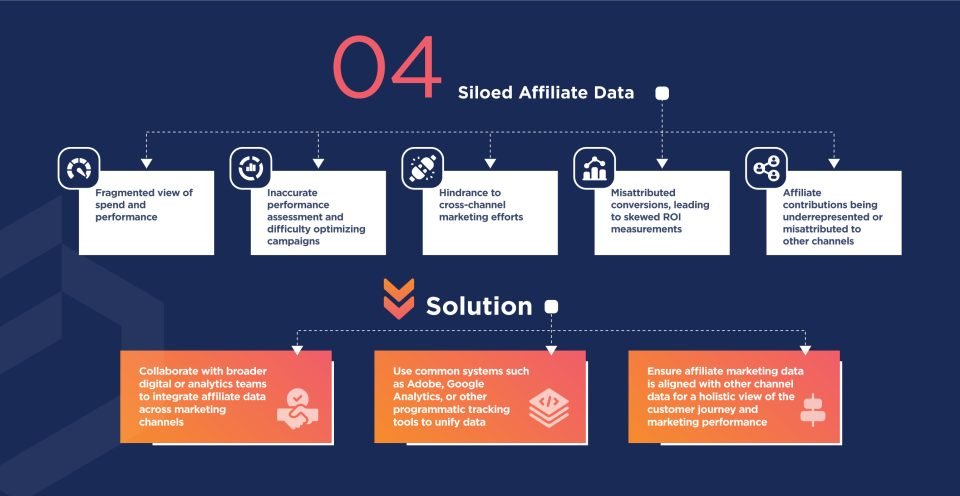
The Challenge:
In large organizations, data silos are a common challenge where different teams manage their data in isolation, leading to inefficiencies and missed opportunities in affiliate marketing. When affiliate data isn’t integrated with other marketing channels, it results in a fragmented view of spend and performance, making it difficult to accurately assess performance or optimize campaigns. This lack of integration can also hinder cross-channel marketing efforts and lead to misattributed conversions, skewing ROI measurements.
What This Means For You As A Marketer:
When data is siloed, affiliate marketing teams may not have access to the full spectrum of customer insights that are available to other departments, such as CRM, sales, or digital marketing teams. This lack of integration means that valuable information about customer behavior, preferences, and interactions might not be shared across the organization, leading to a disjointed view of the customer journey. As a result, affiliate marketing strategies may be based on incomplete data, making it difficult to accurately assess performance, attribute conversions, or identify areas for optimization. In addition, siloed teams and departments often results in affiliate traffic getting misattributed as direct or referral traffic or being double-counted towards other tactics. This means there may be an underrepresented view of affiliate’s contribution to performance.
The Solution:
To overcome this challenge, teams managing affiliate programs need to work with their broader digital or analytics counterparts to identify what common systems could be used to integrate data across their different marketing channels. Most commonly this is through Adobe, Google Analytics, or other programmatic tracking systems.
Case Example
Scenario:
One of our clients, a large financial institution, wanted the ability to compare performance of all digital marketing channels by evaluating results across various products and campaign messages. However, their existing setup had affiliate data sitting entirely separately from their programmatic, display and search channels. It meant their digital teams had no understanding of how the affiliate channel – and specific affiliates – were actually performing or impacting results.
How We Fixed It:
We developed a novel solution that allowed us to set up interstitial dynamic click trackers that were embedded into the client’s affiliate tracking links. It meant that they could capture click-level data seamlessly into their Google Analytics system used for their other channels. This integration allowed the client to now have full visibility within their own systems of all channels including affiliates, particularly when it came to post-transaction data. By providing this transparency, they could analyze which channels were driving the best results and attribute success with greater accuracy. This approach empowered them to optimize campaign performance and make more informed data-driven decisions to refine their affiliate marketing strategy for even stronger future outcomes.
5. Struggling with Lack of Quality Data Metrics for Optimization

The Challenge:
The most effective affiliate marketing programs can optimize not just based on volume of accounts and approval rates, but also quality and value over time. As an example, if your bank leadership really cares about deposit volumes, you want to be able to map affiliate campaigns to the long-term balances of referred accounts to demonstrate channel value. If you can’t do this, it narrows the variables you have to work with to optimize performance (which usually is just CPA or what you can spend per account). Traditional banking systems, often reliant on legacy technology, are not designed to track and share the comprehensive data needed by affiliates. Additionally, even when data is available, it may be disorganized or difficult for affiliates to access and use effectively. The absence of real-time data further exacerbates these challenges, limiting affiliates’ ability to react promptly to changes in the market or customer behavior.
What This Means For You As A Marketer:
The lack of comprehensive and accessible data leaves affiliates with limited information, making it difficult to optimize campaigns effectively. Without a clear view into account quality, affiliates are forced to make decisions based on incomplete data, which often leads to suboptimal campaign performance. Not only that, but you may also be missing out on opportunities to scale quality results because you don’t have any data points to justify the increased spend. This can result in wasted resources, missed opportunities, and a one-size-fits-all approach that fails to maximize ROI. In addition, the inability to access real-time data also means that affiliates may continue investing in underperforming campaigns, further diminishing the effectiveness of the affiliate program.
The Solution: Maximizing Data Integration for Campaign Optimization
To overcome the challenges associated with the lack of quality data metrics, the key lies in integrating marketing and customer data to ensure a seamless flow of insights across all stages of the customer journey. This approach goes beyond simply sharing data—it’s about designing a holistic strategy that captures the complete impact of marketing efforts on customer behavior over time.
Integrate Marketing and Customer Data:
Often, the focus in affiliate programs is on transparency up to the point of account approval, but there’s a gap in tracking how marketing influences customers after they sign up. This is where integrating data from acquisition reports and customer reports becomes critical. Although it requires a larger investment—asking clients to create ‘vintage’ reports that track customers’ progress 6 months, 1 year, or even 2 years post-signup—the insights gained can revolutionize campaign strategies. This data allows banks to optimize for long-term customer value, building more impactful campaigns and fostering stronger customer relationships. Even if this data can be shared anecdotally, it can make a world of difference to effective budget allocation and channel performance.
Implement API-Driven Data Integration:
Many banks struggle with outdated systems that make it tough to share real-time data with affiliates. Using API-driven data integration can solve this issue by allowing smooth communication between bank systems and affiliate platforms, providing instant metrics like click-through rates and conversions. But getting internal buy-in for these tech upgrades can be a big challenge. In the meantime, banks can work around it by manually exporting data from their current systems. While it’s not as efficient as APIs or pixel tracking, some banks have seen good results by automating daily batch reports, delivering meaningful improvements even with the limitations.
Conclusion
Tracking is a critical component of any successful affiliate marketing program, especially for large financial institutions where complexity is the norm. By addressing the common challenges of legacy systems, data security, conversion funnel breaks, siloed data, and the lack of granular insights, banks can enhance their make a world of difference to the effectiveness of their affiliate programs. If your bank’s affiliate program is facing any of these challenges and would like to scope solutions with our team, we’d be happy to help and welcome you to reach out.
If your bank’s affiliate program is facing any of these challenges and would like to scope solutions with our team, we’d be happy to help and welcome you to reach out.


 English
  Français