
Digital Financial Services Marketing: What It Really Takes to Compete and Grow (Bound by Banking Webinar Recap)

- Last Updated: May 12, 2026
In this article
Related articles
What does it take for a community bank or credit union to truly compete in the digital age? And what separates the financial institutions that succeed with performance-based digital marketing from those that don’t?
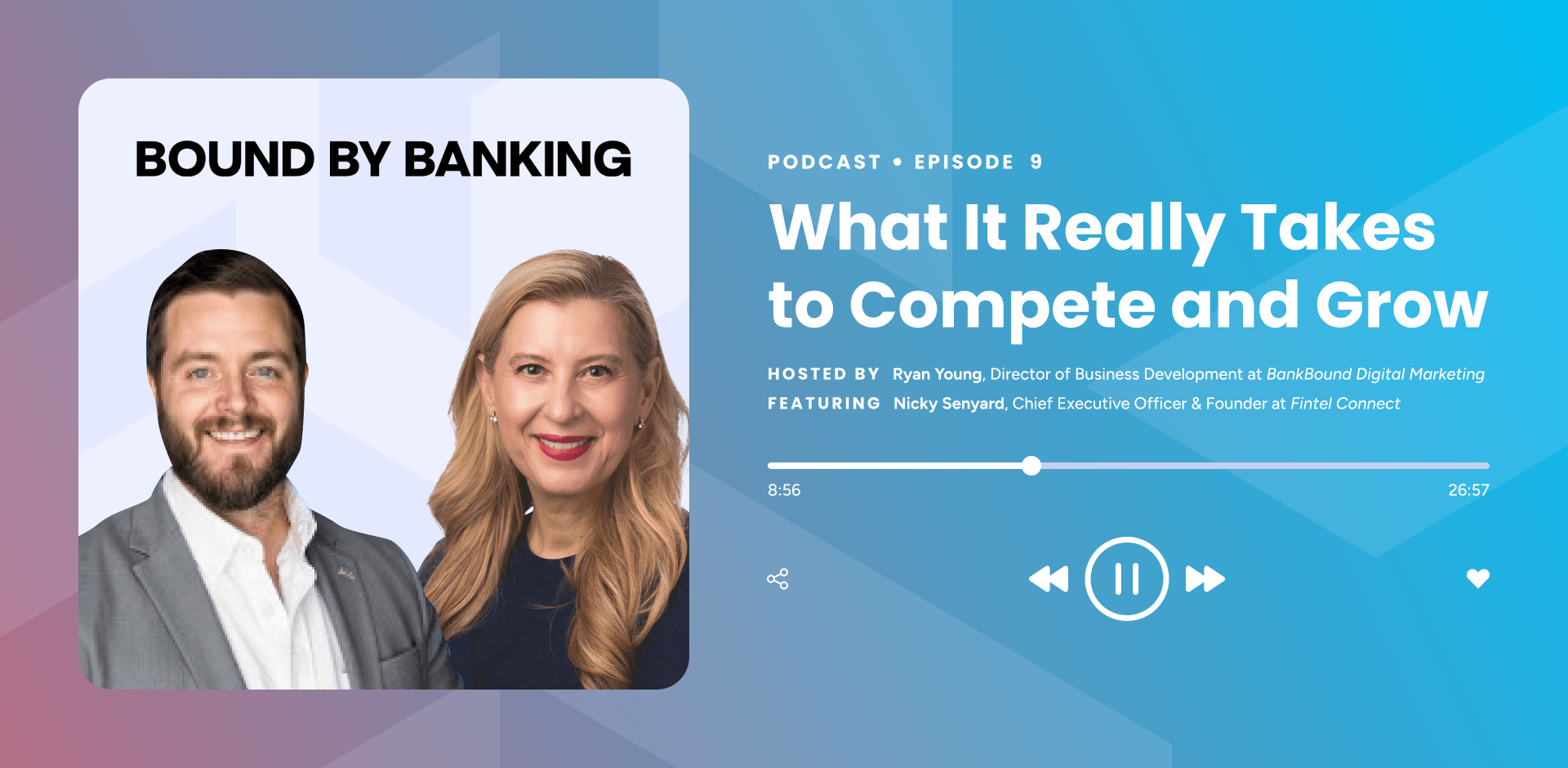
To explore these questions, our CEO Nicky Senyard joined Ryan Young at BankBound for an episode of their Bound by Banking podcast. The conversation covered digital strategy for smaller financial institutions, how to think about AI-driven discovery, and what Fintel Connect looks for before committing to a partnership.
Smaller Financial Institutions Are Still in the Hunt
Ryan asked Nicky whether community banks and credit unions still have a real shot at competing digitally, or whether the gap with the big national players is widening.
Nicky’s answer was direct: they’re absolutely in the hunt, if they choose to be. “In the digital acquisition game, the company or product that wins is the one that is closest to their audience and understands their audience,” Nicky said.
Where smaller financial institutions have the edge:
- They can adjust products, offers, and budgets without multi-layered approvals
- They are closer to their communities and audiences by nature
- They can move faster than large enterprises in financial services marketing
Where they often fall short:
- Optimizing only for the product (content) without understanding the competitive landscape (context)
- Benchmarking against national brands instead of against their own audience understanding
The takeaway: stop benchmarking against the big players. Start benchmarking against how well you know the people you’re trying to serve.
AI Is a New Channel, Not a New Game
Nicky’s take on AI in financial services marketing is deliberately grounding: AI hasn’t rewritten the rules of digital acquisition. It has added new platforms within rules that already exist. “What these LLMs are doing, very simply put, is that they’re breaking Google’s hold on accessing that traffic from an organic perspective,” she said.
She breaks marketing into two buckets: brand marketing and acquisition marketing. Every financial institutions is working across the same core channels, including email marketing, organic search, paid search, social, and affiliate marketing.
LLMs like Claude, Perplexity, and ChatGPT are expanding the options within some of those buckets, not replacing the framework. The discipline is the same: learn the channel, test your way in, scale what works.
What this means practically for financial marketers:
- LLMs still have to find you. If your brand isn’t visible in Google, AI platforms are unlikely to surface you either. The fundamentals of authority, content quality, and discoverability still apply.
- Know your audience’s platforms. Not every audience is using Perplexity or Claude to research financial products. Understand how your specific audience actually searches before investing here.
- Treat AI like any other channel. The industry went through this same story when social media emerged in the mid-2000s and with email before that. Figure it out, capitalize on it, and scale what works.
The institutions that benefit most will be the ones that approach AI-driven discovery with the same methodical curiosity they bring to every other channel, neither panicking nor ignoring it.
Don’t Be Intimidated by Digital Marketing for Financial Services. Just Get Started.
Ryan raised something he encounters regularly: credit unions and community banks that have done very little in digital marketing, even now in 2026.
Nicky said, “My biggest mandate is don’t be intimidated just because you haven’t done it before. Everybody has to learn and make sure you do it in your own style, in your own framework, in your own way.”
Why starting late isn’t as big a disadvantage as it feels:
- Institutions entering digital now can stand on years of hard-won lessons from others.
- They can build clean infrastructure from day one with solid analytics, A/B testing discipline, clear CAC, and LTV tracking.
- The work is executing it in your own way, for your own community.
What playing your own game looks like:
- Don’t mirror what Capital One or JPMorgan does. Adapt it in your own style, for your own audience.
- Work with local influencers the way you once worked with local radio or the community paper.
- Build products and content for a defined audience, not everyone.
As Nicky put it: the first campaign is like the first workout. It starts somewhere, it’s full of opportunity, and the only way to see what your numbers actually look like is to begin.
Long-Term Results Start With the Right Partner Fit
Fintel Connect has built a reputation in the affiliate marketing world for being selective about the financial institutions they bring on. Nicky discussed what performance-based digital marketing actually requires and why not every institution is ready for it.
How affiliate marketing in financial services actually works:
- Publishers are not paid on clicks or impressions.
- Payment is triggered when a real, approved customer deposits $1,000 or is approved for a mortgage.
- Publishers carry the full conversion risk with zero control over the bank’s funnel, KYC process, or product.
“These publishers are excellent marketers. Their job is to get you the right traffic to that conversion point. What they have no control over is how leaky your funnel is, how your KYC works, how interesting the product is,” Nicky said.
This creates a clear division of responsibility that both sides must honor:
| Role | Responsibility | Marketing Mix |
|---|---|---|
| Publisher / Affiliate | Drive the right traffic to the conversion point | ~80% acquisition, ~20% branding |
| Bank / FI | Convert that traffic — strong product, clean funnel, solid brand presence | ~80% branding, ~20% acquisition |
If a bank hasn’t invested in its own digital marketing, hasn’t tested its conversion rates, doesn’t know where its funnel leaks, and hasn’t built brand presence, it’s asking publishers to gamble on an outcome they can’t influence.
“If you ain’t got your house in order, then no one’s going to want to come and buy it,” Nicky said.
Fintel Connect steps back from a potential partnership because of our focus on outcomes over contracts. A campaign that isn’t positioned to perform doesn’t create value on either side.
Signs a financial institution is ready for affiliate marketing
- They know their conversion rate.
- They’ve tested and understand where their funnel drops off.
- They’ve invested in their own digital presence and brand.
- They have a clear read on their CAC and what a funded customer is worth.
Ryan echoed this from BankBound’s perspective: both businesses turn down work for the same reason. Integrity in the partnership matters more than the size of the contract.
What Financial Institutions Should Do Next to Enhance Their Digital Marketing
Whether you’re just starting out in digital or preparing to scale through partner channels, the conversation points to a clear set of priorities.
Build your foundation:
- Audit your digital funnel: know your conversion rate and where prospects drop off before driving more traffic through it.
- Set up clean analytics and A/B testing infrastructure from the start because retrofitting later is far more expensive.
- Understand your CAC and LTV well enough to defend budget decisions internally and with potential partners.
Get your brand in market:
- Run your first digital campaign (paid acquisition, content, or both) and start generating real data.
- Build a digital presence that reflects your community and differentiates you from national players.
- Explore local influencer partnerships the way you once worked with local media.
Prepare for performance-based partnerships:
- Before approaching affiliate marketing partners, make sure your funnel actually converts.
- Understand the partnership ratio: your job is brand and trust and your partners’ job is acquisition.
- Seek out partners in financial services marketing who will tell you the truth, including telling you no when the timing isn’t right.
Conclusion
The core insight from Nicky’s conversation with BankBound isn’t really about AI, or affiliate marketing, or community banks versus national brands. It’s about readiness and honesty.
The financial institutions that grow sustainably in digital are the ones that know their audience, know their numbers, and build partnerships based on shared outcomes. They don’t wait until they feel ready, but they also don’t skip the foundational work that makes everything downstream perform.
And the partners worth working with are the ones willing to say no when it isn’t going to work.


 English
  Français