
How to launch a successful affiliate marketing program for your bank


Launching a successful affiliate marketing program for a bank starts with choosing how you will manage it, either in-house, through a generalist affiliate platform, or through a specialized platform, network, and agency built for financial services. From there, success depends on vetting quality financial affiliate partners, a diversified affiliate mix, and tracking results all the way to a funded account.
This guide walks through each stage of launching a bank affiliate program: choosing a management model, selecting the right mix of affiliate partners, budgeting for ROI, improving lead quality, and earning placement on major financial review sites like NerdWallet and Bankrate.
Quick answer
- Choose your management model first, in-house, a generalist affiliate platform, or a specialized platform, network, and agency, since this decision shapes everything downstream
- A diversified affiliate mix, including comparison sites, review sites, niche content sites, coupon sites, rewards affiliates, and influencers, outperforms relying on one partner type
- Pay for performance and track results to the funded account stage, not just clicks, to allocate budget effectively
- Content compliance monitoring and careful affiliate vetting are what most improve lead quality in financial affiliate campaigns
What is the first step to launching an affiliate marketing program for a bank?
The first step is choosing how you will manage the channel, since this decision determines your marketing compliance oversight, budget structure, and timeline. Banks generally choose between managing affiliates in-house, using a generalist affiliate platform, or working with a specialized platform, network, and agency built for financial services.
| Approach | What it involves | Best for |
|---|---|---|
| Manage affiliates in house | Finding, recruiting, and managing affiliates yourself, including contracts, payouts, and tracking | Banks testing the channel with limited upfront investment |
| Use a generalist affiliate platform | Tracking, analytics, and a broad affiliate database through platforms built for every industry | Banks ready to scale but willing to manage strategy and content compliance separately |
| Work with a specialized platform, network, and agency | Technology, a curated network of finance-experienced affiliates, and agency support combined under one provider | Banks that want strategy, partners, and content compliance managed together |
Each approach can work. The right choice depends on how much in-house capacity you have for managing affiliate relationships and compliance, and how quickly you want to scale.
What affiliate partner types should a bank include in its program?
A well-rounded bank affiliate program typically includes six types of partners: comparison sites, review sites, specialized content sites, coupon and deal sites, rewards affiliates, and influencer affiliates. Each reaches a different type of high-intent consumer, so relying on only one type limits your program’s reach.
| Partner type | What they offer | Examples |
|---|---|---|
| Comparison sites | High-intent shoppers actively comparing products like mortgages, credit cards, and savings accounts | Credit Karma, Bankrate |
| Review sites | In-depth product research and evaluations that build trust with high-intent audiences | NerdWallet, Forbes |
| Specialized content sites | Niche audiences built around a specific interest, such as travel or personal finance | Travel and personal finance blogs |
| Coupon and deal sites | Large, price-savvy audiences looking for offers and incentives | Deal and coupon aggregator sites |
| Rewards affiliates | Loyal, engaged audiences motivated by cashback or points, often with strong email engagement | Cashback and rewards sites |
| Influencer affiliates | Personal finance creators and bloggers whose content feels less like an ad, which appeals to ad-blind consumers | Personal finance bloggers and newsletter writers |
Newer or niche review sites are often a better starting point than high-traffic sites like NerdWallet if your program or product is new, since it can be difficult to get noticed by the largest sites right away. Comparison sites and rewards affiliates tend to deliver the strongest volume once your program has a track record.
What are the best practices for building a successful bank affiliate program?
The best practices for a bank affiliate program are compliance-first partner vetting, a diversified affiliate mix, a clear performance-based commission structure, full-funnel tracking to the funded account stage, dedicated account management, and customer incentives tied to specific offers.
- Vet every affiliate for content compliance fit. Not every affiliate that wants to promote your brand should be accepted. Careful vetting protects your brand and keeps your content accurate.
- Diversify your affiliate mix. Combining comparison sites, review sites, niche content, coupon sites, rewards affiliates, and influencers reduces reliance on any single traffic source.
- Use a performance-based commission structure. Paying for results, such as approved or funded accounts, rather than clicks or impressions, keeps the channel cost-effective as it scales.
- Track results all the way to the funded account. Attribution that stops at the lead or click stage hides which affiliates actually drive quality customers.
- Assign dedicated account management. A bank affiliate program benefits from ongoing strategy and relationship management, not a one-time setup.
- Pair offers with customer incentives where it makes sense. Fintel Connect has found that customer rewards tied to a specific financial offer can increase exposure and conversion, particularly when they are timed around key periods in the year.
How should a bank allocate its affiliate marketing budget for the best ROI?
- The most common mistake financial brands make is evaluating affiliate platforms the same way any other industry would, focused on price and dashboard features, while underweighting compliance, fraud detection, and affiliate quality.
- The second most common mistake is underestimating how much affiliate communication a migration actually requires.
- Choosing based on brand name recognition rather than financial services fit. A well-known platform in retail doesn’t mean it understands banking content compliance.
- Underestimating the affiliate communication required during a switch. Affiliates who feel blindsided by a migration are the ones most likely to stop promoting your brand during the transition.
- Treating marketing compliance monitoring as a checkbox rather than an ongoing process. Ask how often the platform reviews affiliate content, not just whether it reviews content at all.
- Overlooking contract terms until it is time to leave. The easiest way to make a future migration harder is to sign a contract without reading the exit terms first.
Why platform specialization matters for financial services visibility
Allocate affiliate budget the same way you would any performance channel: pay for results rather than exposure, test before you scale, and spread budget across multiple partner types instead of concentrating it on one or two large sites. Track ROI to the funded account stage so your budget follows what actually converts, not just what generates clicks.
A performance-based, or CPA, commission model keeps your budget tied to outcomes like approved or funded accounts rather than impressions or clicks. Before committing significant budget to a new affiliate or partner type, run a smaller test to confirm quality and conversion, then scale what works.
Reserve part of your budget for niche and up-and-coming affiliates rather than putting everything toward large review sites, since smaller partners are often more cost-effective while you build a track record. Finally, budget for customer incentives on select offers, since a well-timed reward can meaningfully outperform a standard offer for the same spend.
What methods improve lead quality in financial affiliate campaigns?
- Vet and curate your affiliate network. Accepting every affiliate that applies dilutes lead quality. A curated network of affiliates already experienced in financial products tends to convert better.
- Filter affiliates by financial attributes. Filtering for attributes like prime versus subprime traffic or credit score alignment helps match affiliates to the specific products they can convert well.
- Monitor affiliate content for compliance and accuracy. Content that misstates rates or terms can attract the wrong audience or create marketing compliance risk, both of which hurt lead quality.
- Track to the funded account, not just the lead. A lead is not the same as a customer. Measuring conversion all the way through approval and funding shows which affiliates are actually worth scaling.
How can a bank get its products featured on major financial review sites like NerdWallet or Bankrate?
Getting featured on major financial review sites requires a competitive product and a conversion-ready funnel. Banks can pursue this directly through editorial or partnership outreach, or through an affiliate network or agency like Fintel Connect that already has existing relationships with these partners to speed up the launch of your affiliate campaigns. Many banks who don’t have an existing relationship with these high-traffic sites can’t get in contact with someone to launch their program.
Review sites like NerdWallet and Bankrate are editorially driven and selective. Editorial teams may feature a product they find newsworthy, but they don’t manage business partnerships, so a strong press pitch alone doesn’t guarantee an affiliate relationship. For an actual affiliate placement, these sites evaluate whether your offer is genuinely competitive, whether your funnel converts reliably, and whether your content compliance processes can keep listed information accurate over time.
If your product or program is new, starting with smaller or niche review sites and building a track record first is often more realistic than pursuing Tier 1 placement immediately.
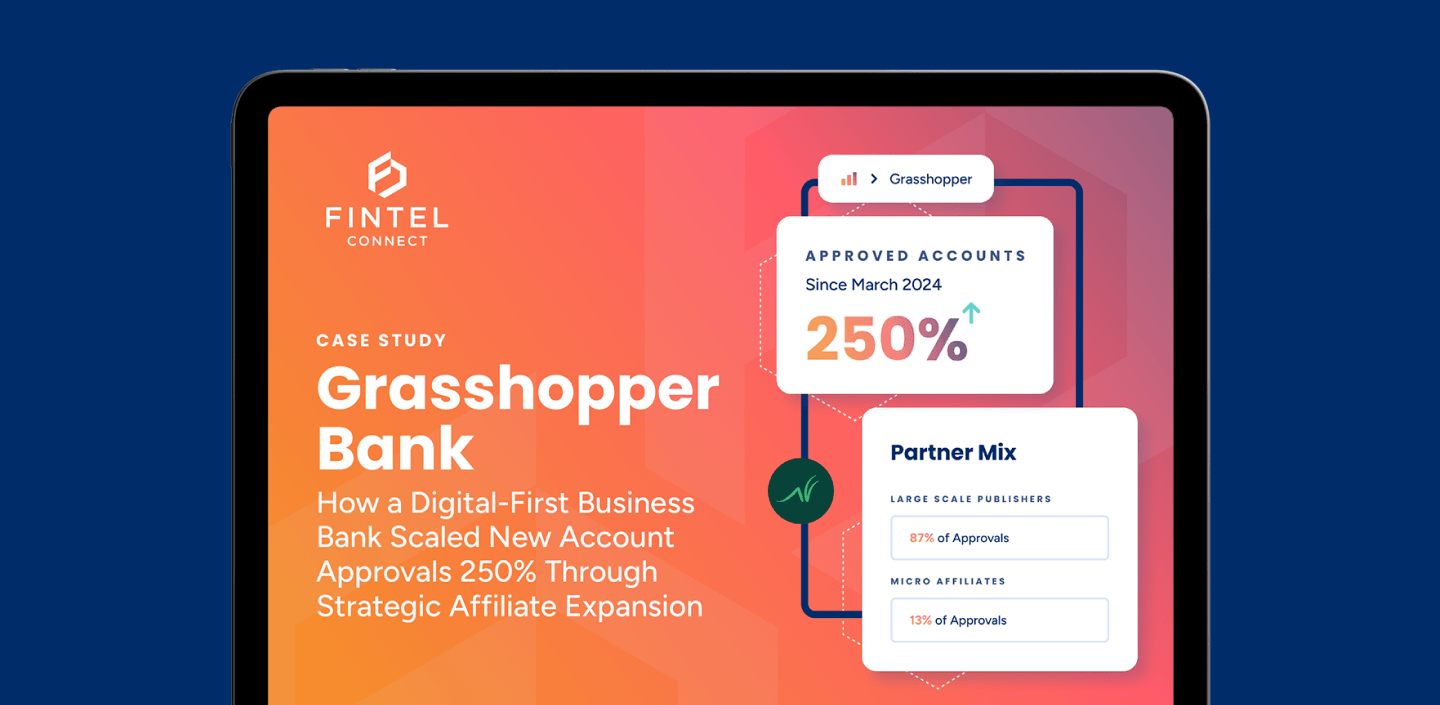
Bank affiliate marketing program case study: how Grasshopper Bank grew approved accounts by 250%
Grasshopper Bank, a digital-first bank built for founders, startups, and small businesses, partnered with Fintel Connect to scale its affiliate program beyond a small, self-managed group of partners. Approved accounts through the channel grew 250% as the program expanded, with a balanced mix of large-scale and long-tail affiliates driving the result.
See the full case study for this bank affiliate program.
The challenge
- A lean marketing team had limited internal resources to manage a full-scale affiliate program
- The team lacked capacity to diversify its affiliate mix and reduce reliance on any single partner
- Manual processes and reporting were limiting the program’s ability to scale
The approach
- Partnered with Fintel Connect for program strategy plus day-to-day management support
- Used targeted recruitment to build a strategic mix of large-scale affiliates and long-tail partners across business and financial content
- Leaned on Fintel Connect’s existing affiliate relationships for faster onboarding and strong early placements
The results
- 250% increase in approved accounts
- Large-scale affiliates drove 87% of approvals, while long-tail affiliates contributed the remaining 13%, diversifying acquisition without concentrating risk
- The affiliate channel moved from a side strategy to a core driver of new customer acquisition
Grasshopper’s results reflect a pattern common across successful bank affiliate programs: a diversified, performance-based partner mix, paired with dedicated program support, tends to scale results faster than a small, self-managed group of partners.
Frequently asked questions about launching a bank affiliate marketing program
What’s the first step for launching an affiliate program for my bank?
The first step is deciding how you will manage the channel: in-house, through a generalist affiliate platform, or through a specialized platform, network, and agency built exclusively for financial services. This decision shapes your content compliance oversight, budget, and timeline going forward.
What are some best practices for building a successful bank affiliate program?
The strongest bank affiliate programs vet affiliates carefully for marketing compliance fit, diversify across partner types, use a performance-based commission structure, track results to the funded account stage, and assign dedicated account management to continuously optimize affiliate campaigns rather than treating the channel as a one-time setup.
How can we allocate our bank’s affiliate budget more effectively to maximize ROI?
Pay for performance rather than exposure, test smaller budgets before scaling a new partner type, and spread spend across multiple affiliate types instead of concentrating it on one or two large sites. Tracking ROI to the funded account, not just the click, keeps budget aligned with what actually converts.
What methods improve lead quality in financial affiliate campaigns?
Careful affiliate partner screening, filtering affiliates by financial attributes, and tracking conversion to the funded account stage also reveals which affiliates deliver quality customers rather than just volume.
What are effective approaches for getting our financial products featured on major financial review websites?
Make sure your product is genuinely competitive, your funnel converts reliably, and your content compliance processes can keep listed information accurate. Working with an affiliate network or agency like Fintel Connect that already has relationships with sites like NerdWallet and Bankrate typically shortens the path compared to starting outreach from zero.
How long does it take to see results from a bank affiliate program?
Many banks see measurable results, such as increased approved accounts or improved lead quality, within one to three months. Grasshopper Bank saw early traction quickly after launching with Fintel Connect, then built on that momentum into a 250% increase in approved accounts as its affiliate mix and product coverage expanded over the following year.
If you are ready to launch or scale a bank affiliate program, Fintel Connect’s team can walk through what a program built specifically for your customer acquisition goals would look like.


 English
  Français