
The executive’s guide to affiliate CPA strategy for banks


Banks carry the broadest product lineup of any financial institution, checking, savings, credit cards, mortgages, investments, and business banking, often all running through the same affiliate program at once. That breadth is a real advantage for reach, but it’s also where most cost per acquisition (CPA) strategy goes wrong: budget spread thin across too many products, or too much acquisition riding on one or two large affiliate relationships.
This guide applies the core CPA framework from our 2026 CPA benchmarking and strategy report specifically to what banks need to get right.
What makes CPA strategy different for banks?
Banks manage more simultaneous product lines than most other financial institutions, and that changes the math on CPA in a specific way: the more products competing for the same affiliate attention and marketing budget, the higher the risk that any one of them is under-resourced or over-exposed to a single partner relationship.
A few things that follow from that:
- Diversification matters more for banks than for single-product fintechs. A bank promoting five product types through the same two comparison sites carries more risk than one spreading acquisition across a genuine mix of affiliate types.
- Product competitiveness has to be evaluated per product line, not once for the whole brand. A competitive savings rate doesn’t offset an uncompetitive business credit card, and affiliates will treat them as entirely separate decisions.
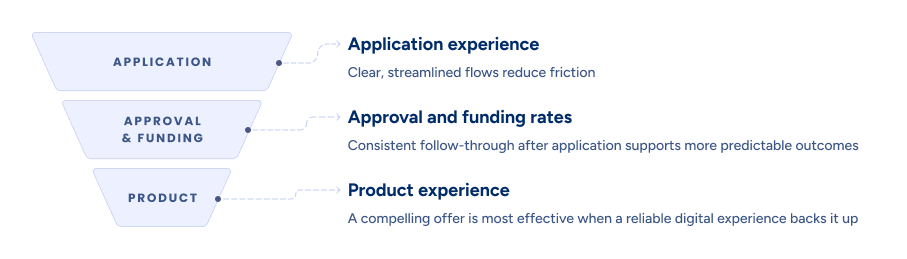
- Conversion efficiency compounds across products. Friction in one application flow doesn’t just cost that product’s CPA, it also signals to affiliates how much operational maturity the rest of your program has.
What are realistic CPA benchmarks for bank products?
Based on Fintel Connect’s 2026 CPA Benchmarking Report, here’s where the market sits for products most relevant to banks in the US:
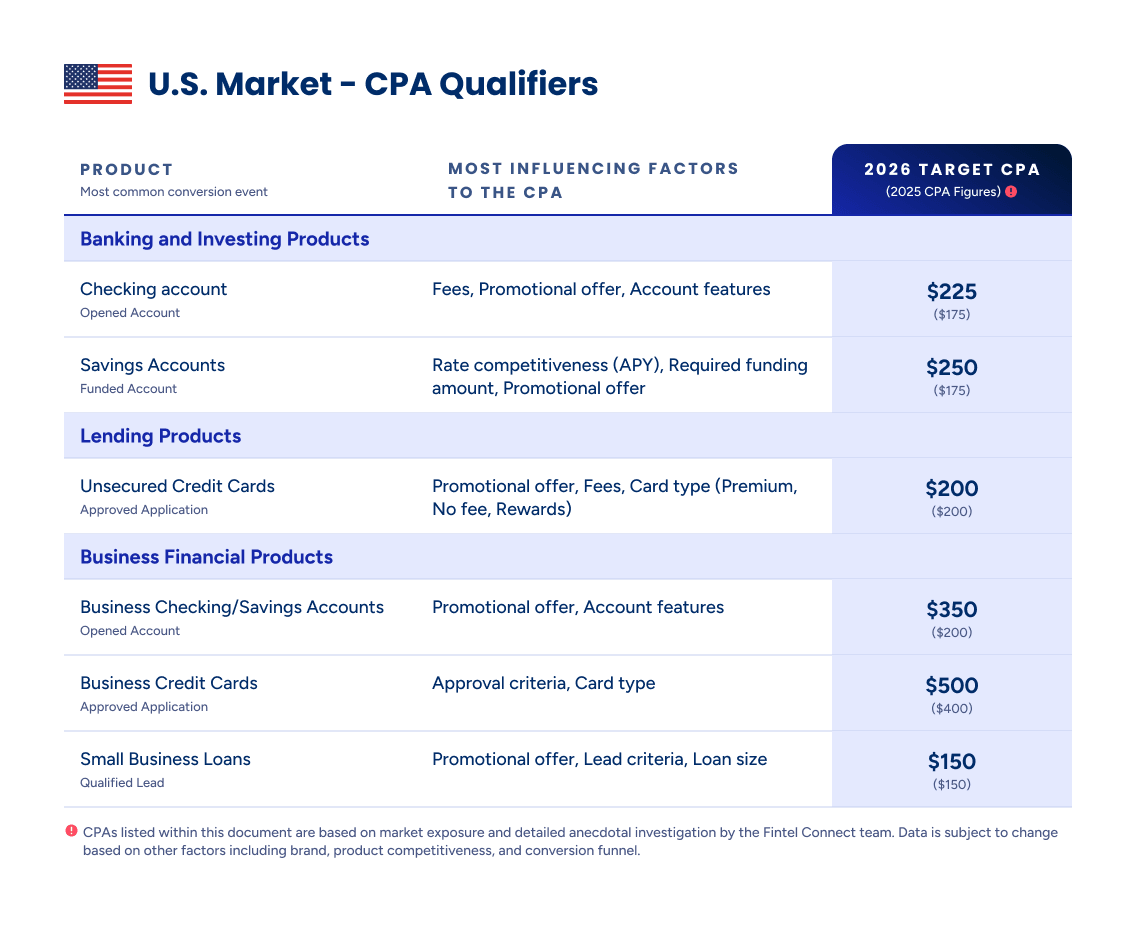
- Checking accounts: $225 (opened account)
- Savings accounts: $250 (funded account)
- Unsecured credit cards: $200 (approved application)
- Business checking and savings accounts: $350 (opened account)
- Business credit cards: $500 (approved application)
- Small business loans: $150 (qualified lead)
Business banking products command the highest benchmarks in the bank category, and for good reason: the pool of qualified business customers is smaller, the search terms are more expensive, and competition for premium affiliate placements in this category is intense. If your business banking CPA looks high next to your consumer products, that’s often the market functioning correctly, not a budget problem.
These figures are directional, not fixed. For the full breakdown by product and conversion event, including Canadian benchmarks, see the complete 2026 CPA benchmark and strategy report.
What’s the biggest CPA mistake banks make?
Of the five common CPA mistakes covered in our report, the one that hits banks hardest is prioritizing low CPA over customer value, specifically, spreading a fixed budget evenly across every product line instead of committing to a CPA that actually reflects what each product is worth.
This shows up in a specific way for multi-product institutions: a bank sets one blended CPA target across checking, credit cards, and business banking, so no single product gets the investment it needs to actually compete for attention. The result is often weak visibility everywhere rather than strong visibility somewhere.
Best practice: set CPA by product line, not by brand. A business credit card and a no-fee checking account are different businesses with different customer values, and they should be budgeted that way.
The other four mistakes, adjusting targets too quickly, setting targets without affiliate input, using higher CPAs to mask a weak product, and launching with an unsustainable CPA, apply to banks too. See the full breakdown of all five mistakes in our pillar guide.
How should banks diagnose a CPA problem?
Before adjusting CPA on any product line, ask one question: is the problem commercial, or is it structural?
- Commercial: Your checking account is competitively priced and converting well, but affiliates still aren’t prioritizing it. The fix is likely CPA or placement, not the product.
- Structural: Your business banking application has a strong rate and offer, but abandonment is high at the application stage. No CPA increase will fix that. Fix the funnel first.
Run this diagnostic per product line, not once for your whole program. A bank’s checking account and business lending product can easily be on opposite sides of this diagnostic at the same time.
Case study: how Grasshopper Bank scaled approvals with a balanced partner mix
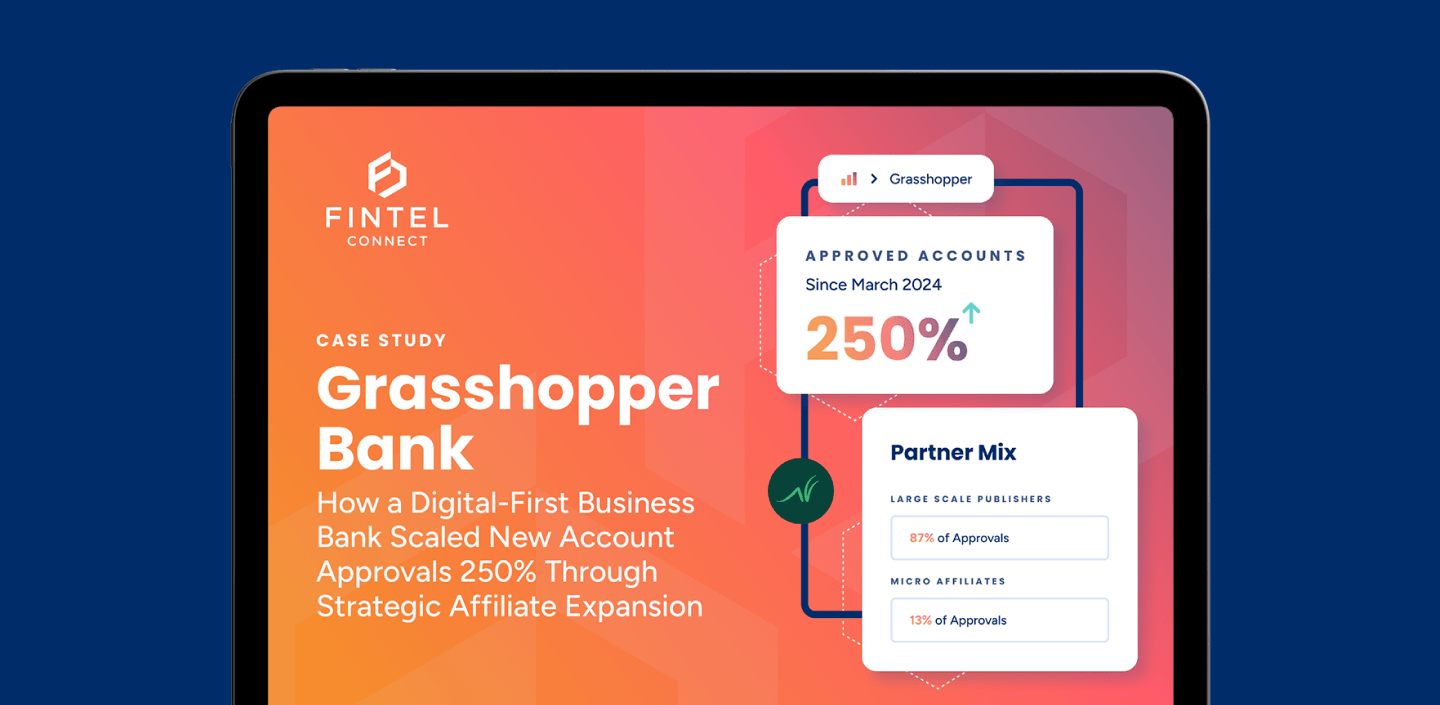
Grasshopper is a digital-first bank built for founders, startups, and small businesses, and like many lean marketing teams, it needed to grow the affiliate channel without adding headcount or compromising on partner quality and compliance.
Working with Fintel Connect, Grasshopper built a partner network that combined large-scale publisher affiliates with micro-affiliates, all on a CPA-only structure, to scale approvals across Innovator Checking, Innovator Savings, and its SBA loan products.
- 250% increase in approved accounts through the affiliate channel since March 2024
- 87% of approvals came from top-tier publisher affiliates, with the remaining 13% from micro-affiliates, a diversified mix rather than reliance on one partner type
What should bank marketing leaders prioritize now?
- Audit budget allocation against product competitiveness. Confirm your highest-CPA products (typically business banking) are getting investment proportional to their value, not just an equal share of a shared budget.
- Set up product-level attribution. Make sure your tracking can report performance separately by product line, not as one blended number, so you can see which products are underperforming for commercial reasons versus structural ones.
- Review partner concentration. If more than a small handful of affiliates account for most of your acquisition, that’s the diversification risk the pillar guide flags, and it’s worth addressing before it becomes a bigger exposure.
Frequently asked questions
What’s a good CPA for a bank checking or savings account?
Current US benchmarks put checking accounts around $225 for an opened account and savings accounts around $250 for a funded account, though the right number for your institution depends on your product’s competitiveness and the conversion event you’re paying for.
Why do business banking products have higher CPA benchmarks than consumer products?
Business banking products face a smaller pool of qualified customers, more expensive search terms, and stronger competition for premium affiliate placements, which pushes benchmarks higher across business checking, business credit cards, and small business lending.
How many affiliate partners should a bank work with?
There’s no fixed number, but banks with multiple product lines should generally diversify across several affiliate types (comparison sites, content creators, niche publishers) rather than concentrating acquisition through one or two large partners, since that concentration is a bigger risk for multi-product institutions than for single-product brands.
Should a bank use the same CPA across all its product lines?
No. Each product line has a different customer value, a different level of competition, and a different conversion event, so CPA should be set per product rather than as one blended target across the whole brand.



 English
  Français