
The Marketing ROI Gap in Banking: How Financial Institutions Spend, Measure, and (Struggle to) Prove Marketing’s Value

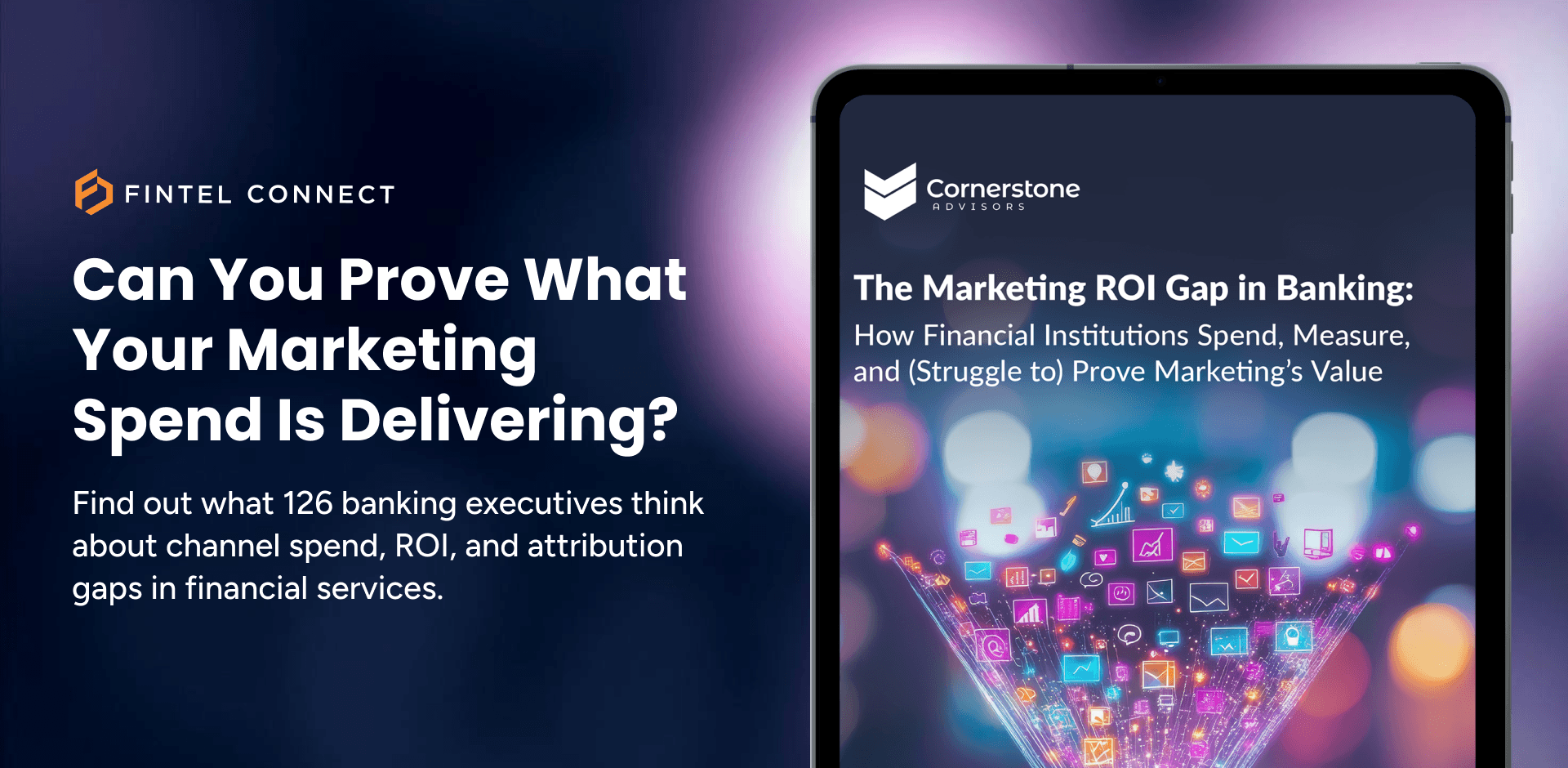
Promotional graphic from Fintel Connect asking “Can You Prove What Your Marketing Spend Is Delivering?” alongside a report titled “The Marketing ROI Gap in Banking” by Cornerstone Advisors, highlighting insights from 126 U.S. banking executives. The image features a tablet displaying digital marketing icons flowing upward, representing effective marketing channels for financial services and the role of an affiliate marketing agency in channel spend, ROI, and attribution gaps.

New research from Cornerstone Advisors, in partnership with Fintel Connect, shows that large financial institutions are under growing pressure to prove marketing’s value, even as weak measurement and attribution make it harder to align spend with results. This report, The Marketing ROI Gap in Banking, highlights where those gaps are creating risk and where stronger growth opportunities may be getting missed.

Why This Matters to Executives at Large Financial Institutions

Marketing leaders are under pressure to prove ROI, yet many institutions still can’t clearly measure what is working. This report shows how banks and credit unions are budgeting, measuring performance, and where the data falls short.

  1. Affiliate marketing remains underused. Only about a third of institutions use affiliate or partner marketing, yet 1 in 5 call it their most under leveraged channel.
  2. Marketing dollars are going to the wrong place: Paid search gets the largest share of budget, yet email is most often cited as the strongest ROI channel.
  3. The budget process is still backward-looking. Nearly 6 in 10 institutions set their marketing budget by adjusting last year’s number.
  4. Measurement is still a structural problem. Nearly 6 in 10 say their core or CRM limits ROI measurement, and not one institution surveyed said it could reliably attribute results across all outcomes measured. 

126 senior executives at U.S. banks and credit unions were surveyed. 48% of respondents were from banks and 52% work at credit unions.

✔️ Learn which marketing channel delivers the most impact—but is the most under-leveraged

✔️ Understand why you may be giving budget to the wrong marketing channels

✔️ Identify why getting attribution, measurement, and outcome-based accountability is critical

✔️ Discover the 3 things needed to make marketing a growth strategy

Who is This Report For?

  • Head of Business: The report helps connect channel decisions to revenue and acquisition outcomes. The real issue is not just lead volume, but whether spend is translating into efficient growth.
  • CMO / Head of Marketing: Paid search commands spend, while stronger ROI signals come from email and affiliate/partner marketing. That matters for leaders who own channel strategy, budget allocation, and ROI accountability.
  • CFO: Nearly 6 in 10 institutions still set marketing budgets by adjusting last year’s number, while 60% say their core or CRM limits ROI measurement. That makes marketing ROI a spend-discipline and governance issue, not just a reporting issue.
  • Head of Affiliates: Only about one-third of institutions actively invest in affiliate/partner marketing, yet one in five call it their most underleveraged channel. That is a strong signal for teams focused on scaling partner-led acquisition.

Why Download This Report? 

There is limited large-scale data on how senior executives at banks and credit unions evaluate channel effectiveness, budget allocation, and marketing ROI. Based on a survey of 126 senior executives from U.S. banks (48% of respondents) and credit unions (52% of respondents), this research gives leaders a clearer view into how other financial institutions are approaching critical decisions.

en_USEnglish