
Webinar Recap: Trends, Tracking, and Best Practices to Drive Funded Growth for Banks and Credit Unions

- Last Updated: septembre 14, 2026
Dans cet article
Related articles
Most financial marketers can tell you how many clicks a campaign drove. Far fewer can tell you how many of those clicks became funded accounts or which channels actually deserve the credit.
That gap is expensive. And according to new research, it’s more common than most institutions want to admit.
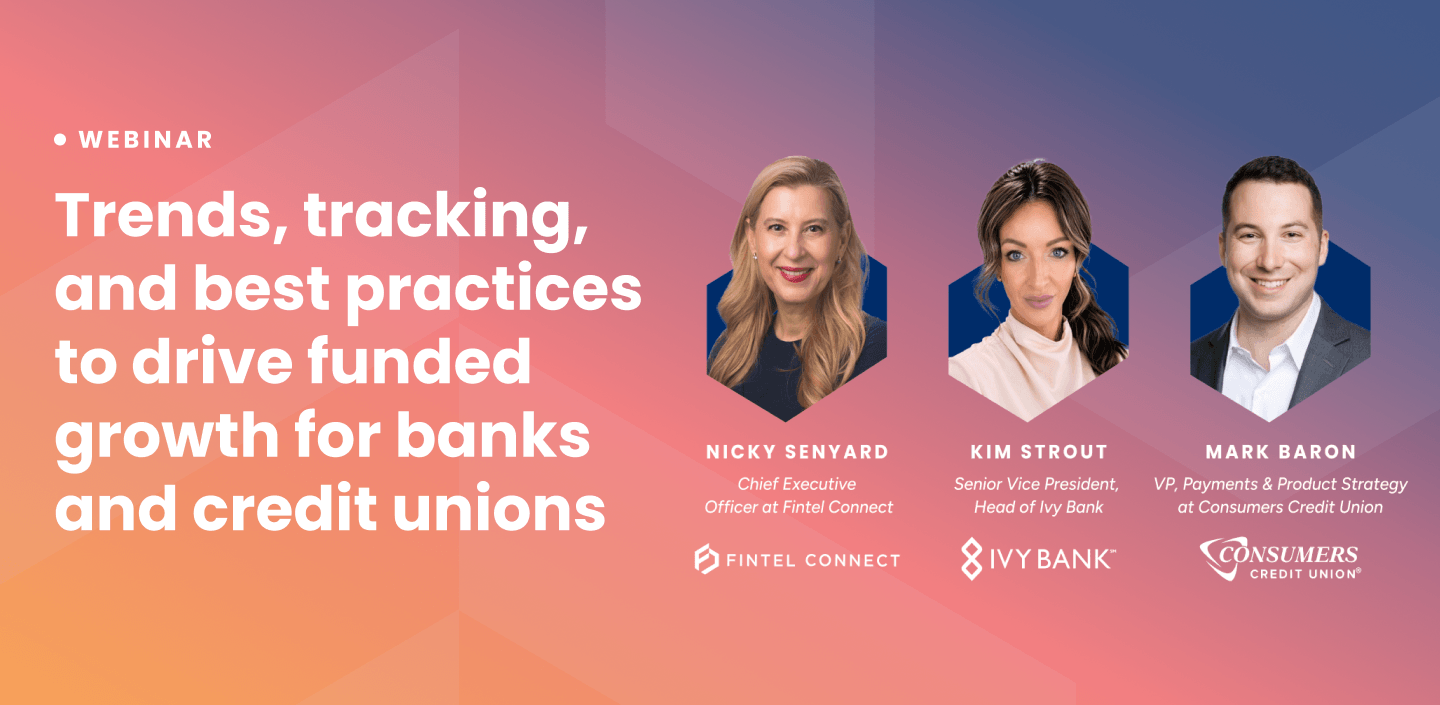
To unpack what’s driving it and what to do about it, our CEO Nicky Senyard hosted a panel discussion with two financial marketing leaders who have been deep into this problem and come out the other side:
- Kim Strout, Senior Vice President and Head of Ivy Bank, a digital-only bank backed by Cambridge Savings Bank that grew from zero customers and zero deposits to over $1.2 billion since launching in 2021
- Mark Baron, VP of Payments and Product Strategy at Consumers Credit Union, a $4.5 billion institution that rebuilt its affiliate marketing program from the ground up with data at the center
Watch the full recording here.
Why attribution is failing financial marketers
The conversation opened with findings from a research study Fintel Connect conducted with Cornerstone Advisors, Le fossé du retour sur investissement marketing dans le secteur bancaire, surveying nearly 126 marketing and senior executives at banks and credit unions across the U.S.
The numbers are hard to ignore:
- 60% of financial institutions say their core CRM integrations limit their ability to measure marketing ROI
- Nearly 1 in 3 believe they credit the wrong source when it comes to attribution for digital acquisition
- 25% believe they are crediting more than one source for the same outcome
When attribution is broken, it’s not just a reporting problem. It’s a decision-making problem. Leadership can’t get behind innovation or growth if the data feeding those decisions isn’t reliable.
The cost of getting attribution wrong isn’t just wasted budget. It’s doubling down on decisions that aren’t accurately aligned with what’s actually driving funded growth.
From clicks to funded accounts: the measurement shift
Both panelists described the same fundamental shift in how they think about marketing performance measurement: moving from front-end metrics to funded outcomes.
Kim’s lesson from building Ivy Bank from scratch:
- It’s not every impression that matters
- It’s not every click that matters
- It’s not even every application that matters
- Every aspect of a customer’s journey across the entire funnel tells a story
- Track how accounts look at 30, 60, and 90 days after opening
- Measure whether customers funded, stayed, and deepened their relationship
- Compare the quality of customers by channel and source, not just volume
- Feed that data back into acquisition strategy to optimize toward revenue, not ad spend
“Not every click is going to be valued the same. You really need to look at the value of the customer at 30, 60, and 90 days, how that relationship is formed, and then look back at what drove that customer to begin with,” said Kim.
What that means in practice:
Kim shared a concrete example of how this played out at Ivy Bank. Early on, the majority of customers fell into an older, high-balance cohort. By leveraging downstream data, the team identified which acquisition channels were attracting which customer profiles, and then deliberately shifted strategy to also attract younger customers who would grow with the bank over time. Today, over 50% of Ivy Bank’s customers are millennials and Gen Z.
The shift leadership actually cares about:
Kim’s point was clear: leadership isn’t going to care about marketing metrics. They want to know how those metrics connect to growth. Framing the conversation around the risk of bad data, not just the opportunity of good data, is often what gets leadership on board.
How to build attribution confidence from the ground up
Both panelists came to this problem from different starting points. Kim built Ivy Bank’s data infrastructure from zero. Mark inherited an existing affiliate marketing program at Consumers Credit Union that lacked confidence in its commission data and affiliate performance, and had to rebuild it entirely.
What Mark learned from the rebuild at Consumers Credit Union:
- The existing program lacked confidence in commissions paid and the value affiliates were actually driving
- Rebuilding required starting from the data up with strategic guidance with Fintel Connect and making data the cornerstone of every conversation
- The real work was orchestrating four or five internal legacy systems to talk to each other and follow the customer through the journey
- It required a cultural shift internally, not just a technical one
“Above and beyond the task of actually doing these things, there was a cultural change that took some intentional conversations internally to get people to understand this next stage of maturity for digital marketing,” said Mark.
What Kim learned from building Ivy Bank’s attribution from scratch:
- Even starting fresh doesn’t mean starting easy as legacy systems at the parent institution created real data challenges.
- The single source of truth matters most: tracking data from the first click through website behavior, application, KYC verification, and funded outcome.
- Early on, the focus was necessarily on impressions and clicks. As the customer base grew, the data started telling a richer, more actionable story.
The practical infrastructure both teams built:
- A single source of truth connecting marketing source to funded outcome
- Consistent tagging across all channels and partners
- End-to-end funnel tracking from first click through KYC and account funding
- Regular data reviews at 30, 60, and 90 days post-acquisition
- Internal alignment between marketing, finance, and product on what success actually means
The three pillars of funded growth
Nicky synthesized the conversation into a framework she returns to in every client conversation. When it comes to digital acquisition for financial institutions, three things have to work together:
1. Volume You need enough acquisition activity to see patterns and make meaningful decisions. Two data points don’t tell you much. Two million do. Volume creates the signal that strategy can act on.
2. Quality Volume without quality is a liability. A channel can become unprofitable when the customers it drives don’t fund, don’t stay, or don’t grow. Quality means funded, active, retained customers, not just approved applications.
3. Efficiency Efficiency is the optimization layer on top of volume and quality. It’s about sustainable acquisition economics, understanding your CAC relative to customer lifetime value, and being able to defend that math to finance and leadership.
How attribution connects to all three:
- Without reliable attribution, you can’t measure which channels deliver quality customers
- Without quality data, you can’t optimize toward efficiency
- Without efficiency metrics, you can’t defend the budget decisions that fund future volume
The data isn’t the end goal. It’s what connects the weeds of digital marketing activity to the outcome that actually matters: a profitable customer.
How financial institutions are approaching AEO
Fintel Connect is working with a growing number of financial brands that are turning to us for strategic guidance on how to get started with AEO or how to optimize their visibility with affiliates.
Nicky’s framework for AEO three areas every financial institution should address:
- On-site optimization: Make your site readable to AI, not just humans. FAQs should target the exact questions your audience is asking. Small content changes can significantly improve your visibility in AI-generated answers.
- Affiliate relationships: Credible third-party citations are the primary driver of AI visibility. Work with affiliate partners to get your brand into listicles, comparison articles, and relevant content that AI platforms pull from. Fintel Connect audits AI visibility for the prompts clients want to be cited for, then identifies the publisher placements most likely to get them there.
- Content creation informed by real customer questions: The best source for AEO content is already inside your institution including call center FAQs, chatbot conversations, and branch queries tell you exactly what your audience is searching for. Use those questions to guide new content creation.
“Credible third parties are the power behind the citations. If you’re going to do anything in addition to your own internal strategy, working with affiliates is what’s actually going to help drive it,” said Nicky.
What banks, credit unions, and fintechs should do next
Whether you’re rebuilding a broken attribution model or building one for the first time, the panel’s advice points to a clear set of priorities.
Start with the data foundation:
- Audit your current tracking, don’t assume it’s working until you’ve tested it.
- Identify every system that touches the customer journey and map how data moves between them.
- Build toward a single source of truth from first click to funded account
- Don’t try to prove everything at once. Pick one channel, follow it as far through the funnel as you can, and build from there.
Measure what leadership actually cares about:
- Tie every channel metric back to funded outcomes, not just applications
- Track customer quality at 30, 60, and 90 days post-acquisition
- Frame budget conversations around the risk of bad data, not just the opportunity of good data
- Build a partner scorecard that compares channels and affiliates on quality and efficiency, not just volume
Prepare for AEO and AI visibility:
- Auditez la manière dont votre marque apparaît dans les prompts IA de grande valeur
- Identify which publisher and affiliate relationships are most likely to drive third-party citation
- Use your call center FAQs, chatbots, and customer service data to inform new content
- Start small, test and learn before committing ongoing budget to AI visibility tools
Don’t give up
Both Kim and Mark were asked how long institutions should give this process before expecting results. The answer from both: there’s no fixed timeframe, and the process never truly ends.
- Mark’s team started with a minimum viable product in late 2025 and has been improving accuracy ever since
- The goal isn’t perfect attribution, it’s incremental confidence that gets better over time
- Once you cross the threshold where you can explain your acquisition cost to finance and confidently commit to volume projections, it changes the entire conversation
Conclusion
The financial institutions that win at digital acquisition aren’t the ones with the most sophisticated tools. They’re the ones that have built the discipline to connect marketing activity to funded outcomes, and then use that clarity to make smarter decisions about where the next dollar goes.
Attribution isn’t a one-time project. It’s an evolving capability that gets sharper as the data compounds. The teams that invest in it now, even imperfectly, will have a meaningful advantage over those that wait for a perfect solution.
Start with what you have. Follow one channel as far through the funnel as you can. Build from there.
Access the full recording and download the Marketing ROI Gap in Marketing report.



 Français
  English