
Résumé de la section
More and more consumers are asking ChatGPT, Gemini, and Claude which bank, credit union, or fintech is worth their business, and the AI is already giving them an answer. That answer names specific brands, in a specific order, backed by specific sources, whether your institution has thought about it yet or not.
If your brand isn't one of those names, the cost isn't a lost ranking. It's a lost recommendation, at the exact moment a consumer is deciding who to trust with their money:
- Missing from the answer means missing the decision entirely, before a prospect ever reaches your website, call center, or branch.
- Showing up isn't the win. Being chosen first is.
- This shift is already underway, which is why financial brands are increasingly focused on building an AI visibility strategy from the ground up, following best practices to show up at the decision-making stage, and optimizing the presence they already have.
This guide is for two kinds of readers:
- If you're just getting started: it walks you through exactly where to focus first
- If you already have some AI visibility strategy in place: it shows you how to measure whether it's actually working and where the gaps are
Either way, the goal is the same: get your brand cited, get it mentioned, and get it recommended first.
Key AI visibility terms and why they matter
| Term | Definition | Why it matters |
|---|---|---|
| Answer engine optimization (AEO) | Structuring content so AI platforms like ChatGPT, Gemini, and Claude can read it, cite it, and surface it directly inside an answer. | This is the outcome most financial brands are chasing right now, but citation alone doesn't guarantee a recommendation. Getting cited is step one, not the finish line. |
| Generative engine optimization (GEO) | The same discipline as AEO, viewed from the angle of optimizing for the generative models producing the answer rather than the answer itself. | Financial executives currently use AEO and GEO interchangeably in practice. What matters more than the label is which stage of the funnel you're optimizing for. |
| LLM (large language model) | The underlying AI model, such as GPT, Gemini, or Claude, that reads sources, decides what to retrieve, and generates the answer a consumer sees. | Each LLM behaves differently. One reads brand-owned pages most often, another leans on publisher citations, and a third pulls heavily from community and video sources, so a single AEO approach applied to only one model will misread your actual visibility across all of them. |
| Citation | A source, whether a brand's own page or a publisher and affiliate page, that an AI model reads and references while building an answer. | A publisher or affiliate citation sits behind the majority of AI-recommended financial brand answers on every platform measured, with its heaviest weight at the decision stage. It's the strongest lever most brands aren't tracking yet. |
| Retrieve | The step where an AI model searches the live web for current sources, rather than relying solely on what it already learned during training. | Not every question triggers retrieval. High-intent, decision-stage questions are far more likely to send the model out to search, which means that's where new content published this quarter can actually move the needle. |
| Share of voice | The relative amount of descriptive detail and prominence a brand receives inside an AI answer compared to other brands named in the same response. | The first-named brand in an answer gets roughly two and a half times the descriptive detail of the eighth-named brand. Being mentioned isn't enough. Position inside the answer is what actually drives share of voice. |
Why this matters more in financial services than almost anywhere else
Financial products are high-trust, high-consideration purchases. Consumers already lean on third-party validation before choosing a bank, a card, or a lender, which is exactly the role AI answers are stepping into.
- Over 54% of consumers now use AI search tools for financial product recommendations and this amount is growing.
- Affiliate citations appear in the majority of AI-recommended answers on every major platform measured, and their influence is heaviest at the decision stage, not at the awareness stage. In other words, the moment a consumer is closest to choosing is the moment third-party sources matter most.
- Brands whose own product pages get read directly by the AI are meaningfully more likely to be recommended first than brands whose pages never get retrieved at all.
The takeaway for financial marketers: showing up in an AI answer is not the win. Being the first name in a short list is.
How AI actually builds a financial recommendation
It helps to understand the sequence an AI model actually follows before it names a brand, because most institutions are only optimizing for the first step.
- Ask. The consumer's question determines everything downstream. A broad, informational question behaves completely differently than a comparison or eligibility question.
- Retrieve. Some questions get answered from the model's own training memory. Others send the model out to search the live web for current sources, and high-intent questions are far more likely to trigger that live search.
- Appear. Being cited as a source creates the opportunity to appear in the answer, but a citation is not the same as being named, and being named is not the same as being recommended.
- Compete. Once several brands make it into the answer, position and coverage decide who wins. The first-named brand in an answer gets roughly two and a half times the descriptive detail of the eighth-named brand, so getting named first is worth far more than simply getting named.
Based on current rates, here are the top high-yield savings accounts in the US to consider:
Marcus by Goldman Sachs consistently ranks among the best, offering competitive everyday rates with no minimum balance. Ally Bank also offers strong rates and is popular among digital-first users. Discover Bank (backed by Home Bank) is frequently cited for its straightforward high-rate offerings.
For more traditional options, US Bancorp's MomentumPLUS Savings and Chase's High Interest eSavings are worth comparing, though their everyday rates tend to be lower than digital-first banks.
Sources cited
This is a simulated demo for illustrative purposes only. Responses do not reflect real LLM output.
Brands whose own product page gets read directly are chosen first meaningfully more often than brands whose page is never retrieved, and the effect is even larger for incumbent brands with a wider catalogue of published content.
A publisher or affiliate citation adds to that effect on top of a brand's own page. Brands with both their own page and a partner citation present in an answer have the highest chosen-first rate of any combination measured.
This is the single most important pattern for a financial marketer to understand: whenever an AI platform recommends a financial brand, an affiliate or publisher citation is present behind that recommendation the majority of the time, on every platform measured. Affiliate content isn't a nice-to-have for AI visibility. It's the evidence AI models are already relying on to decide who to recommend.
Affiliate citations barely register at the awareness stage and climb sharply through consideration, peaking hardest right at the decision stage, exactly where a consumer is choosing between your brand and a competitor.
Affiliates: the gatekeepers of AI search visibility for financial brands
AI models can't take a brand's word for it. When Gemini, Claude, Perplexity, or Copilot builds an answer, most platforms dominantly lean on third-party sources the same way a consumer leans on a friend's recommendation before trusting an ad. That's not a minor detail. It determines who gets recommended and who gets left out entirely.
The data makes the stakes clear:
- Affiliate and publisher content, not brand-owned websites, made up 60% of all sources cited across the financial prompts tested in Fintel Connect's Concurrencer pour la visibilité à l'ère de l'IA report
- On Perplexity and Copilot specifically, that share climbed to 74 to 80%
- Whenever an AI platform recommends a financial brand, an affiliate or owned-page citation sits behind that recommendation the majority of the time, on every platform measured
Publisher share of citations by platform
Concurrencer pour la visibilité à l'ère de l'IA, Fintel Connect, 2025
High Yield Savings citations by source
Here's what that means in practice. A brand with no affiliate presence isn't just harder to find. It's structurally locked out of the sources these models trust most, regardless of how strong its own website is.
The window to close that gap is now, not later. AI search is already the starting point for a growing share of financial research, and the brands building affiliate-backed visibility today are the ones AI models will keep citing tomorrow. Every quarter without a deliberate affiliate strategy is a quarter a competitor spends closing the gap first, and once a model's citation patterns favor a competitor's partners, that advantage compounds.
Affiliates aren't a channel to consider eventually. They're the gatekeepers deciding, right now, which financial brands AI search shows to the next customer.
Getting started: the foundations for brands with no AI visibility strategy yet
If your institution hasn't touched AI visibility at all, start here rather than trying to do everything at once.
- Build a tracked question set. Treat this the same way you'd treat a keyword target list. Write down the actual questions a prospective customer would ask an AI platform about your product category, and check how your brand performs against each one.
- Publish detailed, plain-text eligibility and approval pages. State clearly what type of customer the product fits, what it doesn't fit, what the specific use cases are, and how to apply. AI models read and quote plain, structured product information far more readily than marketing copy.
- Identify which publishers and affiliates are actually cited in your category. The most-cited names differ by product line. A partner list built once and reused across every product misses those differences, so check your category specifically rather than assuming the industry leaders apply to you.
- Get listed on the comparison and ranked-list content AI models read most. The large majority of affiliate citations come from comparison or ranked-list pages, not standalone brand write-ups. Piggybacking onto existing high-performing comparison content gets your brand mentioned faster than waiting for a page about you alone to get discovered.
Accelerate your AI visibility results with an AEO/GEO agency for banks, credit unions, and fintechs
Testing this alone means spending a quarter discovering what a specialist partner already knows: which affiliates and publishers carry weight in your category. For a small marketing team without the bandwidth to run that discovery from scratch, a specialist partner isn't a shortcut around the work. It's how you avoid wasting the time and budget it would otherwise take.
Our own research backs this up. In Fintel Connect's Concurrencer pour la visibilité à l'ère de l'IA report:
- Affiliate and publisher content, not brand-owned websites, made up 60% of all sources cited across the financial prompts we tested
- On Perplexity and Copilot specifically, that share climbed to 74 to 80%
That's the gap an AEO/GEO agency built specifically for banks, credit unions, and fintechs is built to close. Fintel Connect works every day with a growing number of banks, credit unions, and fintechs, including a national bank, to:
- Identify which affiliates and publishers already carry weight in their category
- Close the specific gaps where their brand appears zero times
- Turn affiliate partnerships into AI visibility assets, not just acquisition channels working in isolation
Optimizing: for brands with an existing program or some AI visibility already
If you already have affiliate partnerships or some AI visibility in place, the job shifts from foundation-building to gap-closing.
- Score your current partners on two things: how often their pages get read at the decision stage, and how often they appear in answers where your brand is the one recommended. Not all partner coverage is equally valuable, and this tells you which partnerships are actually doing the work.
- Build the list of tracked questions where your brand appears zero times. That list is your priority order for next quarter's content and partner outreach, not a general to-do list.
- Explore head-to-head comparison content with your affiliates that directly explains your product's advantage over a named competitor, rather than general category content that doesn't differentiate you.
- Audit your product pages for accuracy. Conflicting or outdated rates, fees, or eligibility criteria can disqualify a brand from being cited at all. Accurate, current information is one of the cheapest and most reliable signals you can control.
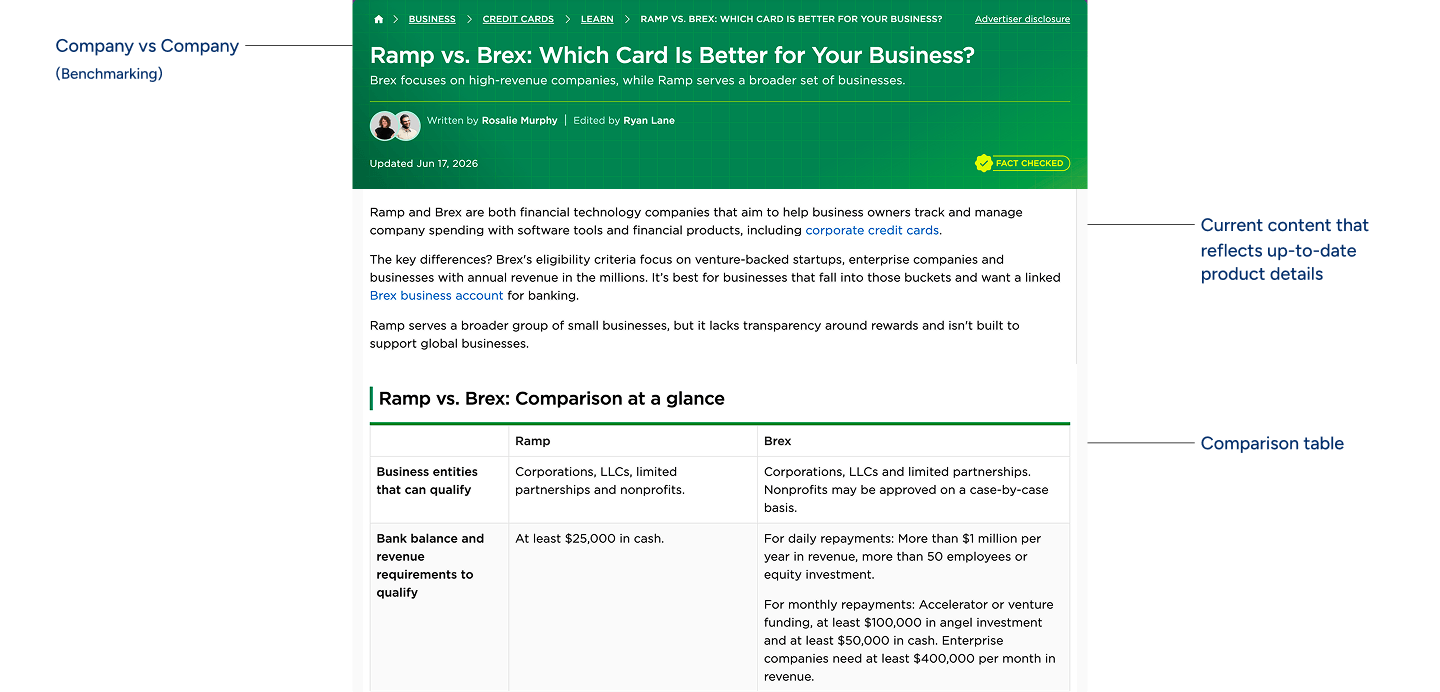
Example of a well-structured article that is cited on AI search platforms
What this looks like by segment
- Banques. Incumbent scale works in your favor on raw citation volume, but crowded answers dilute your odds fast. Question types that produce short brand lists are where your existing scale actually pays off, so prioritize those over broad category questions.
- Credit unions. Member trust and local relevance are angles most competitors in this category haven't optimized for yet in AI answers, which makes this an underused opportunity rather than a catch-up game.
- Fintechs. You can out-cite larger, slower-moving incumbents on comparison and eligibility content faster than you could ever out-rank them in traditional search, because AI models reward clear, structured, current information over sheer domain authority.
Case study: How a national bank improved AI visibility with an AEO/GEO agency
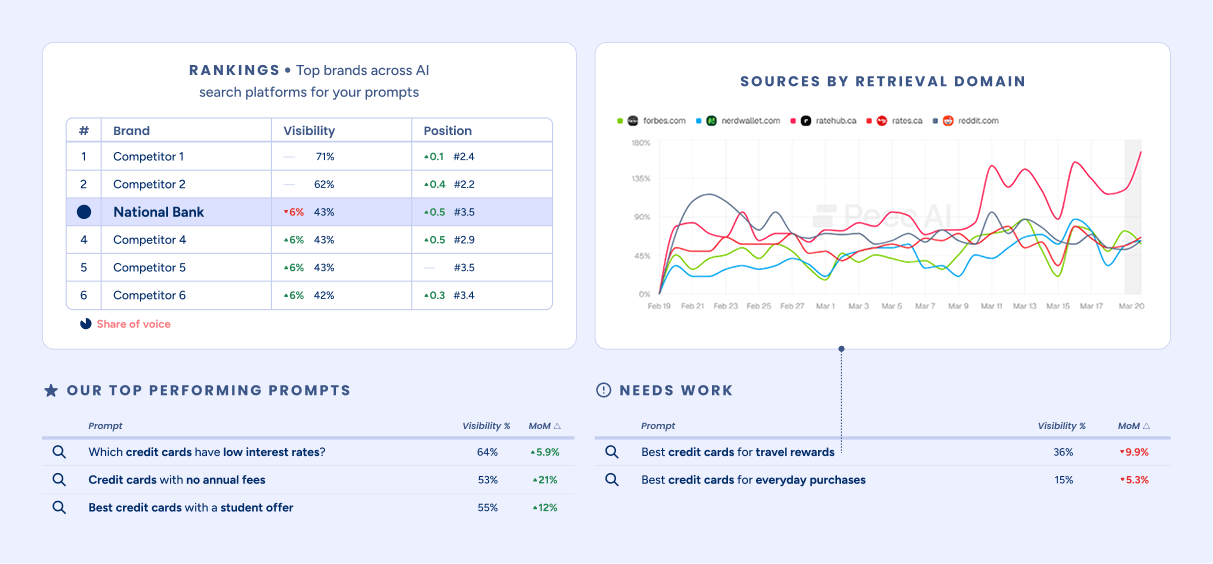
Based on product research and brand positioning goals, we identified high-intent credit card prompts and analyzed the National Bank’s visibility across them to pinpoint where the brand is already strongly associated and where visibility gaps remain. The data shows the bank had strong visibility with fees and APR -related products .
Competitor 1 and Competitor 2 were demonstrably stronger in visibility for prompts related to USPs (e.g. travel rewards) .This shows a competitive gap and helps identify priority prompt topics to improve AI visibility.
Measuring AI visibility: what to track and how
Treat AI visibility measurement with the same discipline you already apply to keyword tracking.
What to measure
- Citation rate: how often your brand's pages or an affiliate citing you appear as a source behind an AI answer
- Brand mention rate: how often your name appears in an answer at all, independent of whether it's cited
- Chosen-first rate: how often you're the first brand named when multiple brands appear, since this is the metric that most closely predicts actual consumer choice
- Share of voice by position: the amount of descriptive detail an answer gives your brand, since that detail drops sharply the further down the list you land.
- Own-page retrieval rate: how often your own product pages get read directly rather than only appearing through a partner's citation.
- Publisher and affiliate coverage: how often your top-performing partners are the actual source behind an answer that names you.
How to measure it
- Build a fixed set of tracked questions across all four funnel stages: awareness, consideration, decision, and post-decision.
- Run that same question set consistently across ChatGPT, Gemini, and Claude. Each platform defaults to different source types, so measuring only one platform will give you a distorted read on your actual visibility.
- Re-run the set on a fixed schedule. Platform behavior shifts meaningfully within a single year, so a one-time audit goes stale fast.
Recommended cadence: quarterly at minimum if you're early in building a strategy, monthly once you're actively optimizing partner content against known gaps.
Sample of a monthly report
The bottom line
AI answers are already recommending financial brands by name, and affiliate and publisher citations are already sitting behind most of those recommendations. Whether your institution is just starting to think about AI visibility or already has a program you're not sure is working, the path forward is the same: know which questions matter, know which partners already carry weight in your category, and know where your brand currently shows up as zero.
Questions fréquemment posées
What is the difference between AEO and GEO?
They describe the same practice from two angles. AEO focuses on optimizing content to be surfaced as a direct answer. GEO focuses on optimizing for the generative models producing that answer. Most marketers use the terms interchangeably.
How do I know if my brand shows up in ChatGPT, Gemini, or Claude?
Run a fixed set of real customer questions against each platform directly and record whether your brand is cited, mentioned, or recommended first. This is the same tracked-question-set approach outlined above.
Do affiliates actually help with AI search visibility?
Yes. Affiliate and publisher citations sit behind the majority of AI-recommended financial brand answers across every platform measured, with the heaviest influence at the decision stage.
Is AEO relevant for a smaller institution or fintech with a small marketing team?
Yes, arguably more so. AI models reward clear, current, well-structured content over sheer domain size, which gives smaller, more agile brands a real opening against larger incumbents.
 Français
  English