
5 bank marketing strategies to keep in your budget in 2026

Dans cet article
Related articles
Consumer research on financial products now increasingly starts with AI search tools, affiliate marketing is still the most underused channel despite ranking near the top for effectiveness among senior financial service executives, and finfluencer marketing has moved from experiment to proven playbook. Here are the five bank marketing strategies we recommend keeping in your budget this year, backed by the latest data.
What are the 5 main marketing strategies banks should budget for in 2026?
Every year we talk with some of the most effective bank, credit union, and fintech marketers about what’s actually working. Here are the five types of bank marketing strategies we recommend carrying into 2026, in the order we’d prioritize them:
- Affiliate and partner marketing, including finfluencers, as the foundation of your acquisition mix
- Community investment, to build the local trust that still drives banking decisions
- Generative engine optimization (GEO), to stay visible as AI tools become a starting point for financial research
- Data analytics, to segment, personalize, and prove what’s working
- Strategic paid search and social, spent with intention rather than habit
Why should affiliate marketing lead your bank marketing strategy?
Affiliate marketing deserves the top spot in your budget: it’s one of the best performing channels available to banks, and most institutions still aren’t using it.
According to Cornerstone Advisors’ Marketing ROI Gap in Banking report:
- Only about a third of banks and credit unions invest in affiliate or partner marketing, one of the least used channels evaluated
- It ranks second overall in effectiveness among all channels surveyed, behind only email, with the strongest rating for customer and lead quality
- One in five marketing leaders call it their most underleveraged channel
Unlike paid search, affiliate marketing doesn’t compete in an attention auction. It places your brand inside ecosystems where consumers are already comparing financial products, and you pay for performance rather than impressions or clicks, a model that often suits institutions without national marketing budgets.
Affiliate programs also extend into finfluencer partnerships, where a trusted voice recommending your product carries more weight than a brand’s own promotion. Two data points worth budgeting around:
- Filene Research Institute’s 2025 FiLab cohort tested influencer campaigns across 13 credit unions and found consistent engagement lifts and positive sentiment, strongest when creators had real creative freedom (Filene Research Institute)
- TikTok now has 2.21 billion monthly active users, with 25 to 34 year olds as its largest segment, so the “young person’s app” objection is outdated (Demandsage)
Weigh any finfluencer partnership against your brand’s risk tolerance and compliance requirements before committing budget.
Case study: how Grasshopper Bank scaled approvals with a balanced partner mix
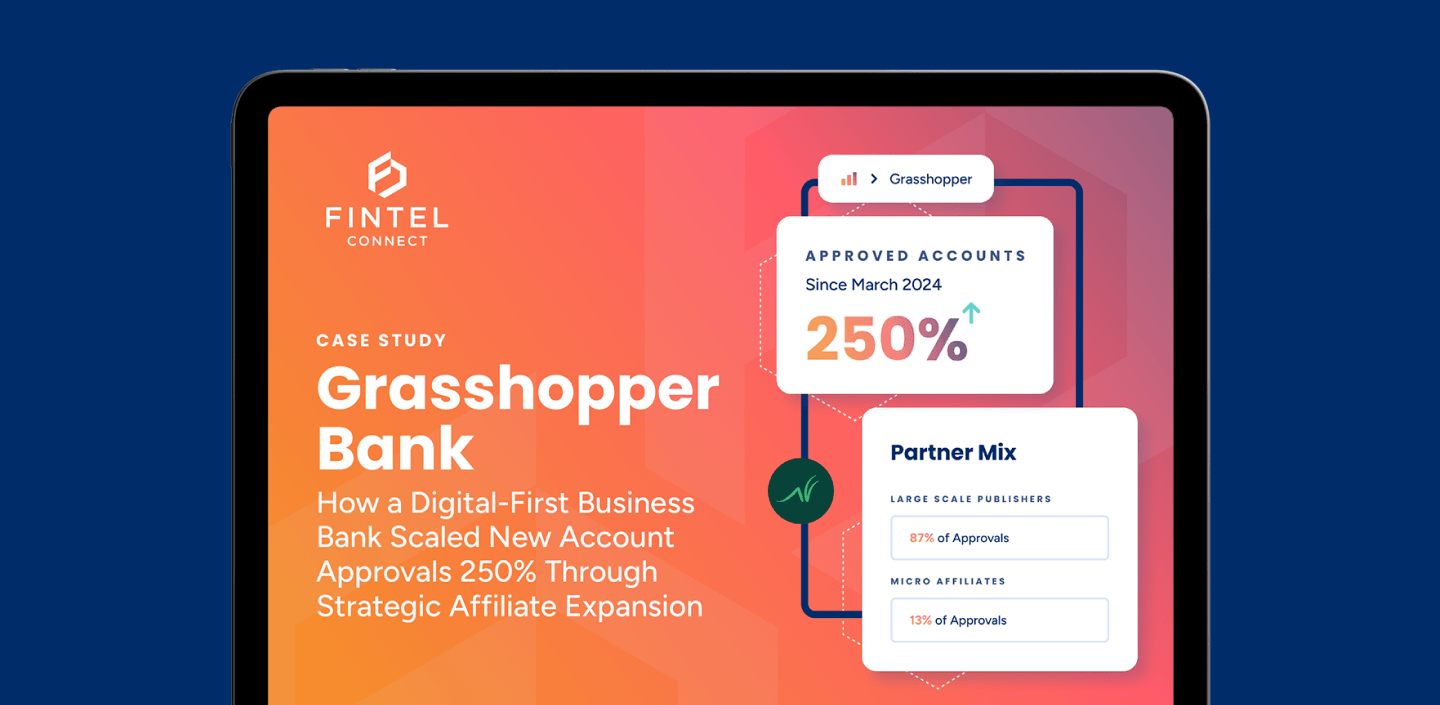
Grasshopper is a digital-first bank built for founders, startups, and small businesses, and like many lean marketing teams, it needed to grow the affiliate channel without adding headcount or compromising on partner quality and compliance. Working with Fintel Connect, Grasshopper built a partner network that combined large-scale publisher affiliates with micro-affiliates, all on a CPA-only structure, to scale approvals across Innovator Checking, Innovator Savings, and its SBA loan products.
Résultats
- 250% increase in approved accounts through the affiliate channel since March 2024
- 87% of approvals came from top-tier publisher affiliates, with the remaining 13% from micro-affiliates, a diversified mix rather than reliance on one partner type
How does community investment fit into bank marketing strategies?
Corporate philanthropy remains one of the most reliable bank strategies to attract customers precisely because it can’t be copied overnight. Aligning your brand with a cause your employees and customers genuinely care about, and showing up through fundraising, volunteering, and local sponsorships, builds a brand profile that compounds over time rather than a campaign that ends when the budget does.
Community banks consistently outperform larger competitors on trust, and local involvement is a major reason why. Bank leadership showing up at community events and offering personalized guidance, functioning as trusted advisors rather than just rate providers, builds relationships that carry customers through decisions they’d otherwise shop around for (Independent Banker). With customer loyalty eroding across the industry and fewer customers staying with their bank without shopping around, that kind of durable trust is worth more than ever.
How is AI search changing marketing strategies for banks?
If there’s one addition every bank marketing budget needs that wasn’t even a consideration two years ago, it’s generative engine optimization (GEO), the practice of making sure your brand is visible and accurately represented when consumers ask AI tools like ChatGPT, Gemini, Copilot, and Perplexity for financial recommendations.
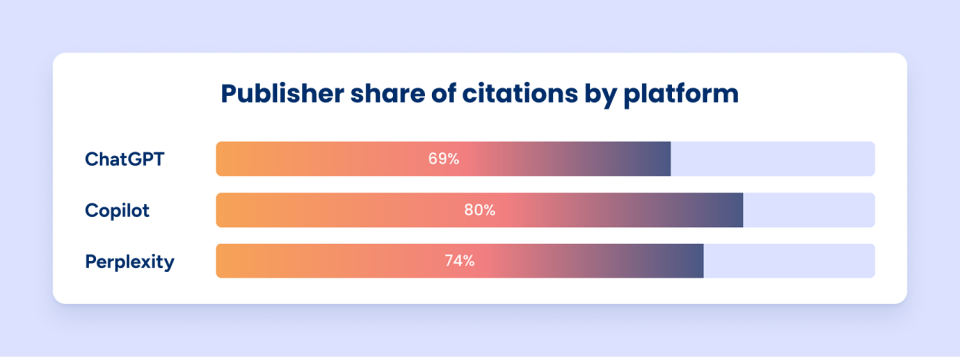
Fintel Connect's Concurrencer pour la visibilité à l'ère de l'IA report found, across four major AI platforms:
- Affiliate and publisher content made up 60% of sources cited for common financial product questions, with NerdWallet and Bankrate alone accounting for 15%
- Listicle style content and comparison tables were the formats most consistently cited
- Embedded ads and iframe promotions never appeared in an AI-generated response, despite being present on 12% of sites tested
In short, visibility in AI search runs through the affiliate and publisher ecosystem, not around it. That points to three moves worth making now:
- Work with affiliates whose content already appears in AI answers
- Structure your own site and partner content around clear headings, FAQs, and comparison formats AI models can extract cleanly
- Track citation and visibility metrics alongside traditional SEO and paid metrics, since AI mentions don’t always show up in existing analytics
How can banks use data analytics to attract customers?
Data will keep playing a deciding role in which bank marketing strategies actually earn their budget in 2026.
A few places to focus:
- Customer segmentation. Segment your base by demographics, behavior, and preferences so campaigns can be tailored to specific groups rather than broadcast to everyone at once, which lifts conversion rates.
- Predictive analytics. Use forecasting tools to anticipate customer behavior and surface cross-sell or upsell opportunities, so messaging reaches the right customer at the right moment.
- A/B testing. Continuously test subject lines, ad copy, and landing page design, then apply what you learn across channels rather than treating each test as a one-off.
The institutions getting the most from this strategy are also the ones investing in better attribution. According to the Marketing ROI Gap in Banking report, six in ten institutions say their core or CRM system limits their ability to measure marketing ROI, and nearly a third admit they’re likely crediting the wrong source more than a quarter of the time. Fixing that measurement gap often does more for your budget than shifting spend between channels.
What’s the smartest way to approach paid search and social in 2026?
Paid search and social still deserve a place in the budget, but they reward intention far more than habit. A few principles worth revisiting each planning cycle:
- Test with time bound campaigns before committing to evergreen spend. If the budget for always-on ads isn’t there, run a fixed campaign first to learn what messaging resonates before scaling it across channels.
- Skip bidding on your own brand name where you don’t need to. If your bank’s name is distinctive, it will already rank first organically, so paying for that click usually just replaces a free one. The exception is when a competitor is bidding on your name or you share a name with another institution.
- Prioritize mid-funnel and retention audiences. Target users who’ve already engaged with your brand, whether that’s visiting a product page or starting a form, since they convert at a meaningfully higher rate than cold audiences.
What are your next steps for putting these strategies to work?
With most of 2026 behind us, this isn’t about locking in a fresh annual budget. It’s about deciding which of these bank marketing strategies deserve more of what’s left this year, and which should shape your planning as 2027 budgeting season approaches.
Before shifting any allocation, ask:
- What are our sales and marketing goals for the year ahead?
- Where in the customer journey do we see the most drop off, and what would fix it?
- Which competitors keep appearing alongside us, and how do we out position them?
- Do we have the internal resources and capacity to run these strategies well, or do we need a partner?
- What vendors or partners could help us spend more efficiently?
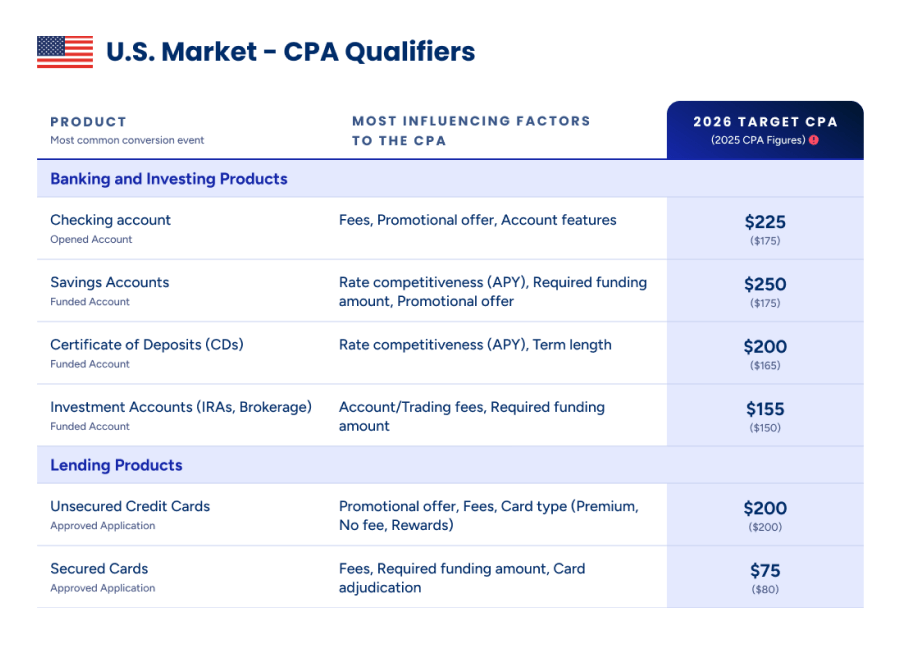
If you’d like a clearer view of what a well-run affiliate program should cost and deliver, our 2026 Finanical Affiliate Cost Per Acquisition Report breaks down current CPA benchmarks by product line across the U.S. and Canada. And if you’re ready to put affiliate marketing at the center of your acquisition strategy, reach out to our team to get started.
Questions fréquemment posées
What are the best marketing strategies for banks?
The best bank marketing strategies for 2026 combine affiliate and partner marketing, community investment, generative engine optimization (GEO) for AI search visibility, data driven personalization, and strategic paid search and social spend. Affiliate marketing deserves particular attention since it ranks second in effectiveness among all channels surveyed by Cornerstone Advisors, yet only about a third of financial institutions in the U.S. currently use it.
What are the types of bank marketing strategies?
Bank marketing strategies generally fall into a few types: acquisition channels like affiliate marketing, paid search, and paid social, brand and trust building efforts like community investment and philanthropy, discovery focused strategies like GEO for AI search visibility, and measurement driven strategies like data analytics and attribution. The strongest bank marketing budgets include a mix of all four types rather than concentrating in just one or two.
What are some bank marketing strategies examples that are working right now?
Grasshopper Bank grew approved accounts by 250% through a balanced affiliate mix of large publishers and micro-affiliates on a CPA-only structure. Credit unions in Filene’s 2025 FiLab cohort saw consistent engagement lifts and positive sentiment from finfluencer campaigns that gave creators creative freedom. These are two concrete bank marketing campaign examples showing how affiliate and influencer strategies are performing in the current market.
What bank strategies help attract new customers most effectively?
The strategies with the strongest track record for attracting new customers are affiliate and partner marketing, which Cornerstone Advisors rates second in effectiveness among all channels surveyed, and community investment, which builds the local trust that drives acquisition and retention for community institutions in particular. Pairing either strategy with strong data attribution helps confirm which specific partners and campaigns are driving the highest quality customers.
Is affiliate marketing still worth budgeting for in 2026?
Yes, and increasingly so. Affiliate marketing ranks second in effectiveness among all channels evaluated in the Marketing ROI Gap in Banking report, with particularly strong ratings for customer and lead quality, yet only about a third of banks and credit unions currently invest in it. As AI search tools increasingly cite affiliate and publisher content over brand owned websites, affiliate marketing is also becoming a key lever for AI visibility, not just direct acquisition.



 Français
  English