
How to allocate your bank’s affiliate marketing budget for maximum ROI


Banks get the most ROI from affiliate marketing budget by setting CPA based on business outcomes rather than a fixed number, reallocating spend toward channels and affiliates already proven to convert, and avoiding the common trap of budgeting from last year’s number instead of current performance data. Most banks currently do the opposite.
Quick answer
- CPA is a business decision, not a fixed benchmark: the right CPA depends on your conversion event, customer value, and affiliate economics, not just what competitors pay
- 56% of banks and credit unions set marketing budgets by adjusting last year’s number rather than performance data, which locks in whatever was already working, or wasn’t
- Paid search receives the largest share of marketing budget (46%) despite affiliate marketing rating higher for customer and lead quality
- If given more budget, 36% of bank and credit union marketing leaders said they would put it toward affiliate marketing, the third most cited channel for reallocation
- Coast Capital Savings Federal Credit Union cut its cost per acquisition by 12.5% while growing new account acquisitions 650%, after moving to a targeted, data-backed affiliate strategy
Why do banks often allocate affiliate marketing budget the wrong way?
Banks most often misallocate affiliate marketing budget by setting it the same way they set budgets for every other channel: adjusting last year’s number rather than starting from expected outcomes. Le fossé du retour sur investissement marketing dans le secteur bancaire, A 2026 survey of 126 bank and credit union marketing executives, commissioned by Fintel Connect and conducted by Cornerstone Advisors, found nearly 6 in 10 institutions determine budgets this way, and 7 in 10 said it’s common to modify budgets mid-year, usually triggered by executive requests or competitive pressure rather than performance data.
This creates a specific problem for affiliate marketing, since the channel’s budget share doesn’t reflect its own performance:
- Paid search commands the largest share of marketing budget at 46%
- Affiliate and partner marketing receives only 15%
- Yet affiliate marketing rated 3.34 out of 5 for customer and lead quality, the second highest of nine channels evaluated, ahead of paid search at 2.65
- Only about a third of institutions currently use affiliate marketing at all, and 21% named it their most underleveraged channel
How should a bank determine the right CPA before allocating budget?
The right CPA isn’t a fixed number pulled from what competitors pay. According to Fintel Connect’s 2026 CPA Guide to Affiliate Customer Growth in Financial Services, the right CPA depends on your product’s competitiveness, the conversion event you’re paying for, customer value, and how efficiently your funnel converts, and it should shift as your program matures.
Before setting a budget, the CPA Guide recommends asking:
- What conversion event are we paying for? The further down the funnel the event sits, from a submitted application to a funded account, the higher the CPA can be justified.
- What does a valuable customer look like? Funded balances, loan size, retention, and cross-sell potential should all influence how much you’re willing to pay to acquire a customer.
- What will affiliate partners need to make the economics work? Affiliates weigh traffic costs, conversion rates, and competing offers when deciding whether to promote a product, which sets a floor on what CPA will actually attract quality partners.
- When should CPA be reviewed? Quarterly at minimum, and immediately when a competitor offer, seasonal pattern, or affiliate performance shift materially changes conversion outcomes.

In practice, this means defining specific KPIs before you set a budget, not after. Useful examples to track per affiliate include funded accounts, approval rate on credit products, and customer value measured over 6 to 12 months, rather than raw lead or click volume.
What budget allocation mistakes should banks avoid?
- Prioritizing a low CPA over customer value. A CPA that looks high on the surface can still be efficient if it delivers stronger customers. Define what success means, funded balances, approved applications, long-term value, before setting a budget target.
- Adjusting budget or CPA targets too quickly. Affiliate programs need enough time and volume to generate meaningful data. Reacting within weeks limits testing and makes it hard to know what is actually driving results.
- Setting budget without affiliate input. Affiliates have direct visibility into competing offers and audience demand. Excluding them from budget planning produces less realistic targets.
- Using a higher CPA to paper over a weak product or funnel. No amount of additional budget fixes an uncompetitive offer or a high-friction application process. Fix the product and funnel first.
- Launching with an unsustainably high CPA. Start with a competitive but sustainable number, then increase strategically as partner quality and conversion performance justify it.
How can banks reallocate budget for better ROI right now?
- Audit performance by individual affiliate, not just by channel total, and move budget away from partners who aren’t converting
- Shift a portion of spend from flat-fee or exposure-based arrangements toward performance-based, CPA-only structures, and consider tiered commissions or stretch bonuses for your best-performing affiliates rather than one flat rate for everyone
- Segment budget by product line, since ROI profiles differ: a high-yield savings account typically needs a lower CPA to stay profitable, while credit cards and personal loans can support a higher CPA given their stronger long-term value
- Budget in tranches with quarterly reviews instead of one fixed annual number, and hold back a 5 to 10% contingency fund to reallocate mid-year toward high-intent periods or new opportunities
- Reallocate incremental budget toward decision-stage, high-intent placements: Fintel Connect’s 2026 AI Search Guide for Financial Marketers found 90% of decision-stage AI prompts produce a citation naming a brand, compared with just 8.8% at the awareness stage
- Diversify between large-scale affiliates for volume and long-tail affiliates for lower-cost incremental growth, rather than concentrating budget in one relationship
- Set aside a small share of budget for experimentation, testing new affiliate types, content formats, or payout models like flat-fee or hybrid structures, since the channel evolves quickly
- Track spend to the funded account, not the click or lead, so budget decisions are based on which affiliates deliver real customers
What does the data say about where the next marketing dollar should go?
Affiliate marketing operates on different logic than an auction-based channel like paid search. Instead of competing for attention against megabanks and fintechs with far larger budgets, institutions participate in ecosystems where consumers are already comparing financial products, and can pay for results rather than impressions. For banks and credit unions without a national marketing budget, that structural difference often matters more than any single CPA adjustment.
The survey data backs this up directly: affiliate marketing was the third most cited channel banks would fund first if their budget increased, behind only organic search and paid search, and ahead of display, paid social, and email.
Case study: cutting cost per acquisition while scaling growth
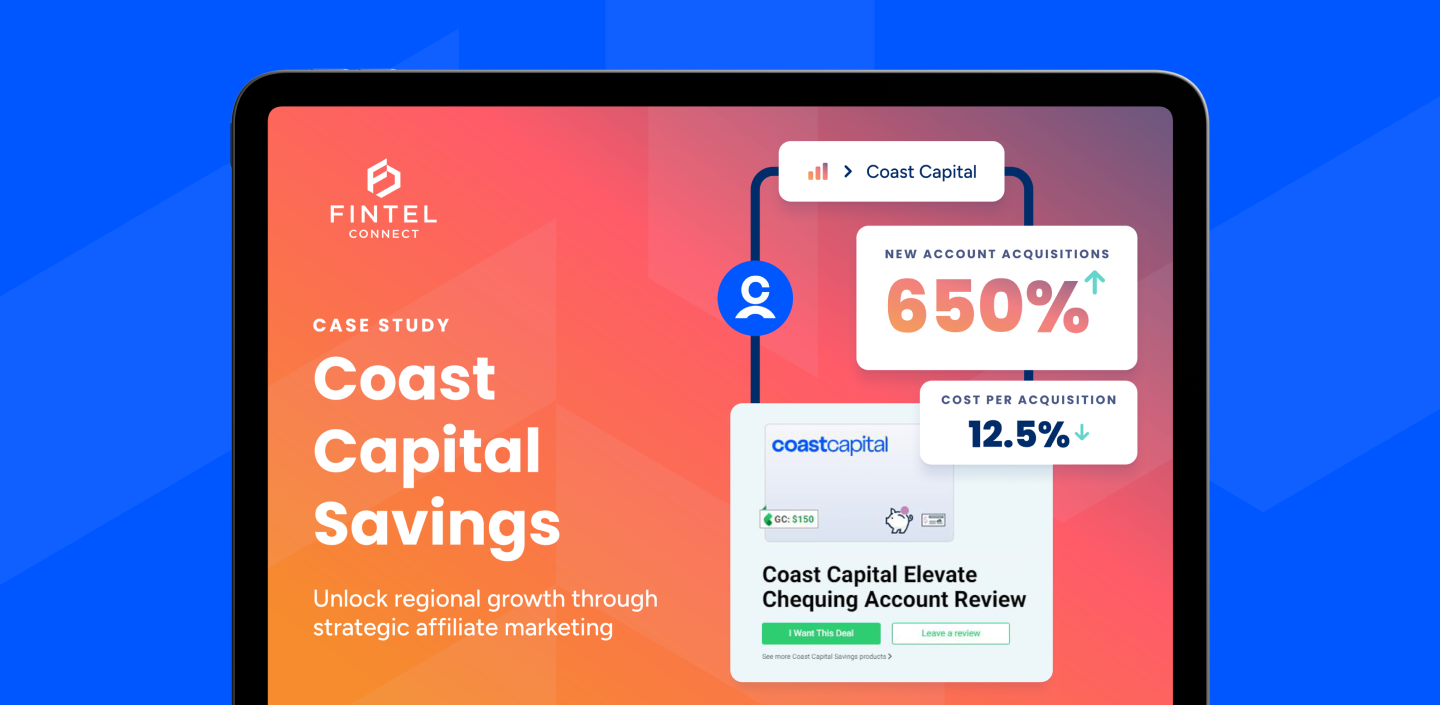
Coast Capital Savings Federal Credit Union, Canada’s largest credit union by membership, had hesitated to invest further in affiliate marketing due to budget constraints and uncertainty forecasting ROI.
After partnering with Fintel Connect on a targeted, regionally focused strategy with transparent ROI forecasting, Coast Capital grew new account acquisitions by 650% while cutting cost per acquisition by 12.5% in the same period. Affiliate marketing now drives 18% of the credit union’s new membership applications, proof that reallocating budget deliberately, not just increasing it, is what moved the ROI needle.
Questions fréquemment posées
How much of a bank’s marketing budget should go to affiliate marketing?
There’s no universal percentage. Banks and credit unions currently allocate around 15% of marketing budget to affiliate and partner marketing on average, but the right amount depends on your product mix, customer acquisition goals, and how efficiently your funnel converts. The more useful benchmark is performance relative to other channels, not a fixed share of spend.
Should banks pay affiliates per click, per lead, or per funded account?
Paying for outcomes further down the funnel, such as an approved or funded account, keeps affiliate incentives aligned with actual business value rather than volume. Cost per click or cost per lead structures are easier to set up but reward traffic over quality.
How often should a bank review its affiliate CPA?
At minimum quarterly, with off-cycle reviews triggered by a competitor’s new offer, a seasonal shift, or a meaningful change in affiliate performance. Adjusting CPA too frequently, before enough data has accumulated, is one of the most common mistakes banks make.
Why do banks overspend on paid search relative to its results?
Paid search is a familiar, easy-to-scale channel, which is why it commands the largest average budget share among banks and credit unions. But it’s also an auction that megabanks and well-funded fintechs will generally win. Affiliate marketing, by contrast, rewards category relationships and trust, advantages a smaller institution can actually compete on.
Should banks use a fixed or flexible affiliate marketing budget?
A flexible budget, allocated in quarterly tranches with a 5 to 10% contingency fund, generally works better than one fixed annual number for a performance-based channel like affiliate marketing, since it allows for reallocating toward what is working as new data comes in throughout the year.
What is the fastest way to improve ROI from an existing affiliate budget?
Reallocating budget toward already-proven affiliates and decision-stage placements typically produces faster ROI gains than adding new budget, since it corrects for the common pattern of spend being set by habit rather than performance.
Turning budget allocation into a performance decision
Allocating affiliate marketing budget effectively is less about finding more money and more about treating every dollar as a decision tied to a specific outcome, rather than a number inherited from last year. Banks that define what a valuable customer looks like, set CPA around that definition, and reallocate based on real performance data consistently get more from the same budget than those simply spending more.
If you want to see how your current affiliate budget compares to what similar banks and credit unions are seeing in ROI, Fintel Connect’s team can walk through the benchmarks specific to your product mix.



 Français
  English