
Digital marketing for financial services: the complete guide to channels, ROI, and where to invest next
Dans cet article
Related articles
Financial institutions are spending marketing dollars on the wrong channels, and the data proves it. The latest research from Cornerstone Advisors and Fintel Connect, Le fossé du retour sur investissement marketing dans le secteur bancaire, surveyed 126 senior marketing executives at U.S. banks and credit unions, found a persistent gap between where institutions spend and where they actually see returns. Closing that gap starts with a simple shift: build your channel mix around what the data shows works, not around habit, a generalist playbook, or what a competitor happens to be doing.
That’s exactly what the report set out to measure. The key findings:
- Paid search commands the largest share of the average marketing budget, yet email marketing is cited most often as delivering the strongest ROI
- Affiliate and partner marketing is used by only a third of institutions, yet it’s the channel most frequently named as underleveraged, and it rates second overall in effectiveness.
This guide breaks down what to do with those findings, channel by channel:
- Affiliate and partner marketing
- Recherche payante
- Marketing par courrier électronique
- Paid social
- Organic search and content, plus the AI search visibility layer that now sits across all five
Each section covers the Cornerstone data on usage, budget share, and perceived ROI, along with data-backed best practices, so you can see exactly where your own spend may be misallocated.
Le rôle de chaque canal et ce qu'il signifie pour vos comptables agréés
Banks and credit unions spend 0.10% of assets on marketing each year, a figure that has barely moved in a decade even as the average institution’s asset size has roughly doubled. Most set that budget by adjusting last year’s number rather than by expected return: 56% budget this way, and only 12% set it top-down.
The channel data shows where that habit breaks down:
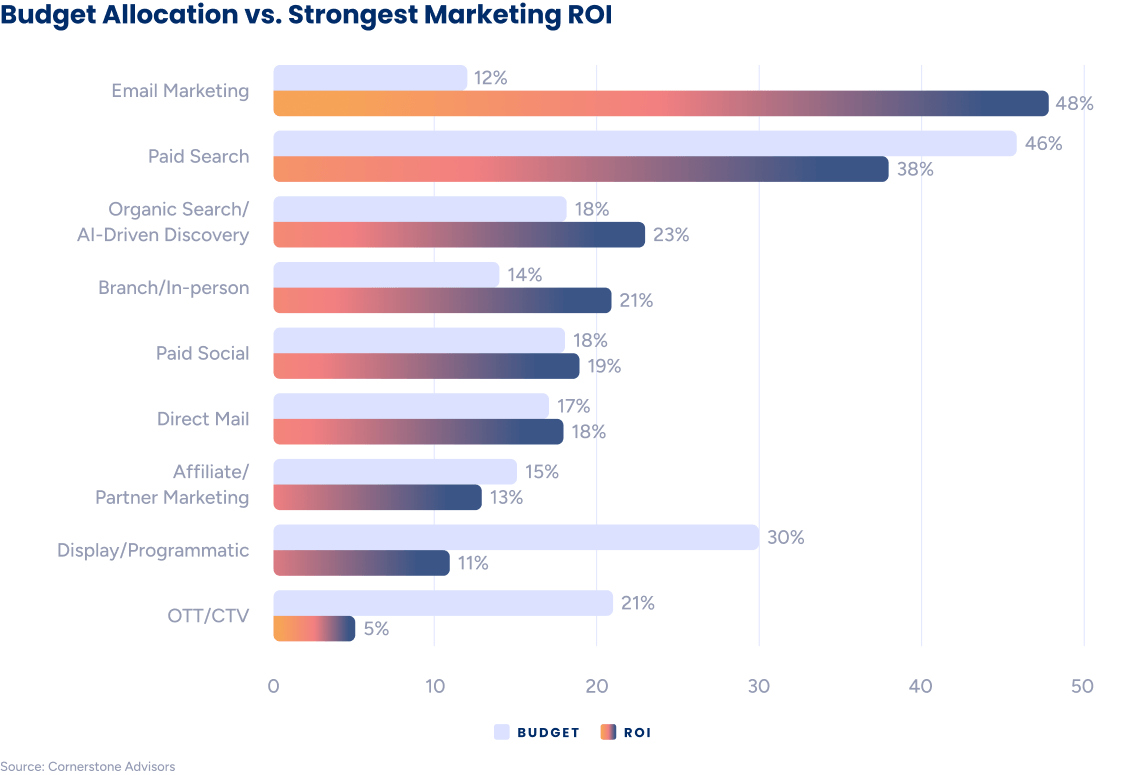
- Paid search: takes 46% of the budget among the two largest line items institutions name, more than any other channel, yet only 38% of executives cite it as their strongest ROI
- Email marketing: just 12% of the budget, the smallest share measured, yet named by 48% of executives as a top-ROI channel, the highest of any channel
Affiliate and partner marketing: the widest gap in the study. Used by only 32% of institutions, one of the least-adopted channels, yet named by 1 in 5 executives (21%) as the single most underleveraged channel, more than any other. Its effectiveness rating (3.17 of 5) ranks second overall behind only email, and its customer and lead quality rating (3.34) trails only branch and in-person channels.
The rest of this guide walks through each channel, starting with the one the data says deserves more attention than it’s getting.
1. Affiliate marketing: the most underleveraged channel in digital marketing of financial services
Affiliate and partner marketing is the channel financial institutions most often say they’re not using enough, and the data backs up why. It ranks second overall on effectiveness (3.17 out of 5), second only to email, and its standout attribute is customer and lead quality (3.34), trailing only branch and in-person relationships. Yet only 32% of institutions run an affiliate program at all, and it receives just 15% of the budget among the top two channels institutions name.
Cornerstone Advisors’ own analysis of this gap is direct: affiliate and partner marketing is one of the few channels where a community institution’s local relationships and trust constitute a structural advantage, while paid search, the channel commanding the largest budget share, is a channel where megabanks and fintechs can simply outbid smaller institutions. “The competitive logic here is backward,” the report states. “Chasing paid search is a game community banks and credit unions can’t win.”
Why affiliate performs differently
- It’s performance-based. Institutions pay for results, funded accounts and qualified applications, rather than impressions or clicks. Paid search spend produces results only while the budget is running; a well-developed affiliate program keeps producing after that.
- It reaches consumers already comparing products. Affiliate and partner ecosystems put a financial brand in front of consumers actively researching and comparing options, rather than competing for attention in an open auction.
- Its real constraint is scalability, not quality. Affiliate’s lowest-rated attribute (3.00) reflects the upfront work of identifying, vetting, and activating partners, not a ceiling on how well the channel performs once it’s built.
The impact of affiliate digital marketing looks like in practice for banks, credit unions, and fintechs
- Banque Sauterelle, a digital business bank, grew approved accounts 250% by diversifying its publisher mix instead of concentrating spend in one or two large affiliates, pairing large publishers (87% of the mix) with smaller, micro affiliates to reach a wider range of business owners.
- Neo Financial, a digital-only bank, grew customer approvals 511% over two years by building a curated, content compliance-vetted affiliate program instead of treating affiliate as an afterthought channel.
- Coast Capital Savings, a federal credit union, grew new-account acquisition 650% year over year while reducing CPA by 12.5%, using performance data to guide where affiliate spend went next rather than defaulting to last year’s allocation.
2. Paid search
Paid search is the most heavily used and most heavily funded channel in the study: 73% of institutions run it, and it takes 46% of the budget among the top two channels named, more than any other channel measured. Its average effectiveness rating (3.08) is solid but trails both email and affiliate, and only 38% of executives cite it as a top-ROI channel despite the budget it commands.
Blended cost-per-click across finance and insurance keywords currently averages $3.39, according to 2026 data from WordStream and LocaliQ, though institutions bidding on competitive lending, insurance, or wealth management terms should expect to pay well above that category average.
Best practices for banks, credit unions, and fintechs
- Bid for long-tail, high-intent terms. Broad category terms put you in direct competition with megabanks and fintechs who can outspend most community institutions indefinitely.
- Build content compliance review into the ad-copy workflow. Regulatory disclosure requirements should be part of the creative process, not a final check before launch.
- Hold the channel to a CAC standard, not a volume standard. Paid search can generate account openings that don’t produce the funded relationships or lifetime value that justify the spend if lead quality isn’t part of how you measure it.
3. Email marketing
Email is the most-used channel in the study (85% of institutions) and, despite receiving the smallest share of the budget of any channel measured (12%), it’s the channel most frequently cited as delivering the strongest ROI (48%). Its average effectiveness rating (3.55) is the highest of any channel, driven by the highest-rated cost efficiency score in the study (4.12).
External benchmarks support the pattern: financial services email open rates average 20 to 26% across segments, ahead of the roughly 17.8% cross-industry average, according to 2025 data from WOLF Financial, with click-through rates in the 2.4 to 3.1% range.
Best practices for banks, credit unions, and fintechs
- Segment by funded status, not just demographics. A customer who opened an account but never funded it needs a different message than one who’s been active for a year.
- Build lifecycle nurture sequences. Onboarding, cross-sell, and retention each call for different cadences and content, not one newsletter template reused across the customer lifecycle.
- Keep compliance review cadence tight. Email is high-volume by nature, so disclosure and regulatory review need to be a repeatable step, not a bottleneck that slows send frequency.
4. Paid social
Paid social is used by 77% of institutions and receives 18% of the top-two budget share, roughly in line with organic search and ahead of affiliate. Its average effectiveness rating (2.78) trails email, affiliate, organic search, and paid search, and only 19% of executives cite it as a top-ROI channel, with customer and lead quality (2.06) its weakest attribute of any channel measured.
Independent 2025 benchmark data from Hootsuite shows engagement rates for financial institutions vary meaningfully by platform: Instagram leads at 3.8%, followed by LinkedIn at 3.2%, with Facebook and TikTok trailing well behind at 1.8% and 1.6% respectively, a useful signal for where to prioritize spend and creative.
Best practices for banks, credit unions, and fintechs
- Match the platform to the audience and product. LinkedIn’s engagement profile tends to fit executive and business-banking audiences; Instagram tends to fit consumer products.
- Test creative on a real cadence. Paid social’s lowest-rated attribute is lead quality, which is often a creative and targeting problem more than a platform problem.
- Set expectations at the top of funnel. The data suggests paid social performs better as an awareness and consideration channel than as a direct-response channel for financial products.
5. Organic search, content, and AI-driven discovery
Cornerstone groups organic search and AI-driven discovery together, and the data explains why that pairing makes sense: 71% of institutions invest here, its average effectiveness rating (3.13) ranks third overall, and 23% of executives cite it as a top-ROI channel, also third overall. It’s also the channel institutions most want more of: 69% said it’s where they’d put additional budget if their 2026 budget increased, more than any other channel, and 17% already call it underleveraged, second only to affiliate.
Google’s own guidance is direct about what separates content that ranks from content that doesn’t in a YMYL (your money or your life) category like financial services: content needs to demonstrate experience, expertise, authoritativeness, and trust, not just cover a topic.
Best practices for banks, credit unions, and fintechs
- Build for E-E-A-T from the start. Author credentials, cited sources, and factual accuracy matter more in financial content than in almost any other category, per Google’s own quality guidance.
- Structure content for both search and AI answer engines. “How-to” formatted articles tend to earn higher on-target citation precision from AI answer engines, while listicle formats (“best” and “top” roundups) tend to earn higher raw citation volume; a strong content program uses both formats deliberately, not by accident.
- Treat this as a compounding asset, not a campaign. Unlike paid channels, organic visibility built well continues generating traffic and citations after the initial investment, which is likely part of why it’s the channel institutions most want to increase funding for.
The channel every institution now needs to think about: AI search visibility
Digital marketing for financial services in 2026 isn’t only about which channels get budget. It’s increasingly about whether AI search engines cite your institution at all. This isn’t a Cornerstone-measured channel, it’s a visibility layer that sits across all five, and it’s earning its own look for one reason: AI visibility in financial services runs disproportionately through the affiliate ecosystem.
A J.D. Power survey reported by the American Bankers Association (September 2025) found 51% of consumers now turn to AI tools for financial advice, most often on savings (45%), credit cards (41%), and investing or budgeting (36%). Fintel Connect’s own research, Concurrencer pour la visibilité à l'ère de l'IA found that across ChatGPT, Copilot, and Perplexity, more than 70% of AI-generated answers about financial products pull from affiliate and publisher content rather than brand websites, and that banking is one of the leading categories of all AI search queries.
The implication: an institution underinvesting in affiliate, as most are, is very likely also underinvesting in its own AI visibility, whether it’s asked that question or not.
Best practices for banks, credit unions, and fintechs
- Track who’s already being cited. Identify which affiliates and publishers AI platforms already cite in your category, since extending existing visibility is easier than building it from nothing.
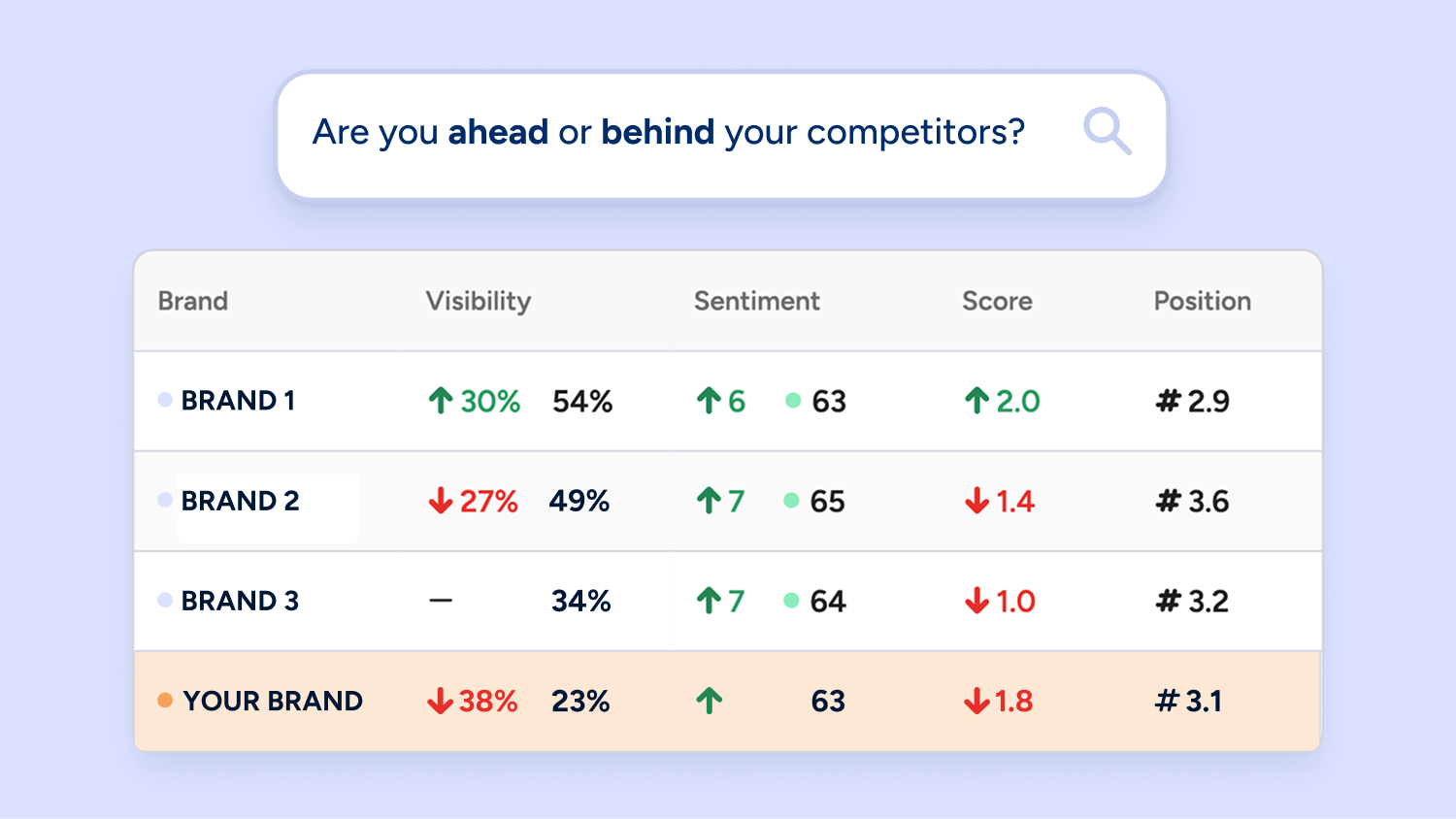
- Monitor visibility like a paid channel. Competitive tracking across AI platforms is now measurable and reportable, not a one-time audit.
- Treat it as a reason to invest in affiliate, not a separate budget line. The two are structurally connected in financial services specifically.
How to choose the right digital marketing channel mix
Not every institution should weight these channels the same way. The right mix depends on team size, product type, and how mature your measurement infrastructure already is.
| Chaîne | Usage | Top-2 budget share | Cited for strongest ROI | Avg. rating (of 5) | Meilleur pour |
|---|---|---|---|---|---|
| Affiliate / partner marketing | 32% | 15% | 13% | 3.17 | Institutions that want lead quality and performance-based cost |
| Recherche payante | 73% | 46% | 38% | 3.08 | Institutions that can sustain megabank-level bidding |
| Marketing par courrier électronique | 85% | 12% | 48% | 3.55 | Existing customers and members, cross-sell |
| Paid social | 77% | 18% | 19% | 2.78 | Awareness and top-of-funnel targeting |
| Organic search / content / AI-driven discovery | 71% | 18% | 23% | 3.13 | Long-term visibility across search and AI answer engines |
Source: Cornerstone Advisors / Fintel Connect, “The Marketing ROI Gap in Banking” (2026), Figures 5, 6, 7, and Table C.
- Smaller teams, leaner budgets: prioritize email (highest ROI citation, lowest cost) and affiliate (performance-based cost structure, no ongoing spend commitment) over paid search, where competing against megabank budgets is a losing game.
- Institutions with an established paid search program: narrow toward long-tail, high-intent terms rather than broad category terms, and hold the channel to a lead-quality standard, not just a volume standard.
- Any institution investing in content or SEO: build for E-E-A-T and structure content for both traditional search and AI answer engines, since 69% of institutions surveyed already plan to increase spend here.
Common mistakes financial institutions make in digital marketing
- Setting budgets by adjusting last year’s number. 56% of institutions do this, which means channel allocation is driven by precedent, not performance, and it’s a big part of why paid search keeps commanding the largest budget share despite trailing affiliate on almost every effectiveness attribute.
- Underfunding the channel with the best lead quality. Affiliate’s customer and lead quality rating (3.34) trails only branch and in-person, yet it receives one of the smallest budget allocations of any channel measured.
- Weak attribution masking the real picture. Six in 10 institutions say their core or CRM system limits their ability to measure marketing ROI, a third believe they’re crediting the wrong source more than a quarter of the time, and not a single institution surveyed said it could reliably attribute results across all the outcomes measured.
- Treating AI search visibility as someone else’s problem. With 51% of consumers already turning to AI tools for financial information, a financial brand invisible in AI-generated answers is invisible to a fast-growing share of its own market.
Questions fréquemment posées
What is digital marketing for financial services?
Digital marketing for financial services is the set of channels, paid search, email, paid social, affiliate and partner marketing, and organic search and content, that banks, credit unions, and fintechs use to acquire and retain customers, evaluated against the added constraints of regulatory compliance and long consideration cycles that don’t apply to most other industries.
Which digital marketing channel has the best ROI for banks and credit unions?
According to Cornerstone Advisors’ 2026 survey of 126 bank and credit union marketing executives, email marketing is cited most often as delivering the strongest ROI (48%), followed by paid search (38%). Affiliate and partner marketing rates second overall on effectiveness (3.17 of 5) despite being used by only a third of institutions surveyed.
Is affiliate marketing worth it for financial institutions?
The data suggests it’s underused relative to its performance. Affiliate and partner marketing ranks second overall in effectiveness, is rated highest of any channel for customer and lead quality apart from branch and in-person, and operates on a performance-based cost structure. Only 32% of institutions currently run one, and 1 in 5 executives call it the most underleveraged channel in their organization.
How do banks measure digital marketing ROI?
Inconsistently, according to the same research. Six in 10 institutions say their core or CRM system limits ROI measurement, and none of the institutions surveyed said they could reliably attribute marketing results across every outcome measured, from application starts through funded accounts and profitability.


 Français
  English