
Webinar Recap: Cross-Border Conversions, Winning in Canada’s Credit Card Market

- Last Updated: August 13, 2026
Canada is one of the strongest growth opportunities in financial services right now, but it isn’t a copy-and-paste of the U.S. market. Consumers compare products differently, tracking works differently, and the content that earns trust follows local rules. For affiliates and the financial brands that partner with them, getting these differences right is what separates the programs that grow from the ones that stall.
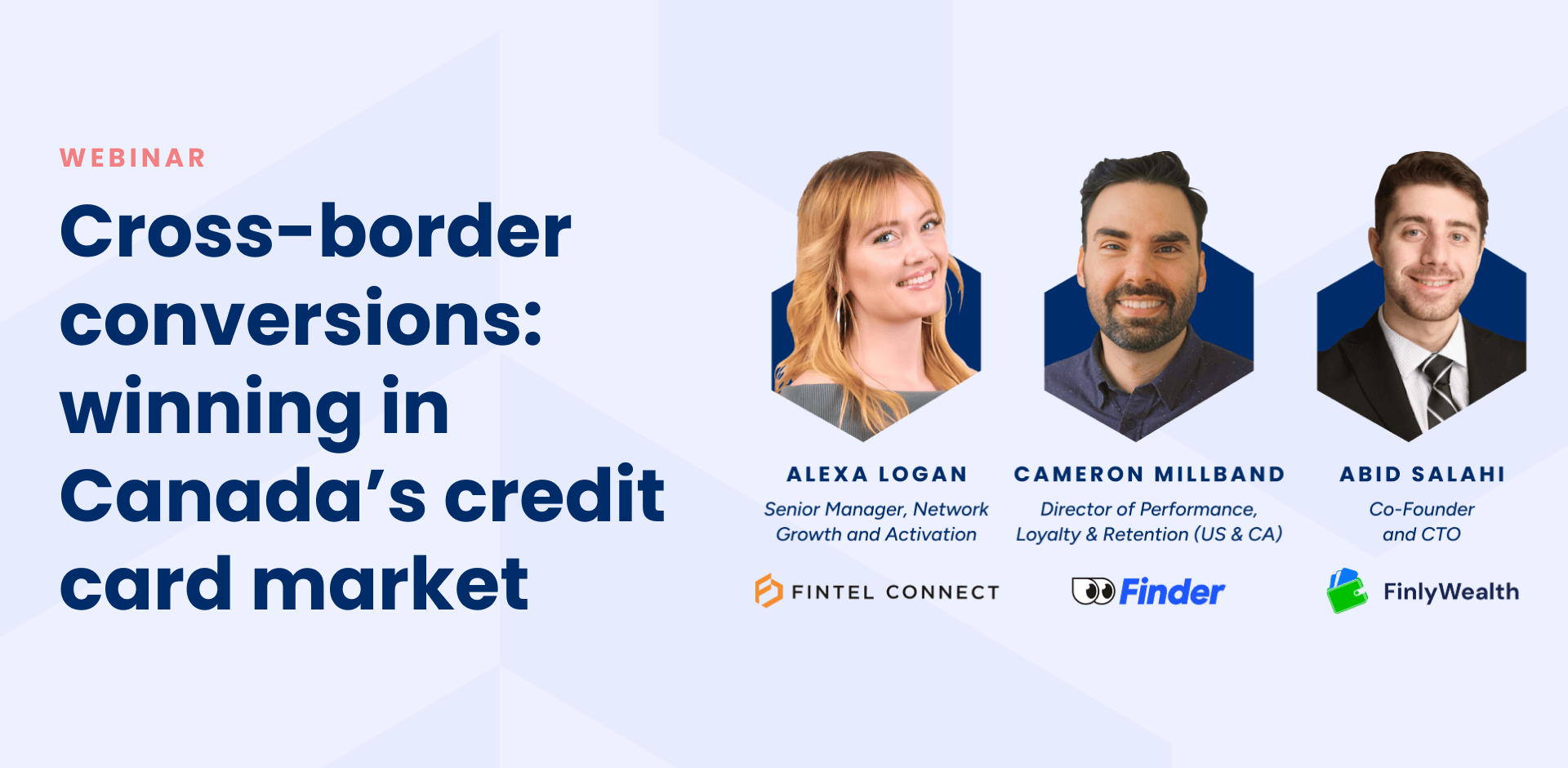
To break down what it takes to win in Canada, Fintel Connect’s Alexa Logan, Senior Manager of Network Growth and Activation, hosted a conversation with two affiliate leaders working in the market every day:
- Cameron Millband, Director of Performance, Loyalty and Retention (US and CA), Finder
- Abid Salahi, Co-Founder and CTO, FinlyWealth
Why Canada is not a copy-paste of the U.S. market
The panel opened on a point every affiliate and brand entering Canada needs to hear: the market runs on a different set of rules, and the strategy that works in the U.S. doesn’t transfer cleanly.
Alexa noted that credit card openings in the U.S. have declined over the last 10 years, while Canada is seeing growth. As the Canadian market matures, more new contenders are entering the credit card space, which opens room for affiliates and brands willing to move.
The Canadian market is roughly 10 times smaller than the U.S., with a concentration of institutions that Canadians already know and trust. That changes the game, because you’re competing for attention in a tighter market where trust is concentrated in fewer names.
The takeaway: the opportunity in Canada is real and growing, but it rewards the affiliates and brands who treat it as its own market, not an extension of the U.S.
How conversion tracking works differently in Canada
One of the most practical differences the panel raised was tracking, and it’s the one that trips up newcomers most often.
Cameron explained that the Canadian market has less tracking transparency than the U.S. In the U.S., postback tracking is typically shared openly with affiliates. In Canada, the expectation on the affiliate side is that advertisers share less. That means affiliates often can’t see conversions in real time and have to forecast more.
For affiliates used to full-funnel visibility, this is a mindset shift. The ones who succeed are comfortable working without real-time conversion data and are solutions-oriented about closing the gaps.
What this means in practice:
- Expect less tracking transparency than you get in the U.S.
- Be ready to forecast rather than rely on real-time conversion data
- Treat tracking as a problem to solve collaboratively, not a dealbreaker
“In the Canadian market, there’s definitely less transparency. You need to be more reliant on your data and able to forecast without having that conversion come through in real time,” Cameron Millband, Finder
How Canadian consumers research and compare financial products
Winning Canadian traffic starts with understanding how Canadian consumers actually make decisions, and Abid’s point was that they approach it with more skepticism.
Canadians comparison shop carefully and want a clear reason before they commit. They need to understand why a specific product makes sense for them, not just that it exists. That raises the bar on content: you have to justify the recommendation, not just list features. It’s why FinlyWealth built its platform around accuracy.
Abid also noted that the highest-intent Canadian consumers are often in communities like Reddit and other social channels, where they ask real questions and compare notes before deciding.
For affiliates, that points to two priorities:
- Lead with why a product fits a specific person, not just what it offers
- Build genuine credibility in the communities where high-intent consumers already gather
“A lot of Canadians search for the reasons why they should get a certain credit card, as opposed to just getting a credit card for the sake of it,” Abid Salahi, FinlyWealth
Where the strongest growth opportunities are beyond credit cards
Credit cards were the focus, but the panel pointed to broader momentum across the Canadian market.
Abid highlighted the newcomer segment, particularly in banking, as a strong source of traffic. New arrivals to Canada research financial products heavily and often turn to each other in online communities to compare options.
Cameron pointed to banking bonuses as a bright spot, noting that Canadian offers are strong and that the market is opening up. The strategies covered in the session extend beyond credit cards as well, applying across other verticals including lending, investing, and business banking.
The signal for affiliates and brands: the growth isn’t limited to one product line, and the newcomer and banking segments are worth a close look.
What AI and GEO mean for affiliate visibility
Abid’s view was that AI-driven traffic is coming in but is still small. He cautioned against treating AI visibility as a standalone strategy, describing it instead as a byproduct of doing SEO well. AI tools change constantly, so the durable move is to do SEO really well and let AI visibility follow.
Cameron, whose team at Finder has strong SEO capability, is seeing AI referral volume but not at the point of overtaking organic search. He noted a lot of zero-click behavior, where users get their answer without visiting, then arrive directly or after seeing a brand mentioned on Reddit. The AI platforms don’t publish their ranking logic, though playbooks are emerging that show results. Whether to invest in it depends on your traffic strategy. One upside he flagged: people who research with AI tools tend to arrive more informed, which means higher intent when they land.
Alexa tied it back to content. Think about how your audience searches for a guide, and how specific those queries get, down to something like the best travel credit card for someone who flies to Japan twice a year. Opinion-driven content performs, and Reddit is a major source of citability. The moving target is figuring out which publishers AI tools will cite.
Practical guidance from the panel:
- Do SEO well first, and treat AI visibility as an outcome of that work
- Create specific, niche, opinion-driven guides that answer real questions
- Build presence and credibility on Reddit, where both consumers and AI tools look
What affiliates look for in a brand partnership
Alexa asked what makes an affiliate walk away from a partnership.
Cameron’s approach is to probe a brand’s goals early and check whether they align with the affiliate’s. Programs are usually volume-based from the start and take significant upfront work, so affiliates weigh that cost against the long-term opportunity. Aligned goals and workable tracking are essential, and in Canada especially, both sides need to be solutions-oriented about tracking.
Abid’s focus was content compliance and flexibility. Affiliates have to follow the brand’s requirements for how offers are worded and displayed, so you can’t go off-script on reward claims. The affiliate’s job is to work within those requirements while keeping a clear traffic source, and to give the brand a real reason to partner. He pointed to FinlyWealth’s approach of keeping recommendations purely mathematical and transparent about terms and conditions, which is why the tool became trusted and recommended on Reddit for its accuracy.
What affiliates want to see from a brand partner:
- Goals that align with the affiliate’s, set out clearly from the start
- Tracking that works, with both sides willing to solve for gaps
- Clear compliance and display requirements they can build within
- A genuine reason the partnership is worth the upfront investment
What financial brands get wrong when pitching affiliates
Cameron’s flag is a brand that can’t answer basic performance questions. If they don’t know their conversion rates, their deposit numbers, or whether there’s a minimum deposit to open an account, it signals they aren’t ready.
Abid’s flag is a product built on a big welcome offer with no lasting value. If you strip out the welcome bonus and the product doesn’t hold up as an everyday card over the next few years, it won’t work for consumers or affiliates. He added that being open to publisher feedback is underrated. Many financial institutions don’t listen to it, when it should feed directly into product-level planning at the bank.
For brands, the lesson is to come prepared with your metrics, build a product that stands on its own beyond the sign-up bonus, and treat affiliate feedback as product insight.
What financial affiliates should do next
The session closed on practical advice for anyone growing in the Canadian market, whether you’re a Canadian affiliate scaling up or a U.S. affiliate expanding north.
Cameron’s advice for getting started was to pick a niche you’re passionate about rather than going broad, and to build a routine of publishing content consistently. Content built on genuine interest reads as more credible than content written only to rank.
On timing, the panel noted that getting content live in Canada is faster than it used to be. What once took months can now rank within a week, though other pages still take 30 days or more. The U.S. market is dominated by established comparison sites, so in Canada the opportunity is in finding the gaps. Choosing a niche you care about also helps you stay with it through the stretches before results show.
To grow in Canada, focus on:
- Picking a focused niche you’re genuinely interested in, not a broad one
- Publishing consistently to build credibility and momentum
- Looking for the gaps that established U.S.-style comparison sites haven’t filled
- Planning for variable timelines, since some content ranks fast and some takes longer
Connect with Fintel Connect to explore affiliate partnerships and growth in the Canadian market:


 English
  Français